2,281 posters, 63 videos, 56 audios, 43 topics, 18 sessions, 6,174 authors, 2,323 institutions
ePostersLive by SciGen Technologies S.A. All rights reserved.
RCOG World Congress 2025
June 23 - 25, 2025 | ExCeL London, UK
EP.0525
Massive Hemoperitoneum from a Detached Degenerative Pedunculated Uterine Fibroid: Case Report
Poster Presenter
Authors
Affiliations
Part of Topic
General gynaecology
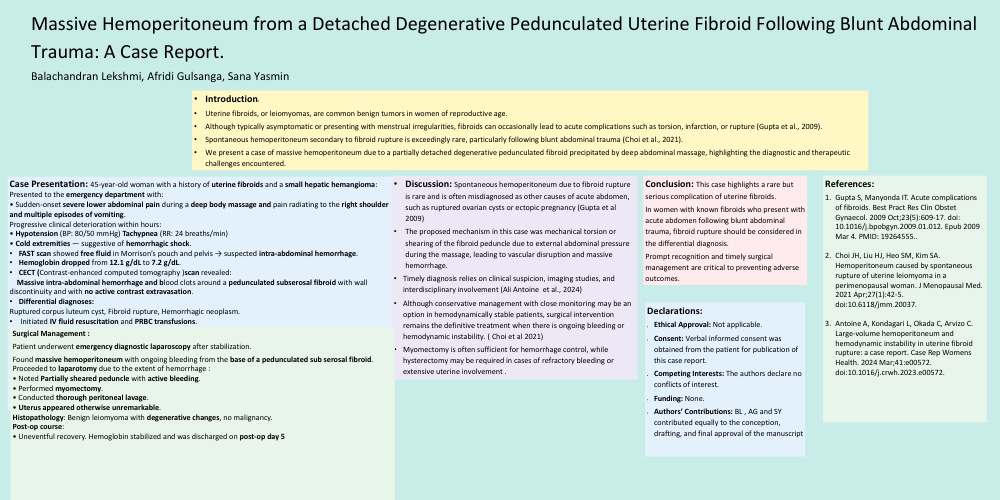
Massive Hemoperitoneum from a Detached Degenerative Pedunculated Uterine Fibroid Following Blunt Abdominal Trauma: A Case Report.
Balachandran Lekshmi, Afridi Gulsanga, Sana Yasmin
Introduction:
•Uterine fibroids, or leiomyomas, are common benign tumors in women of reproductive age.
•Although typically asymptomatic or presenting with menstrual irregularities, fibroids can occasionally lead to acute complications such as torsion, infarction, or rupture (Gupta et al., 2009).
•Spontaneous hemoperitoneum secondary to fibroid rupture is exceedingly rare, particularly following blunt abdominal trauma (Choi et al., 2021).
•We present a case of massive hemoperitoneum due to a partially detached degenerative pedunculated fibroid precipitated by deep abdominal massage, highlighting the diagnostic and therapeutic challenges encountered.
Case Presentation: 45-year-old woman with a history of uterine fibroids and a small hepatic hemangioma: Presented to the emergency department with:
Sudden-onset severe lower abdominal pain during a deep body massage and pain radiating to the right shoulder and multiple episodes of vomiting.
Progressive clinical deterioration within hours:
• Hypotension (BP: 80/50 mmHg) Tachypnea (RR: 24 breaths/min)
• Cold extremities — suggestive of hemorrhagic shock.
•FAST scan showed free fluid in Morrison’s pouch and pelvis → suspected intra-abdominal hemorrhage.
•Hemoglobin dropped from 12.1 g/dL to 7.2 g/dL.
•CECT (Contrast-enhanced computed tomography )scan revealed:
Massive intra-abdominal hemorrhage and blood clots around a pedunculated subserosal fibroid with wall discontinuity and with no active contrast extravasation.
Differential diagnoses:
Ruptured corpus luteum cyst, Fibroid rupture, Hemorrhagic neoplasm.
• Initiated IV fluid resuscitation and PRBC transfusions.
Surgical Management :
Patient underwent emergency diagnostic laparoscopy after stabilization.
Found massive hemoperitoneum with ongoing bleeding from the base of a pedunculated sub serosal fibroid. Proceeded to laparotomy due to the extent of hemorrhage :
• Noted Partially sheared peduncle with active bleeding.
• Performed myomectomy.
• Conducted thorough peritoneal lavage.
• Uterus appeared otherwise unremarkable.
Histopathology: Benign leiomyoma with degenerative changes, no malignancy.
Post-op course:
• Uneventful recovery. Hemoglobin stabilized and was discharged on post-op day 5
Discussion:
Spontaneous hemoperitoneum due to fibroid rupture is rare and is often misdiagnosed as other causes of acute abdomen, such as ruptured ovarian cysts or ectopic pregnancy (Gupta et al 2009)
The proposed mechanism in this case was mechanical torsion or shearing of the fibroid peduncle due to external abdominal pressure during the massage, leading to vascular disruption and massive hemorrhage.
Timely diagnosis relies on clinical suspicion, imaging studies, and interdisciplinary involvement (Ali Antoine et al., 2024)
Although conservative management with close monitoring may be an option in hemodynamically stable patients, surgical intervention remains the definitive treatment when there is ongoing bleeding or hemodynamic instability. ( Choi et al 2021)
Myomectomy is often sufficient for hemorrhage control, while hysterectomy may be required in cases of refractory bleeding or extensive uterine involvement .
Conclusion: This case highlights a rare but serious complication of uterine fibroids.
In women with known fibroids who present with acute abdomen following blunt abdominal trauma, fibroid rupture should be considered in the differential diagnosis.
Prompt recognition and timely surgical management are critical to preventing adverse outcomes.
Declarations:
Ethical Approval: Not applicable.
Consent: Verbal informed consent was obtained from the patient for publication of this case report.
Competing Interests: The authors declare no conflicts of interest.
Funding: None.
Authors’ Contributions: BL , AG and SY contributed equally to the conception, drafting, and final approval of the manuscript
References:
1.Gupta S, Manyonda IT. Acute complications of fibroids. Best Pract Res Clin Obstet Gynaecol. 2009 Oct;23(5):609-17. doi: 10.1016/j.bpobgyn.2009.01.012. Epub2009 Mar 4. PMID: 19264555..
2.Choi JH, Liu HJ, Heo SM, Kim SA. Hemoperitoneum caused by spontaneous rupture of uterine leiomyoma in a perimenopausal woman. J Menopausal Med. 2021 Apr;27(1):42-5. doi:10.6118/jmm.20037.
3.Antoine A, Kondagari L, Okada C, Arvizo C. Large-volume hemoperitoneum and hemodynamic instability in uterine fibroid rupture: a case report. Case Rep WomensHealth. 2024 Mar;41:e00572. doi:10.1016/j.crwh.2023.e00572.