2,281 posters, 63 videos, 56 audios, 43 topics, 18 sessions, 6,174 authors, 2,323 institutions
ePostersLive by SciGen Technologies S.A. All rights reserved.
RCOG World Congress 2025
June 23 - 25, 2025 | ExCeL London, UK
EP.0523
Identifying Care gaps for Women with HMB: Reducing Admission and Blood Transfusion
Poster Presenter
Part of Topic
General gynaecology
Identifying Care gaps for Women with HMB: Reducing Admission and Blood Transfusion.
Authors: Dr Rabia Haq; Ms Shamsa Kassam; Mr Bright Gyampoh 3. Luton and Dunstable Hospital, Bedfordshire Foundation Trust UK
Background Heavy menstrual bleeding (HMB) is a prevalent gynaecological condition in pre menopausal women, often leading to significant physical, emotional, and social challenges. It accounts for 20% of visits to gynaecology services. Early recognition, accurate diagnosis, and effective management are crucial for improving the quality of life for affected women. Without timely intervention, HMB can lead to iron deficiency and anaemia, frequently resulting in emergency admissions and blood transfusions. This project aims to identify gaps in the care of women with HMB and explore strategies to reduce unnecessary hospital admissions and transfusions.
Aims & Objectives • To report the prevalence of inpatient blood transfusions. • To describe patient characteristics and treatments. • To identify gaps in care pathways that lead to hospitalization.
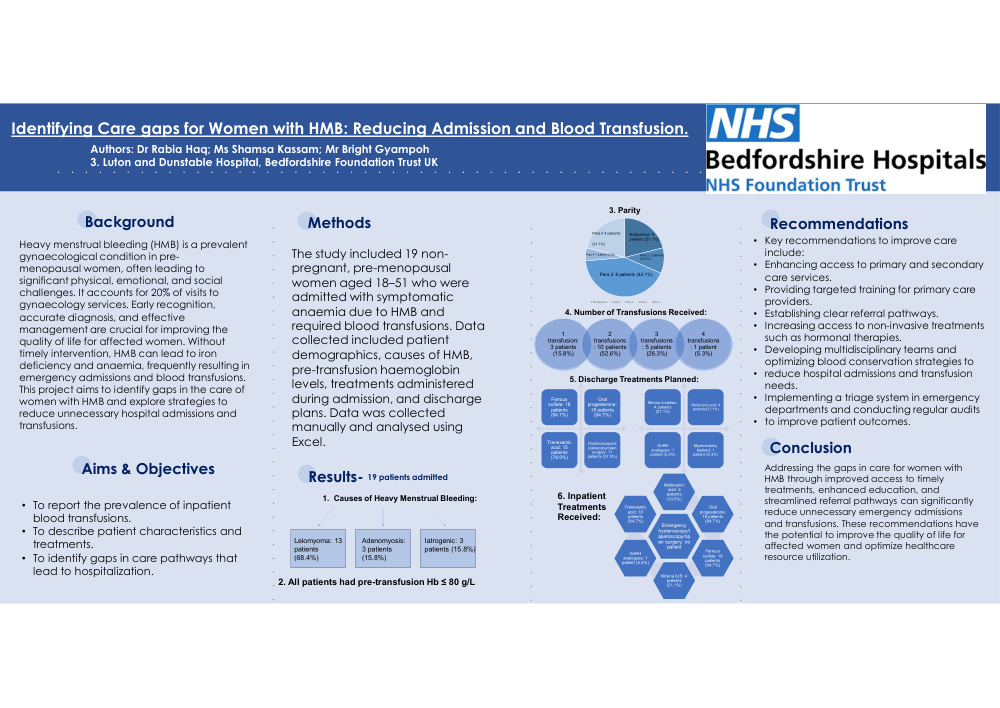
Methods The study included 19 non pregnant, pre-menopausal women aged 18–51 who were admitted with symptomatic anaemia due to HMB and required blood transfusions. Data collected included patient demographics, causes of HMB, pre-transfusion haemoglobin levels, treatments administered during admission, and discharge plans. Data was collected manually and analysed using Excel.
Results: Leiomyoma was identified as the most common cause of HMB, affecting 68.4% of patients, followed by adenomyosis and iatrogenic causes, both at 15.8%. All patients had pre-transfusion haemoglobin levels ≤ 80 g/L, and 52.6% required two or more blood transfusions. The majority of patients received medical management, including Tranexamic acid, oral progesterone, and ferrous sulphate, all at 94.7% of patients, Mefenamic acid (10.5%), Mirena IUS (21.1%) and GnRH analogues (5.3%). No patients required surgical procedures such as hysteroscopy or laparoscopy during hospitalization. Upon discharge, patients were primarily prescribed iron supplements and oral progesterone, with 21.1% receiving the Mirena IUS and Mefenamic acid. A significant portion (57.9%) underwent hysteroscopy, laparoscopy, or open surgery, while 5.3% received GnRH analogues and an equal percentage had myomectomy scheduled.
Recommendations: • Key recommendations to improve care include: • Enhancing access to primary and secondary care services. • Providing targeted training for primary care providers. • Establishing clear referral pathways. • Increasing access to non-invasive treatments such as hormonal therapies. • Developing multidisciplinary teams and optimizing blood conservation strategies to • reduce hospital admissions and transfusion needs. Mefenamic acid: 4 patients (21.1%) Myomectomy booked: 1 patient (5.3%) Oral progesterone: 18 patients (94.7%) Ferrous sulfate: 18 patients (94.7%) • Implementing a triage system in emergency departments and conducting regular audits • to improve patient outcomes.
Conclusion: Addressing the gaps in care for women with HMB through improved access to timely treatments, enhanced education, and streamlined referral pathways can significantly reduce unnecessary emergency admissions and transfusions. These recommendations have the potential to improve the quality of life for affected women and optimize healthcare resource utilization.