2,281 posters, 63 videos, 56 audios, 43 topics, 18 sessions, 6,174 authors, 2,323 institutions
ePostersLive by SciGen Technologies S.A. All rights reserved.
RCOG World Congress 2025
June 23 - 25, 2025 | ExCeL London, UK
EP.0522
Unexpected Descent: Submucous Fibroid Prolapses through the Cervix Following MyoSure Resection
Poster Presenter
Part of Topic
General gynaecology
UNEXPECTED DESCENT: SUBMUCOUS FIBROID PROLAPSES THROUGH THE CERVIX FOLLOWING MYOSURE RESECTION
H. Brown 1, P. Ojo 2, F. Olaoye 2, S. Al-Juboori 1
1 Obstetrics and Gynaecology Department, The Queen Elizabeth Hospital, Kings Lynn ; 2 Norwich Medical School; University of East Anglia, Norwich
Case report:
This case report describes a 48-year-old lady presenting to the gynaecology clinic with HMB.
An ultrasound scan (USS) of the pelvis showed a 3.5cm posterior wall fibroid with thickened endometrium of 29mm and the possibility of a polyp. A subsequent hysteroscopy under general anaesthetic was scheduled with a hysteroscopic resection of the fibroid using MyoSure® Tissue Removal Suite, plus endometrial biopsies and insertion of IUS performed. Histology showed a leiomyoma with no evidence of malignancy.
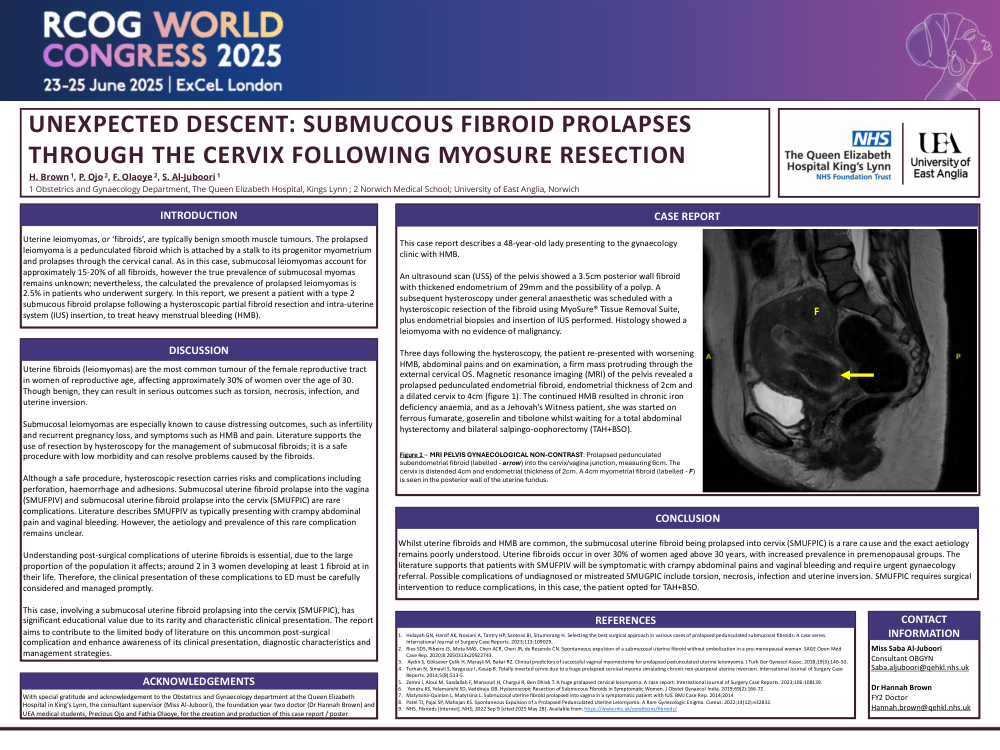
Three days following the hysteroscopy, the patient re-presented with worsening HMB, abdominal pains and on examination, a firm mass protruding through the external cervical OS. Magnetic resonance imaging (MRI) of the pelvis revealed a prolapsed pedunculated endometrial fibroid, endometrial thickness of 2cm and a dilated cervix to 4cm (figure 1). The continued HMB resulted in chronic iron deficiency anaemia, and as a Jehovah’s Witness patient, she was started on ferrous fumarate, goserelin and tibolone whilst waiting for a total abdominal hysterectomy and bilateral salpingo-oophorectomy (TAH+BSO).
Introduction:
Uterine leiomyomas, or ‘fibroids’, are typically benign smooth muscle tumours. The prolapsed leiomyoma is a pedunculated fibroid which is attached by a stalk to its progenitor myometrium and prolapses through the cervical canal. As in this case, submucosal leiomyomas account for approximately 15-20% of all fibroids, however the true prevalence of submucosal myomas remains unknown; nevertheless, the calculated the prevalence of prolapsed leiomyomas is 2.5% in patients who underwent surgery. In this report, we present a patient with a type 2 submucous fibroid prolapse following a hysteroscopic partial fibroid resection and intra-uterine system (IUS) insertion, to treat heavy menstrual bleeding (HMB).
Discussion:
Uterine fibroids (leiomyomas) are the most common tumour of the female reproductive tract in women of reproductive age, affecting approximately 30% of women over the age of 30. Though benign, they can result in serious outcomes such as torsion, necrosis, infection, and uterine inversion.
Submucosal leiomyomas are especially known to cause distressing outcomes, such as infertility and recurrent pregnancy loss, and symptoms such as HMB and pain. Literature supports the use of resection by hysteroscopy for the management of submucosal fibroids; it is a safe procedure with low morbidity and can resolve problems caused by the fibroids.
Although a safe procedure, hysteroscopic resection carries risks and complications including perforation, haemorrhage and adhesions. Submucosal uterine fibroid prolapse into the vagina (SMUFPIV) and submucosal uterine fibroid prolapse into the cervix (SMUFPIC) are rare complications. Literature describes SMUFPIV as typically presenting with crampy abdominal pain and vaginal bleeding. However, the aetiology and prevalence of this rare complication remains unclear.
Understanding post-surgical complications of uterine fibroids is essential, due to the large proportion of the population it affects; around 2 in 3 women developing at least 1 fibroid at in their life. Therefore, the clinical presentation of these complications to ED must be carefully considered and managed promptly.
This case, involving a submucosal uterine fibroid prolapsing into the cervix (SMUFPIC), has significant educational value due to its rarity and characteristic clinical presentation. The report aims to contribute to the limited body of literature on this uncommon post-surgical complication and enhance awareness of its clinical presentation, diagnostic characteristics and management strategies.
Conclusion:
Whilst uterine fibroids and HMB are common, the submucosal uterine fibroid being prolapsed into cervix (SMUFPIC) is a rare cause and the exact aetiology remains poorly understood. Uterine fibroids occur in over 30% of women aged above 30 years, with increased prevalence in premenopausal groups. The literature supports that patients with SMUFPIV will be symptomatic with crampy abdominal pains and vaginal bleeding and require urgent gynaecology referral. Possible complications of undiagnosed or mistreated SMUGPIC include torsion, necrosis, infection and uterine inversion. SMUFPIC requires surgical intervention to reduce complications, in this case, the patient opted for TAH+BSO.
References:
1.Hidayah GN, Harzif AK, Noviani A, Tantry HP, Santoso BI, Situmorang H. Selecting the best surgical approach in various cases of prolapsed pedunculated submucosal fibroids: A case series. International Journal of Surgery Case Reports. 2023;113:109029.
2.Rios SDS, Ribeiro JS, Mota MAS, Chen ACR, Chen JR, de Resende CN. Spontaneous expulsion of a submucosal uterine fibroid without embolization in a pre-menopausal woman. SAGE Open Med Case Rep. 2020;8:2050313x20922743.
3.Aydın S, Göksever Çelik H, Maraşlı M, Bakar RZ. Clinical predictors of successful vaginal myomectomy for prolapsed pedunculated uterine leiomyoma. J Turk Ger Gynecol Assoc. 2018;19(3):146-50.
4.Turhan N, Simavli S, Kaygusuz I, Kasap B. Totally inverted cervix due to a huge prolapsed cervical myoma simulating chronic non-puerperal uterine inversion. International Journal of Surgery Case Reports. 2014;5(8):513-5.
5.Zemni I, Aloui M, Saadallah F, Mansouri H, Chargui R, Ben Dhiab T. A huge prolapsed cervical leiomyoma: A case report. International Journal of Surgery Case Reports. 2023;106:108139.
6.Yendru KS, Yelamanchi SD, Vaddiraju GB. Hysteroscopic Resection of Submucous Fibroids in Symptomatic Women. J Obstet Gynaecol India. 2019;69(2):166-72.
7.Matytsina-Quinlan L, Matytsina L. Submucosal uterine fibroid prolapsed into vagina in a symptomatic patient with IUS. BMJ Case Rep. 2014;2014
8.Patel TJ, Pajai SP, Mahajan KS. Spontaneous Expulsion of a Prolapsed Pedunculated Uterine Leiomyoma: A Rare Gynecologic Enigma. Cureus. 2022;14(12):e32832.
9.NHS. Fibroids [Internet]. NHS; 2022 Sep 9 [cited 2025 May 28]. Available from:https://www.nhs.uk/conditions/fibroids/
Acknowledgement:
With special gratitude and acknowledgement to the Obstetrics and Gynaecology department at the Queen Elizabeth Hospital in King’s Lynn, the consultant supervisor (Miss Al-Juboori), the foundation year two doctor (Dr Hannah Brown) and UEA medical students, Precious Ojo and Fathia Olaoye, for the creation and production of this case report / poster.