2,281 posters, 63 videos, 56 audios, 43 topics, 18 sessions, 6,174 authors, 2,323 institutions
ePostersLive by SciGen Technologies S.A. All rights reserved.
RCOG World Congress 2025
June 23 - 25, 2025 | ExCeL London, UK
EP.0519
Clinical Manifestations and Management of Prurigo in Pregnancy: A Systematic Review
Poster Presenter
Authors
Dana Hendie, Marwah Qadi, Elaf Aljohani, Bedoor Alghanmi, Rand Alfawaz, Ali Alghamdi, Relam Alhassani, Lara Aljohani, Malak Al Khatieb, Maria Abdulaziz Alrafi
Affiliations
Mohammed Bin Rashid University Of Medicine and Health Sciences, Taibah University,, Fakeeh Collage for Medical Sciences,, King Abdul Aziz University, Umm Al-Qura University, King faisal University, King Abdulaziz University,, Almaarefa university
Part of Topic
General gynaecology
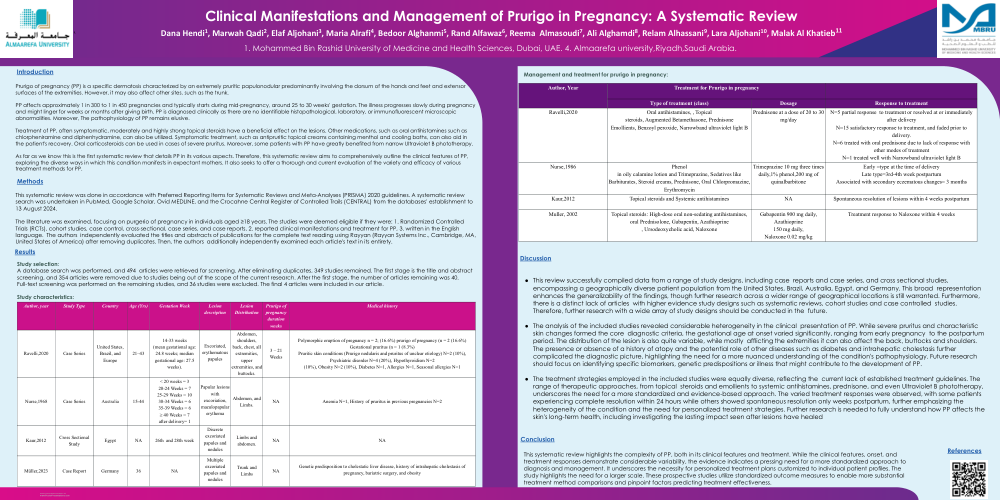
Clinical Manifestations and Management of Prurigo in Pregnancy: A Systematic Review
Dana Hendi1, Marwah Qadi2, Elaf Aljohani3, Maria Alrafi4, Bedoor Alghanmi5, Rand Alfawaz6, Reema Almasoudi7, Ali Alghamdi8, Relam Alhassani9, Lara Aljohani10, Malak Al Khatieb11.
1. Mohammed Bin Rashid University of Medicine and Health Sciences, Dubai, UAE. 4. Almaarefa university,Riyadh,Saudi Arabia.
introduction
Prurigo of pregnancy (PP) is a specific dermatosis characterized by an extremely pruritic papulonodular predominantly involving the dorsum of the hands and feet and extensor surfaces of the extremities. However, it may also affect other sites, such as the trunk.
PP affects approximately 1 in 300 to 1 in 450 pregnancies and typically starts during mid-pregnancy, around 25 to 30 weeks' gestation. The illness progresses slowly during pregnancy and might linger for weeks or months after giving birth. PP is diagnosed clinically as there are no identifiable histopathological, laboratory, or immunofluorescent microscopic abnormalities. Moreover, The pathophysiology of PP remains elusive.
Treatment of PP, often symptomatic, moderately and highly strong topical steroids have a beneficial effect on the lesions. Other medications, such as oral antihistamines such as chlorpheniramine and diphenhydramine, can also be utilized. Symptomatic treatment, such as antipruritic topical creams containing menthol and cooling baths, can also aid in the patient's recovery. Oral corticosteroids can be used in cases of severe pruritus. Moreover, some patients with PP have greatly benefited from narrow Ultraviolet B phototherapy.
As far as we know this is the first systematic review that details PP in its various aspects. Therefore, this systematic review aims to comprehensively outline the clinical features of PP, exploring the diverse ways in which this condition manifests in expectant mothers. It also seeks to offer a thorough and current evaluation of the variety and efficacy of various treatment methods for PP.
Methods
This systematic review was done in accordance with Preferred Reporting Items for Systematic Reviews and Meta-Analyses (PRISMA) 2020 guidelines. A systematic review search was undertaken in PubMed, Google Scholar, Ovid MEDLINE, and the Crocahne Central Register of Controlled Trails (CENTRAL) from the databases' establishment to 13 August 2024.
The literature was examined, focusing on purgerio of pregnancy in individuals aged ≥18 years. The studies were deemed eligible if they were: 1. Randomized Controlled Trials (RCTs), cohort studies, case control, cross-sectional, case series, and case reports, 2. reported clinical manifestations and treatment for PP, 3. written in the English language. The authors independently evaluated the titles and abstracts of publications for the complete text reading using Rayyan (Rayyan Systems Inc., Cambridge, MA, United States of America) after removing duplicates. Then, the authors additionally independently examined each article's text in its entirety.
Results
Study selection:
A database search was performed, and 494 articles were retrieved for screening. After eliminating duplicates, 349 studies remained. The first stage is the title and abstract screening, and 354 articles were removed due to studies being out of the scope of the current research. After the first stage, the number of articles remaining was 40. Full-text screening was performed on the remaining studies, and 36 studies were excluded. The final 4 articles were included in our article.
Study characteristics:
Management and treatment for prurigo in pregnancy:
Disscusion
-
This review successfully compiled data from a range of study designs, including case reports and case series, and cross sectional studies, encompassing a geographically diverse patient population from the United States, Brazil, Australia, Egypt, and Germany. This broad representation enhances the generalizability of the findings, though further research across a wider range of geographical locations is still warranted. Furthermore, there is a distinct lack of articles with higher evidence study designs such as systematic reviews, cohort studies and case controlled studies. Therefore, further research with a wide array of study designs should be conducted in the future.
-
The analysis of the included studies revealed considerable heterogeneity in the clinical presentation of PP. While severe pruritus and characteristic skin changes formed the core diagnostic criteria, the gestational age at onset varied significantly, ranging from early pregnancy to the postpartum period. The distribution of the lesion is also quite variable, while mostly afflicting the extremities it can also affect the back, buttocks and shoulders. The presence or absence of a history of atopy and the potential role of other diseases such as diabetes and intrahepatic cholestasis further complicated the diagnostic picture, highlighting the need for a more nuanced understanding of the condition's pathophysiology. Future research should focus on identifying specific biomarkers, genetic predispositions or illness that might contribute to the development of PP.
-
The treatment strategies employed in the included studies were equally diverse, reflecting the current lack of established treatment guidelines. The range of therapeutic approaches, from topical steroids and emollients to systemic antihistamines, prednisone, and even Ultraviolet B phototherapy, underscores the need for a more standardized and evidence-based approach. The varied treatment responses were observed, with some patients experiencing complete resolution within 24 hours while others showed spontaneous resolution only weeks postpartum, further emphasizing the heterogeneity of the condition and the need for personalized treatment strategies. Further research is needed to fully understand how PP affects the skin's long-term health, including investigating the lasting impact seen after lesions have healed
Conclusion
This systematic review highlights the complexity of PP, both in its clinical features and treatment. While the clinical features, onset, and treatment responses
demonstrate considerable variability, the evidence indicates a pressing need for a more standardized approach to diagnosis and management. It underscores the
necessity for personalized treatment plans customized to individual patient profiles. The study highlights the need for a larger scale. These prospective studies utilize standardized outcome measures to enable more substantial treatment method comparisons and pinpoint factors predicting treatment effectiveness.
References