2,281 posters, 63 videos, 56 audios, 43 topics, 18 sessions, 6,174 authors, 2,323 institutions
ePostersLive by SciGen Technologies S.A. All rights reserved.
RCOG World Congress 2025
June 23 - 25, 2025 | ExCeL London, UK
EP.0517
Significance of Androgen Markers in PCOS Diagnosis and Metabolic Phenotype Prediction
Part of Topic
General gynaecology
Significance of Androgen Markers in PCOS Diagnosis and
Metabolic Phenotype Prediction
Huina Su1, Xiaowan Sun1, Changsheng Xia1, Liping Wang2, Yang Xu2, Ling Ji2, Changzhong Li2, Xin Yang1*
1 Department of Obstetrics and Gynecology, Peking University People's Hospital, Beijing, China.
2 Department of Obstetrics and Gynecology, Peking University Shenzhen Hospital, Shenzhen, China.
Corresponding author: Xin Yang, Department of Obstetrics and Gynecology, Peking University People's Hospital, Beijing, China. E-mail: xinyang_2003@sina.com.
Objective
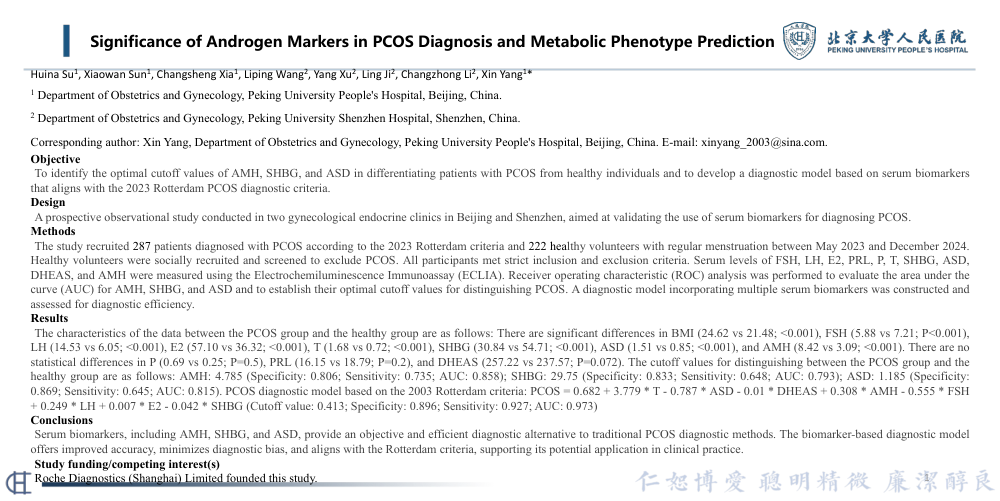
To identify the optimal cutoff values of AMH, SHBG, and ASD in differentiating patients with PCOS from healthy individuals and to develop a diagnostic model based on serum biomarkers that aligns with the 2023 Rotterdam PCOS diagnostic criteria.
Design
A prospective observational study conducted in two gynecological endocrine clinics in Beijing and Shenzhen, aimed at validating the use of serum biomarkers for diagnosing PCOS.
Methods
The study recruited 287 patients diagnosed with PCOS according to the 2023 Rotterdam criteria and 222 healthy volunteers with regular menstruation between May 2023 and December 2024. Healthy volunteers were socially recruited and screened to exclude PCOS. All participants met strict inclusion and exclusion criteria. Serum levels of FSH, LH, E2, PRL, P, T, SHBG, ASD, DHEAS, and AMH were measured using the Electrochemiluminescence Immunoassay (ECLIA). Receiver operating characteristic (ROC) analysis was performed to evaluate the area under the curve (AUC) for AMH, SHBG, and ASD and to establish their optimal cutoff values for distinguishing PCOS. A diagnostic model incorporating multiple serum biomarkers was constructed and assessed for diagnostic efficiency.
Results
The characteristics of the data between the PCOS group and the healthy group are as follows: There are significant differences in BMI (24.62 vs 21.48; <0.001), FSH (5.88 vs 7.21; P<0.001), LH (14.53 vs 6.05; <0.001), E2 (57.10 vs 36.32; <0.001), T (1.68 vs 0.72; <0.001), SHBG (30.84 vs 54.71; <0.001), ASD (1.51 vs 0.85; <0.001), and AMH (8.42 vs 3.09; <0.001). There are no statistical differences in P (0.69 vs 0.25; P=0.5), PRL (16.15 vs 18.79; P=0.2), and DHEAS (257.22 vs 237.57; P=0.072). The cutoff values for distinguishing between the PCOS group and the healthy group are as follows: AMH: 4.785 (Specificity: 0.806; Sensitivity: 0.735; AUC: 0.858); SHBG: 29.75 (Specificity: 0.833; Sensitivity: 0.648; AUC: 0.793); ASD: 1.185 (Specificity: 0.869; Sensitivity: 0.645; AUC: 0.815). PCOS diagnostic model based on the 2003 Rotterdam criteria: PCOS = 0.682 + 3.779 * T - 0.787 * ASD - 0.01 * DHEAS + 0.308 * AMH - 0.555 * FSH + 0.249 * LH + 0.007 * E2 - 0.042 * SHBG (Cutoff value: 0.413; Specificity: 0.896; Sensitivity: 0.927; AUC: 0.973)
Conclusions
Serum biomarkers, including AMH, SHBG, and ASD, provide an objective and efficient diagnostic alternative to traditional PCOS diagnostic methods. The biomarker-based diagnostic model offers improved accuracy, minimizes diagnostic bias, and aligns with the Rotterdam criteria, supporting its potential application in clinical practice.
Study funding/competing interest(s)
Roche Diagnostics (Shanghai) Limited founded this study.