2,281 posters, 63 videos, 56 audios, 43 topics, 18 sessions, 6,174 authors, 2,323 institutions
ePostersLive by SciGen Technologies S.A. All rights reserved.
RCOG World Congress 2025
June 23 - 25, 2025 | ExCeL London, UK
EP.0514
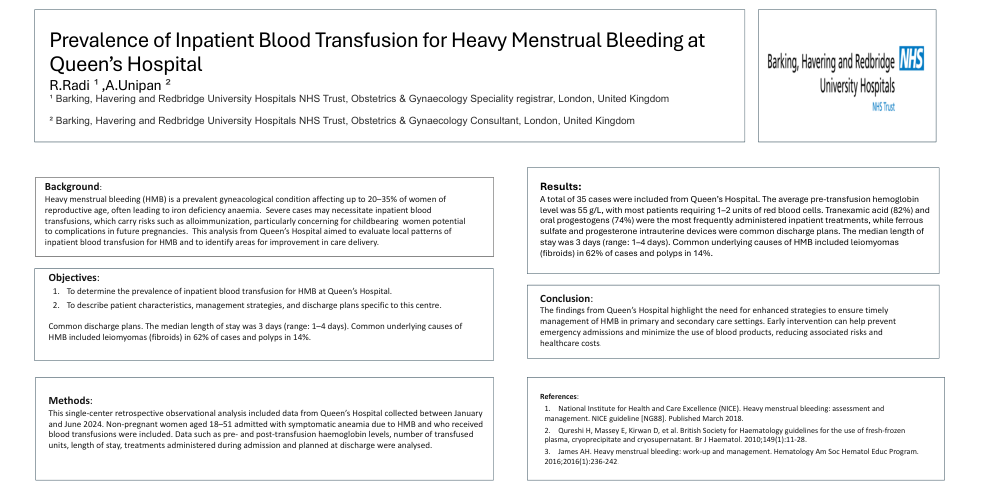
Prevalence of Inpatient Blood Transfusion for Heavy Menstrual Bleeding atQueen’s Hospita
Poster Presenter
Authors
Affiliations
Barking, Havering and Redbridge University Hospitals NHS Trus, BHRUT, London
Part of Topic
General gynaecology
Title: Prevalence of Inpatient Blood Transfusion for Heavy Menstrual Bleeding at Queen’s Hospita
Background: Heavy menstrual bleeding (HMB) is a prevalent gynecological condition affecting up to 20–35% of women of reproductive age, often leading to iron deficiency anemia. Severe cases may necessitate inpatient blood transfusions, which carry risks such as alloimmunization, particularly concerning for women of childbearing potential due to potential complications in future pregnancies. This analysis from Queen’s Hospital to evaluate local patterns of inpatient blood transfusion for HMB and identify areas for improvement in care delivery.
Objectives:
1. To determine the prevalence of inpatient blood transfusion for HMB at Queen’s Hospital.
2. To describe patient characteristics, management strategies, and discharge plans specific to this center.
Methods:
This single-center retrospective observational analysis included data from Queen’s Hospital collected between January and June 2024. Non-pregnant women aged 18–51 admitted with symptomatic anemia due to HMB and who received blood transfusions were included. Data on pre- and post-transfusion hemoglobin levels, number of transfused units, length of stay, and treatments administered during admission and planned at discharge were analyzed.
Results:
A total of 35 cases were included from Queen’s Hospital. The average pre-transfusion hemoglobin level was 55 g/L, with most patients requiring 1–2 units of red blood cells. Tranexamic acid (82%) and oral progestogens (74%) were the most frequently administered inpatient treatments, while ferrous sulfate and progesterone intrauterine devices were common discharge plans. The median length of stay was 3 days (range: 1–4 days). Common underlying causes of HMB included leiomyomas (fibroids) in 62% of cases and polyps in 14%.
Conclusion:
The findings from Queen’s Hospital highlight the need for enhanced strategies to ensure timely management of HMB in primary and secondary care settings. Early intervention can help prevent emergency admissions and minimize the use of blood products, reducing associated risks and healthcare costs.
References:
1. National Institute for Health and Care Excellence (NICE). Heavy menstrual bleeding: assessment and management. NICE guideline [NG88]. Published March 2018.
2. Qureshi H, Massey E, Kirwan D, et al. British Society for Haematology guidelines for the use of fresh‐frozen plasma, cryoprecipitate and cryosupernatant. Br J Haematol. 2010;149(1):11-28.
3. James AH. Heavy menstrual bleeding: work-up and management. Hematology Am Soc Hematol Educ Program. 2016;2016(1):236-242.