2,281 posters, 63 videos, 56 audios, 43 topics, 18 sessions, 6,174 authors, 2,323 institutions
ePostersLive by SciGen Technologies S.A. All rights reserved.
RCOG World Congress 2025
June 23 - 25, 2025 | ExCeL London, UK
EP.0510
MANAGEMENT OF TUBOOVARIAN ABSCESSES : ULTRASOUND-GUIDED PUNCTURE VERSUS SURGICAL TREATMENT
Poster Presenter
Authors
Imene Labidi, Sana Menjli, Haithem Aloui, Hassine Saber Abouda
Affiliations
Part of Topic
General gynaecology
Introduction:
Tubo-ovarian abscess (TOA) represents a severe complication of upper genital tract infections. Surgical intervention is now reserved for cases where medical management fails or when there is a life-threatening condition. However, surgery is associated with several potential complications. Ultrasound-guided aspiration has emerged as a less invasive alternative to surgical drainage, demonstrating comparable success rates. The aim of our study was to evaluate the feasibility, efficacy, and safety of transvaginal ultrasound-guided aspiration in comparison to surgical treatment.
Methods: This was a retrospective, descriptive, and comparative study involving patients admitted with tubo-ovarian abscess (TOA) over a two-year period. The study compared the immediate clinical and biological outcomes between two groups: those managed with ultrasound-guided aspiration and those undergoing surgical treatment.
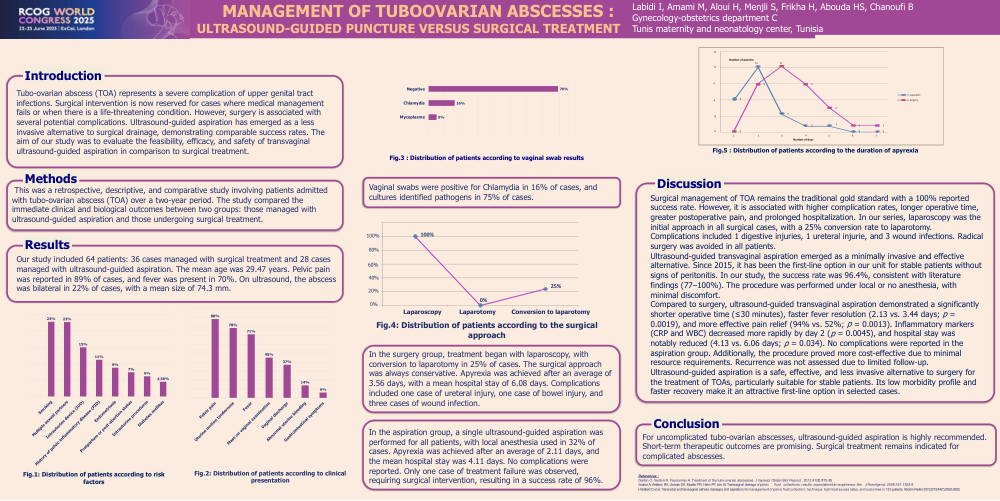
Results: Our study included 64 patients: 36 cases managed with surgical treatment and 28 cases managed with ultrasound-guided aspiration. The mean age was 29.47 years. Pelvic pain was reported in 89% of cases, and fever was present in 70%. On ultrasound, the abscess was bilateral in 22% of cases, with a mean size of 74.3 mm. Vaginal swabs were positive for Chlamydia in 16% of cases, and cultures identified pathogens in 75% of cases. In the surgery group, treatment began with laparoscopy, with conversion to laparotomy in 25% of cases. The surgical approach was always conservative. Apyrexia was achieved after an average of 3.56 days, with a mean hospital stay of 6.08 days. Complications included one case of ureteral injury, one case of bowel injury, and three cases of wound infection.
In the aspiration group, a single ultrasound-guided aspiration was performed for all patients, with local anesthesia used in 32% of cases. Apyrexia was achieved after an average of 2.11 days, and the mean hospital stay was 4.11 days. No complications were reported. Only one case of treatment failure was observed, requiring surgical intervention, resulting in a success rate of 96%.
Discussion: Surgical management of TOA remains the traditional gold standard with a 100% reported success rate. However, it is associated with higher complication rates, longer operative time, greater postoperative pain, and prolonged hospitalization. In our series, laparoscopy was the initial approach in all surgical cases, with a 25% conversion rate to laparotomy. Complications included 1 digestive injuries, 1 ureteral injurie, and 3 wound infections. Radical surgery was avoided in all patients. Ultrasound-guided transvaginal aspiration emerged as a minimally invasive and effective alternative. Since 2015, it has been the first-line option in our unit for stable patients without signs of peritonitis. In our study, the success rate was 96.4%, consistent with literature findings (77–100%). The procedure was performed under local or no anesthesia, with minimal discomfort. Compared to surgery, ultrasound-guided transvaginal aspiration demonstrated a significantly shorter operative time (≤30 minutes), faster fever resolution (2.13 vs. 3.44 days; p= 0.0019), and more effective pain relief (94% vs. 52%; p= 0.0013). Inflammatory markers (CRP and WBC) decreased more rapidly by day 2 (p= 0.0045), and hospital stay was notably reduced (4.13 vs. 6.06 days; p= 0.034). No complications were reported in the aspiration group. Additionally, the procedure proved more cost-effective due to minimal resource requirements. Recurrence was not assessed due to limited follow-up. Ultrasound-guided aspiration is a safe, effective, and less invasive alternative to surgery for the treatment of TOAs, particularly suitable for stable patients. Its low morbidity profile and faster recovery make it an attractive first-line option in selected cases.
Conclusion: For uncomplicated tubo-ovarian abscesses, ultrasound-guided aspiration is highly recommended. Short-term therapeutic outcomes are promising. Surgical treatment remains indicated for complicated abscesses.