2,281 posters, 63 videos, 56 audios, 43 topics, 18 sessions, 6,174 authors, 2,323 institutions
ePostersLive by SciGen Technologies S.A. All rights reserved.
RCOG World Congress 2025
June 23 - 25, 2025 | ExCeL London, UK
EP.0509
Evaluating and Improving Benign Gynaecology Services: A Retrospective Audit Across NHS Hospitals
Poster Presenter
Part of Topic
General gynaecology
Evaluating and Improving Benign Gynaecology Services: A Retrospective Audit Across NHS Hospitals
Dr Anusuya Bansal, Diana Princess of Wales Hospital, Grimsby, UK
Dr Thomas Reid , Pilgrim Hospital, Boston, UK
Ms Narmatha Kangeyan, Lincoln County Hospital, Lincoln, UK
Objective:
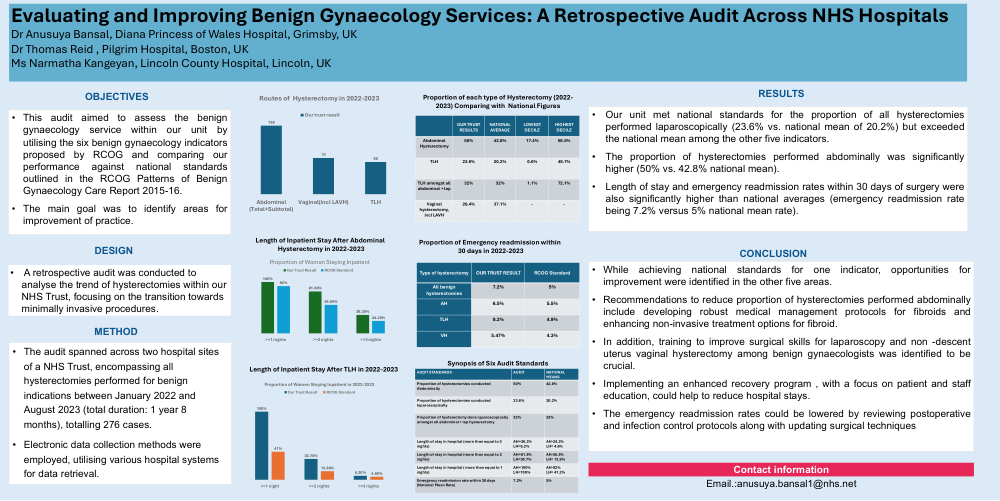
This audit aimed to assess the benign gynaecology service within our unit by utilising the six benign gynaecology indicators proposed by RCOG and comparing our performance against national standards outlined in the RCOG Patterns of Benign Gynaecology Care Report 2015-16. The main goal was to identify areas for improvement of practice
Design:
A retrospective audit was conducted to analyse the trend of hysterectomies within our NHS Trust, focusing on the transition towards minimally
invasive procedures.
Method:
The audit spanned across two hospital sites of a NHS Trust, encompassing all hysterectomies performed for benign indications between January 2022 and August 2023 (total duration: 1 year 8 months), totalling 276 cases. Electronic data collection methods were employed, utilising various hospital systems for data retrieval.
Results:
Our unit met national standards for the proportion of all hysterectomies performed laparoscopically (23.6% vs. national mean of 20.2%) but exceeded the national mean among the other five indicators. The proportion of hysterectomies performed abdominally was significantly higher (50% vs. 42.8% national mean). Length of stay and emergency readmission rates within 30 days of surgery were also significantly higher than national averages (emergency readmission rate being 7.2% versus 5% national mean rate).
Conclusions:
While achieving national standards for one indicator, opportunities for improvement were identified in the other five areas. Recommendations to reduce proportion of hysterectomies performed abdominally include developing robust medical management protocols for fibroids and enhancing non-invasive treatment options for fibroid. In addition, training to improve surgical skills for laparoscopy and non -descent uterus vaginal hysterectomy among benign gynaecologists was identifed to be crucial. Implementing an enhanced recovery program , with a focus on patient and staff education, could help to reduce hospital stays. The emergency readmission rates could be lowered by reviewing postoperative and infection control protocols along with updating surgical techniques.