2,281 posters, 63 videos, 56 audios, 43 topics, 18 sessions, 6,174 authors, 2,323 institutions
ePostersLive by SciGen Technologies S.A. All rights reserved.
RCOG World Congress 2025
June 23 - 25, 2025 | ExCeL London, UK
EP.0502
Scar Tenderness Predicts Repeat Cesarean Outcomes: Intraoperative and Feto-maternal Analysis
Poster Presenter
Authors
Hessah Al Rajih, Huwida Attia, Shazia Maqsoud, Fatimah Alzahrani
Affiliations
Part of Topic
General gynaecology
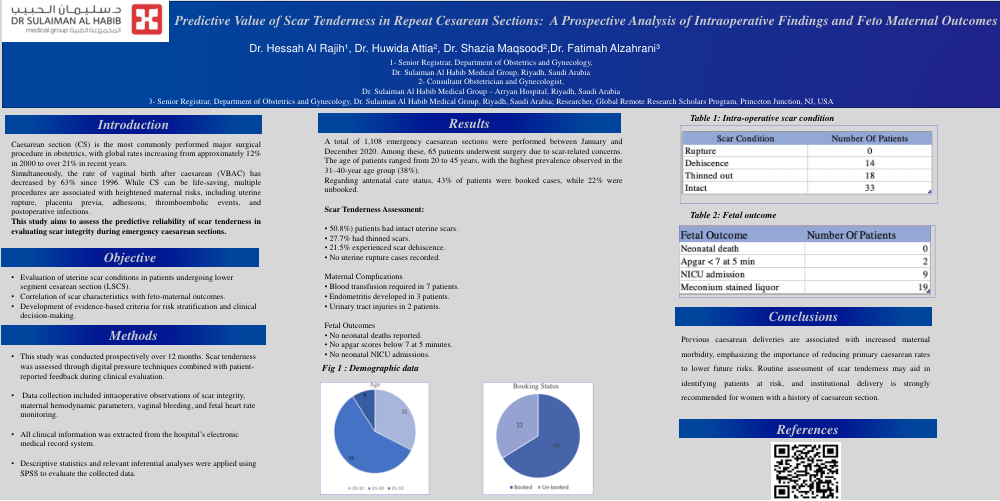
Title: Predictive Value of Scar Tenderness in Repeat Cesarean Sections: A Prospective Analysis of Intraoperative Findings and Feto-maternal Outcomes
Objective: To evaluate intraoperative uterine scar conditions and their correlation with feto-maternal outcomes in patients with previous lower segment Cesarean sections (LSCS) presenting with scar tenderness, to develop an evidence-based criteria for risk stratification.
Design: A prospective observational study conducted over one year at Dr Sulaiman Al Habib Medical Group-Arryan Hospital Riyadh, analyzing the relationship between pre-operative scar tenderness and subsequent surgical findings.
Method: The study included a total of 1,108 emergency Cesarean sections performed between January 2020 to December 2020. Scar tenderness assessment involved standardized digital pressure below the pubic symphysis between uterine contractions while engaging patients in conversation. Among these, 65 patients presented with scar tenderness requiring emergency cesarean section. Evaluation variables and data points included intraoperative scar conditions (intact, thinned, dehiscence, rupture), maternal hemodynamics, vaginal bleeding, and fetal heart patterns. Data collection was utilized through the electronic medical record system of the hospital, with standardized documentation protocols.
Results: Our analysis results of the 65 patients with scar tenderness revealed specific scar conditions: 33 intact, 18 thinned, 14 with dehiscence, and no ruptures. Maternal morbidity assessment showed significant complications including blood transfusion (three cases), endometritis (one single case only), and urinary complications (one single case only). Fetal outcomes analysis has highlighted the following findings including, no neonatal deaths, twocases of Apgar scores <7 at five-minute time interval, no NICU admissions, and 19 cases of meconium-stained liquor. Age distribution analysis showed predominance in the 31-40 age group (38%), with 43% of cases being booked and 22% unbooked.
Conclusions: Scar tenderness serves as a significant predictive indicator for possiblecomplications in repeat cesarean sections. Maternal morbidity increases proportionally with the number of previous cesarean sections, highlighting the importance of reducing primary cesarean rates. Our findings support applying routine scar tenderness assessment as a sensitive screening method for all patients undergoing trial of labor after cesarean (TOLAC). In addition to that, the results significantly indicate that all cases of previous CS should undergo institutional delivery to ensure the best maternal and fetal outcomes possible whenever applicable according to the patient’s status and assessment considerations.