2,281 posters, 63 videos, 56 audios, 43 topics, 18 sessions, 6,174 authors, 2,323 institutions
ePostersLive by SciGen Technologies S.A. All rights reserved.
RCOG World Congress 2025
June 23 - 25, 2025 | ExCeL London, UK
EP.0501
Anise as a Gynecological Supplement: A Systematic Review and Meta-Analysis
Poster Presenter
Authors
Yomna W. Mahmoud, Yassin El-Shnawy El-Shnawy, Yara Ali Eltobgi, Ekram Hasanin, Sara Naser Sebie, Nourhan A. El kholany, Mariam S. Abdulhafiz, Mohamed Ramadan S., Raghad W.Y. Mahmoud, Hanaa F. Abdelrahman, Muhammad T. Abuawwad, Mohammad J. Taha
Affiliations
Kasr al Ainy Faculty of Medicine, Cairo University, Faculty of Medicine, University of Tripoli, Faculty of Pharmacy, German University in Cairo and Biotechnology, Abbassia Dermatology Clinic
Part of Topic
General gynaecology
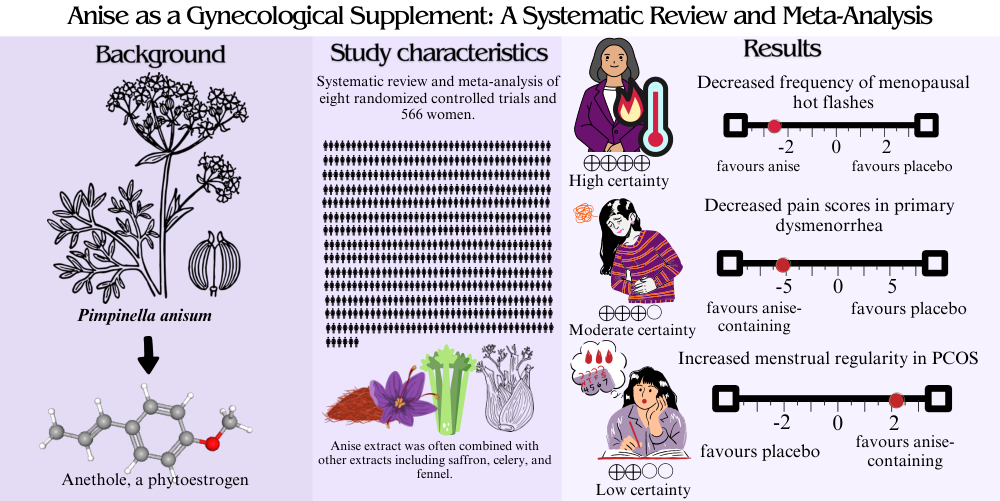
Anise, Pimpinella anisum, is a flowering plant of high phytoestrogen content and medicinal properties. The systematic review and meta-analysis aimed to investigate the influence of anise and anise-containing supplements on gynecological complaints. An online search was conducted up to August 2024 on Google Scholar, Scopus, Cochrane Library, and PubMed. Studies were assessed using the Cochrane Risk of Bias 2 tool and GRADE for certainty of evidence. Meta-analysis was done using risk ratio (RR) and mean difference (MD), respectively, with a 95% confidence interval (CI). Eight randomized controlled trials evaluating the effect of anise on gynecological symptoms in 566 women, both menopausal and non-menopausal, were included. Regular menstruation occurred more frequently in oligomenorrheic polycystic ovarian syndrome patients treated with anise-containing supplement than with metformin (RR = 2.31, 95% CI [1.35, 3.96]). In primary dysmenorrhea, pain scores decreased in the anise-containing supplement group compared to placebo (MD = -5.78, 95% CI [-6.27, -5.28]) and premenstrual tension syndrome symptoms improved. In menopausal women, anise decreased the frequency of hot flashes (MD = -2.78, 95% CI [-3.84, -1.72]) with hot flashes less likely to be severe (RR = 0.07, 95% CI [0.01, 0.49]). Sexual dysfunction and constipation were reduced in postmenopausal women. Anise’s safety profile was favorable, but vaginal spotting in menopausal women warrants further investigation. The quality of the studies and certainty of evidence varied. There is compelling evidence for further pharmaceutical exploration of anise as a gynecological supplement. Larger, higher quality randomized controlled trials are needed to confirm these findings.