2,281 posters, 63 videos, 56 audios, 43 topics, 18 sessions, 6,174 authors, 2,323 institutions
ePostersLive by SciGen Technologies S.A. All rights reserved.
RCOG World Congress 2025
June 23 - 25, 2025 | ExCeL London, UK
EP.0493
Cephalothoracopagus conjoined twins: A rare type of conjoined twins.
Poster Presenter
Part of Topic
Fetal medicine
Cephalothoracopagus conjoined twins: A rare type of conjoint twins
Introduction:
Cephalothoracopagus is an extremely rare variety of conjoined twins. In this variety of twins, they are fused at head, chest and the upper abdomen but the pelvis and lower limbs are separated. The incidence of conjoined twins is 1 in 50,000-1 in 200,000 but cephalothoracopagus variety is very rare, 1 in 3 million births. Appropriate diagnosis and on time management prevents maternal and fetal morbidity and mortality.
Case Description:
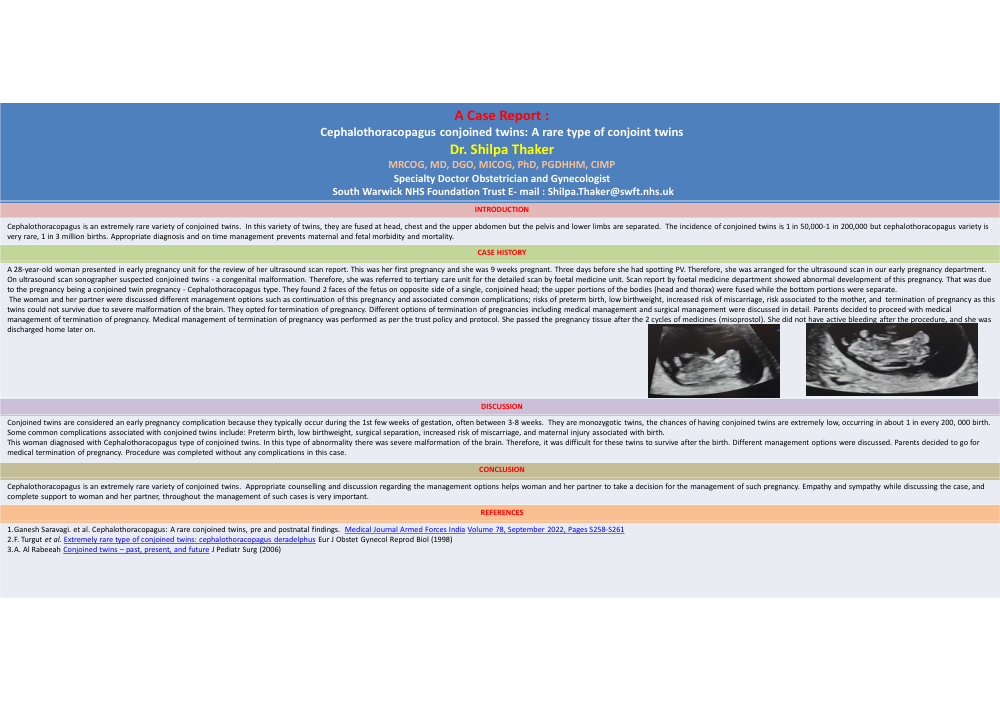
A 28-year-old woman presented in early pregnancy unit for the review of her ultrasound scan report. This was her first pregnancy and she was 9 weeks pregnant. Three days before she had spotting PV. Therefore, she was arranged for the ultrasound scan in our early pregnancy department. On ultrasound scan sonographer suspected conjoined twins - a congenital malformation. Therefore, she was referred to tertiary care unit for the detailed scan by foetal medicine unit. Scan report by foetal medicine department showed abnormal development of this pregnancy. That was due to the pregnancy being a conjoined twin pregnancy - Cephalothoracopagus type. They found 2 faces of the fetus on opposite side of a single, conjoined head; the upper portions of the bodies (head and thorax) were fused while the bottom portions were separate.
The woman and her partner were discussed different management options such as continuation of this pregnancy and associated common complications; risks of preterm birth, low birthweight, increased risk of miscarriage, risk associated to the mother, and termination of pregnancy as this twins could not survive due to severe malformation of the brain. They opted for termination of pregnancy. Different options of termination of pregnancies including medical management and surgical management were discussed in detail. Parents decided to proceed with medical management of termination of pregnancy.
Medical management of termination of pregnancy was performed as per the trust policy and protocol. She passed the pregnancy tissue after the 2 cycles of medicines (misoprostol). She did not have active bleeding after the procedure, and she was discharged home later on.
Discussion:
Conjoined twins are considered an early pregnancy complication because they typically occur during the 1st few weeks of gestation, often between 3-8 weeks. They are monozygotic twins, the chances of having conjoined twins are extremely low, occurring in about 1 in every 200, 000 birth.
Some common complications associated with conjoined twins include: Preterm birth, low birthweight, surgical separation, increased risk of miscarriage, and maternal injury associated with birth.
This woman diagnosed with Cephalothoracopagus type of conjoined twins. In this type of abnormality there was severe malformation of the brain. Therefore, it was difficult for these twins to survive after the birth. Different management options were discussed. Parents decided to go for medical termination of pregnancy. Procedure was completed without any complications in this case.
Conclusion:
Cephalothoracopagus is an extremely rare variety of conjoined twins. Appropriate counselling and discussion regarding the management options helps woman and her partner to take a decision for the management of such pregnancy. Empathy and sympathy while discussing the case, and complete support to woman and her partner, throughout the management of such cases is very important.
References:
1. Ganesh Saravagi. et al. Cephalothoracopagus: A rare conjoined twins, pre and postnatal findings. Medical Journal Armed Forces IndiaVolume 78, September 2022, Pages S258-S261
2. F. Turgut et al. Extremely rare type of conjoined twins: cephalothoracopagus deradelphus Eur J Obstet Gynecol Reprod Biol (1998)
3. A. Al Rabeeah Conjoined twins – past, present, and future J Pediatr Surg (2006)
Cephalothoracopagus conjoined twins: A rare type of conjoint twins