2,281 posters, 63 videos, 56 audios, 43 topics, 18 sessions, 6,174 authors, 2,323 institutions
ePostersLive by SciGen Technologies S.A. All rights reserved.
RCOG World Congress 2025
June 23 - 25, 2025 | ExCeL London, UK
EP.0402
Severe small for gestational age audit cycle at a district general hospital
Poster Presenter
Authors
Affiliations
Royal Derby Hospital, Royal Derby NHS trust, Royal Berkshire
Part of Topic
Fetal medicine
Severe small for gestational age (SGA)audit cycle at a large district general hospital.
Objective
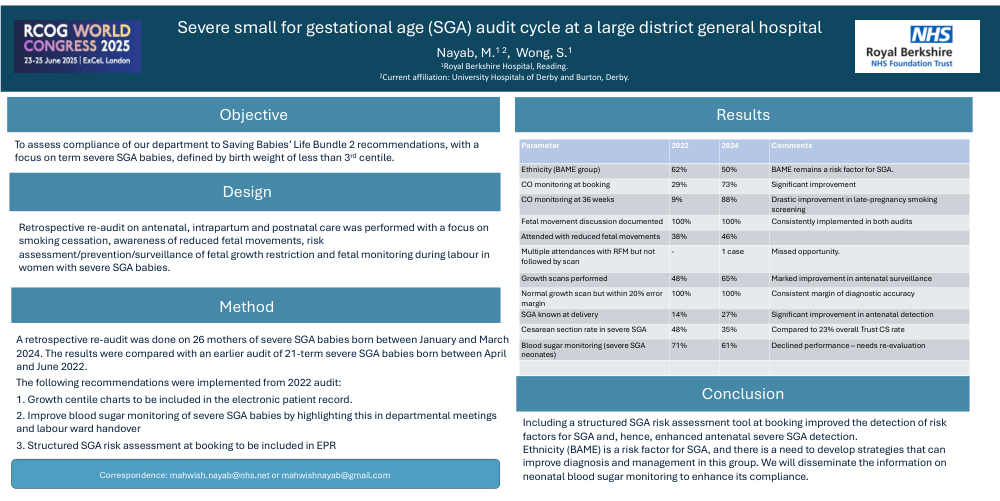
To assess compliance of our department to Saving Babies’ Life Bundle 2 recommendations, with a focus on term severe SGA babies, defined by birth weight of less than 3rd centile.
Design
Retrospective re-audit on antenatal, intrapartum and postnatal care was performed witha focus on smoking cessation, awareness of reduced fetal movements, risk assessment/prevention/surveillance of fetal growth restriction and fetal monitoring during labour in women with severe SGA babies.
Method
A retrospective re-audit was done on 26 mothers of severe SGA babies born between January and March 2024. The results were compared with an earlier audit of 21-term severe SGA babies born between April and June 2022. The recommendations implemented from 2022 audit were:
Growth centile charts to be included in electronic patient record (EPR)
Improve blood sugar monitoring of severe SGA babies by highlighting this in departmental meetings and labour ward hand-over
Structured SGA risk assessment at booking to be included in EPR
Results
62% of the women were from the BAME group in 2022 compared to 50% in 2024. The cesarean section rate was 48% and 35% in severe SGA in 2022 and 2024, respectively, compared to a 23% overalltrust rate for this period. 48%of women had growth scans in 2022 which increased to 65% in 2024. 27%of women were known SGA at delivery in 2024 which was an improvement from 14% in 2022. Although 60% of the audited women in 2024 had normal growth scans, the difference was within a 20% margin of error for all who had scans, which was the case in 2022 as well. Risk for SGA was assessed for all women at booking in 2024 using a structured risk assessment tool recommended after the 2022 audit. Discussion of the significance of fetal movements was done with all women both in 2022 and 2024. 46% attended the assessment unit at least once with reduced movements in 2024 compared to 38% in 2022. However, one attended multiple times with this complaint in 2024 and was not offered a growth scan. CO monitoring showed improvement from 29% to 73% at booking and 9% to 88% at 36 weeks between both audits. Blood sugar monitoring for severe SGA babies declined from 71% to 61% in the re-audit.
Conclusion
The aspects that improved after the implementation of the recommendations from 2022 were SGA risk stratification at booking and CO monitoring. Blood sugar monitoring of severe SGA babies will need further focus and improvement. The significance of growth scans in recurrent reduced fetal monitoring will be highlighted in the meetings.