2,281 posters, 63 videos, 56 audios, 43 topics, 18 sessions, 6,174 authors, 2,323 institutions
ePostersLive by SciGen Technologies S.A. All rights reserved.
RCOG World Congress 2025
June 23 - 25, 2025 | ExCeL London, UK
EP.0404
Placental Glucose Transporter Expression in Early and Late Onset Fetal Growth Restriction
Part of Topic
Fetal medicine
Placental Glucose Transporter Expression in Pregnancies Complicated by Early and Late Onset Fetal Growth Restriction
M Pradhiki Mahindra1, Sara Hillman1, Dimitrios Siassakos1, Kasia Maksym1, Anna David1, Owen Vaughan1.
1Elizabeth Garrett Anderson Institute for Women’s Health University College London, London, United Kingdom
Introduction:
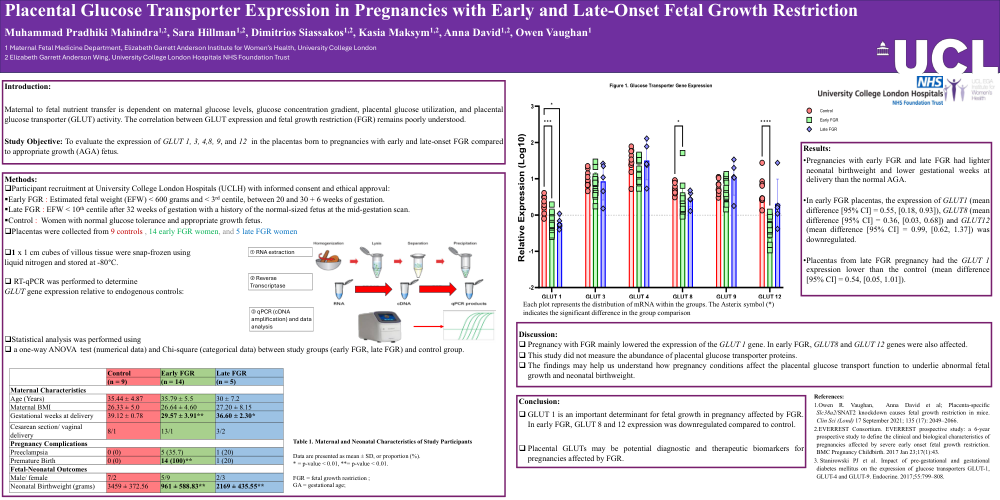
Maternal to fetal nutrient transfer is dependent on maternal glucose levels, glucose concentration gradient, placental glucose utilization, and placental glucose transporter (GLUT) activity. The correlation between fetal growth restriction (FGR) and placental GLUT expression is not fully understood. We evaluated GLUT 1, 3, 4, 8, 9, and 12 expression in the placentas from pregnancies complicated by early and late-onset FGR, compared to appropriate for gestational age (AGA) controls.
Methods:
Women with live singleton fetus and estimated fetal weight < 600 grams and < 3rd centile between 20+0 and 26+6 weeks were recruited at University College Hospital NHS Foundation Trust, with informed consent and ethical approval. Placentas were collected from 14 early-onset FGR (EO-FGR), 5 late-onset FGR (LO-FGR), and 9 AGA pregnancies. From each placenta, villous tissue was snap frozen using liquid nitrogen and stored at -80°C. Following RNA extraction and reverse transcription, RT-qPCR was performed to determine GLUT gene expression relative to endogenous controls (GAPDH and SDHA). Statistical analysis used GraphPad software. Inter-group comparisons were performed using one way ANOVA test.
Results:
Birthweights of neonates from pregnancies affected by EO-FGR (Mean ± SD, 930 ± 601g) and LO-FGR (2169 ± 435g) were lower than birthweights of AGA controls (3459 ± 372g). Compared to AGA pregnancies (39.12 ± 0.78 weeks), gestational age at the time of delivery was also significantly lower in EO-FGR (29.38 ± 4.01 weeks) but not in LO-FGR (36.60 ± 2.30 weeks). GLUT1 and GLUT12 were downregulated in EO-FGR placentas, compared to controls (GLUT1 mean difference [95% CI], 0.55 [0.18, 0.93]; GLUT12, 0.99 [0.62, 1.37]). Only GLUT1 was downregulated in LO-FGR placentas (mean difference [95% CI] 0.54 [0.05, 1.01]). GLUT 3, 4, 8, and 9 were not affected in both EO-FGR and LO-FGR placenta groups.
Discussion:
Pregnancy affected by both FGR subtypes reduced the expression of the placental GLUT 1 gene. In EO-FGR, GLUT 12 gene was also affected. We did not measure the protein abundance of the placental glucose transporters. These findings may help us understand how FGR affects birthweight by altering placental glucose transport function.