2,281 posters, 63 videos, 56 audios, 43 topics, 18 sessions, 6,174 authors, 2,323 institutions
ePostersLive by SciGen Technologies S.A. All rights reserved.
RCOG World Congress 2025
June 23 - 25, 2025 | ExCeL London, UK
EP.0478
Apert Syndrome: A Rare Case Detected Following Polyhydramnios
Poster Presenter
Authors
Nesrine Souayeh, Haithem Aloui, Ameni Mezni, Hadhami Rouis, Asma Belghith, Chaouki Mbarki, Hajer Bettaieb
Affiliations
Ben Arous Regional Hospital, Deprtment of gynecology and Obstetrics, Department of Gynecology and Obstetrics of Tunis Maternity and Neonatology Center, Ben Arous regional hospital, gynecology and obstetrics department, university on Tunis elmanar, faculty of medicine, Ben Arous, Ben Arous regional hospital, gynecology and obstetrics department,universityof Tunis elmanar, faculty of medicine, Ben Arous regional hospital, gynecology and obstetrics department, university of Tunis elmanar, faculty of medecine
Part of Topic
Fetal medicine
INTRODUCTION/BACKGROUND
Apert syndrome, a rare autosomal dominant disorder, poses challenges for prenatal diagnosis. Early diagnosis allows for informed decision-making and appropriate management, including genetic counseling and potential termination of pregnancy if desired by the parents.
RESULTS
METHODS
We present a case of suspected Apert syndrome diagnosed at 31 weeks of gestation. The diagnosis was facilitated by 3D ultrasound imaging, which was instrumental in guiding parental counseling following the discovery of severe polyhydramnios.
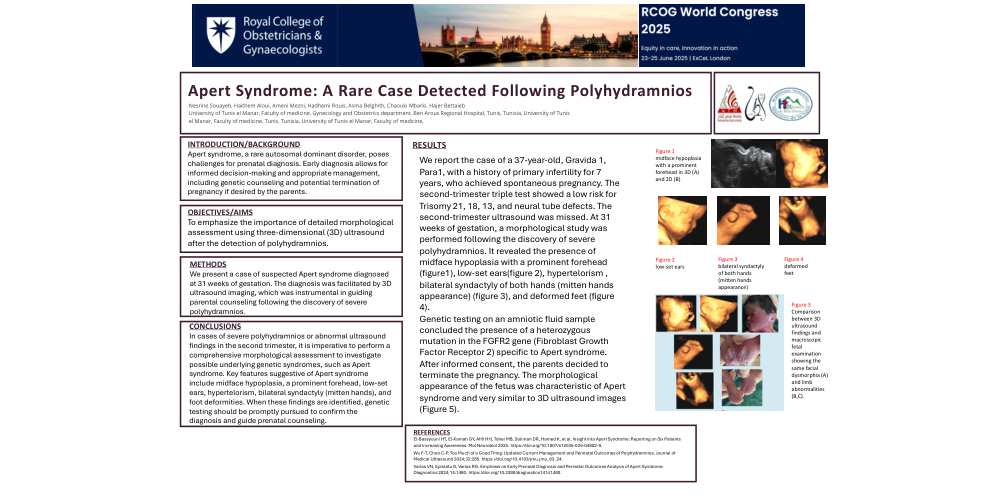
We report the case of a 37-year-old, Gravida 1, Para1, with a history of primary infertility for 7 years, who achieved spontaneous pregnancy. The second-trimester triple test showed a low risk for Trisomy 21, 18, 13, and neural tube defects. The second-trimester ultrasound was missed. At 31 weeks of gestation, a morphological study was performed following the discovery of severe polyhydramnios. It revealed the presence of midface hypoplasia with a prominent forehead (figure1), low-set ears(figure 2), hypertelorism , bilateral syndactyly of both hands (mitten hands appearance) (figure 3), and deformed feet (figure 4).
Genetic testing on an amniotic fluid sample concluded the presence of a heterozygous mutation in the FGFR2 gene (Fibroblast Growth Factor Receptor 2) specific to Apert syndrome. After informed consent, the parents decided to terminate the pregnancy. The morphological appearance of the fetus was characteristic of Apert syndrome and very similar to 3D ultrasound images (Figure 5).