2,281 posters, 63 videos, 56 audios, 43 topics, 18 sessions, 6,174 authors, 2,323 institutions
ePostersLive by SciGen Technologies S.A. All rights reserved.
RCOG World Congress 2025
June 23 - 25, 2025 | ExCeL London, UK
EP.0473
Isolated Umbilical Vein Varix management
Poster Presenter
Authors
Affiliations
Beit-jala hospital, Holly family hospital, beit Jala Govermental hospital
Part of Topic
Fetal medicine
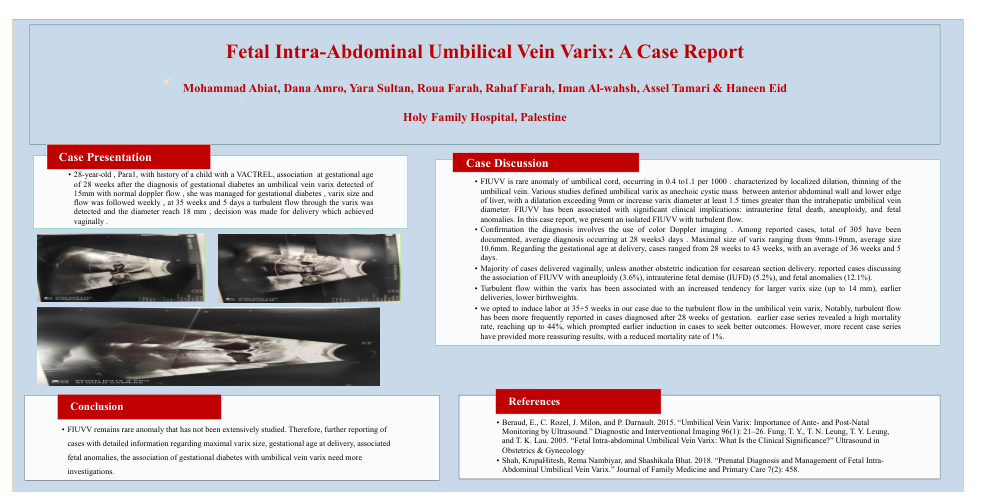
• FIUVV is rare anomaly of umbilical cord, occurring in 0.4 to1.1 per 1000 . characterized by localized dilation, thinning of the
umbilical vein. Various studies defined umbilical varix as anechoic cystic mass between anterior abdominal wall and lower edge
of liver, with a dilatation exceeding 9mm or increase varix diameter at least 1.5 times greater than the intrahepatic umbilical vein
diameter. FIUVV has been associated with significant clinical implications: intrauterine fetal death, aneuploidy, and fetal
anomalies. In this case report, we present an isolated FIUVV with turbulent flow.
• Confirmation the diagnosis involves the use of color Doppler imaging . Among reported cases, total of 305 have been
documented, average diagnosis occurring at 28 weeks3 days . Maximal size of varix ranging from 9mm-19mm, average size
10.6mm. Regarding the gestational age at delivery, cases ranged from 28 weeks to 43 weeks, with an average of 36 weeks and 5
days.
• Majority of cases delivered vaginally, unless another obstetric indication for cesarean section delivery. reported cases discussing
the association of FIUVV with aneuploidy (3.6%), intrauterine fetal demise (IUFD) (5.2%), and fetal anomalies (12.1%).
• Turbulent flow within the varix has been associated with an increased tendency for larger varix size (up to 14 mm), earlier
deliveries, lower birthweights.
• we opted to induce labor at 35+5 weeks in our case due to the turbulent flow in the umbilical vein varix, Notably, turbulent flow
has been more frequently reported in cases diagnosed after 28 weeks of gestation. earlier case series revealed a high mortality
rate, reaching up to 44%, which prompted earlier induction in cases to seek better outcomes. However, more recent case series
have provided more reassuring results, with a reduced mortality rate of 1%.