2,281 posters, 63 videos, 56 audios, 43 topics, 18 sessions, 6,174 authors, 2,323 institutions
ePostersLive by SciGen Technologies S.A. All rights reserved.
RCOG World Congress 2025
June 23 - 25, 2025 | ExCeL London, UK
EP.0472
Refractory case of Obstetrics antiphospholipid syndrome.
Poster Presenter
Authors
Affiliations
Part of Topic
Fetal medicine
Video
Refractory Case of Obstetric Antiphospholipid Syndrome
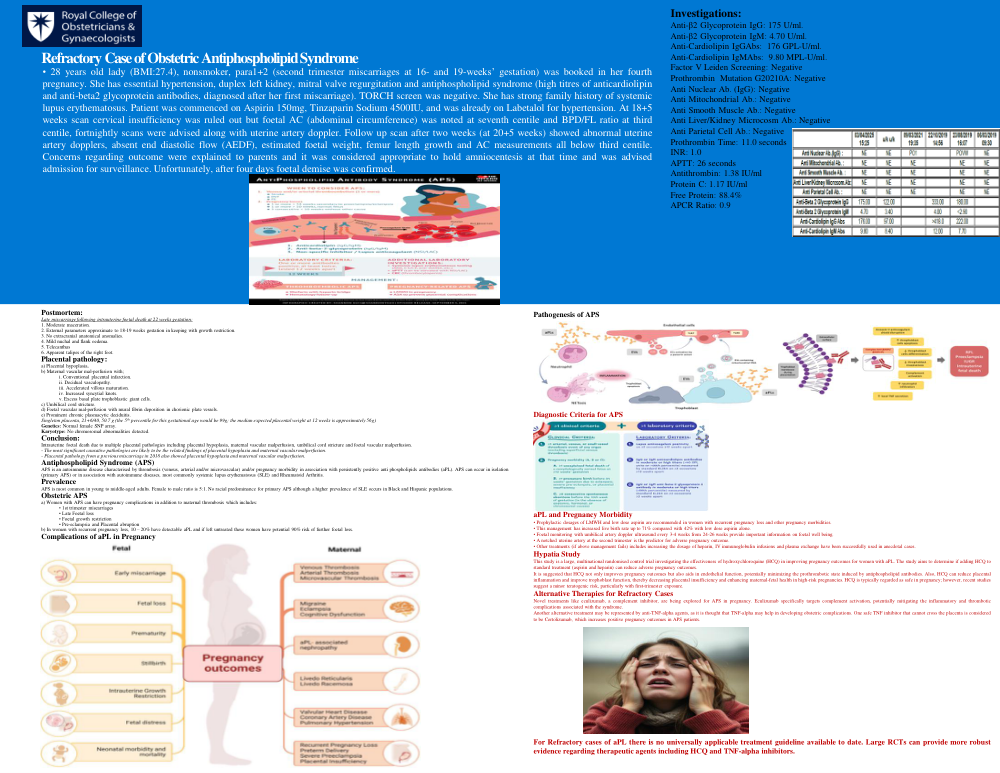
• 28 years old lady (BMI:27.4), nonsmoker, para1+2 (second trimester miscarriages at 16- and 19-weeks’ gestation) was booked in her fourth pregnancy. She has essential hypertension, duplex left kidney, mitral valve regurgitation and antiphospholipid syndrome (high titres of anticardiolipin and anti-beta2 glycoprotein antibodies, diagnosed after her first miscarriage). TORCH screen was negative. She has strong family history of systemic lupus erythematosus. Patient was commenced on Aspirin 150mg, Tinzaparin Sodium 4500IU, and was already on Labetalol for hypertension. At 18+5 weeks scan cervical insufficiency was ruled out but foetal AC (abdominal circumference) was noted at seventh centile and BPD/FL ratio at third centile, fortnightly scans were advised along with uterine artery doppler. Follow up scan after two weeks (at 20+5 weeks) showed abnormal uterine artery dopplers, absent end diastolic flow (AEDF), estimated foetal weight, femur length growth and AC measurements all below third centile. Concerns regarding outcome were explained to parents and it was considered appropriate to hold amniocentesis at that time and was advised admission for surveillance. Unfortunately, after four days foetal demise was confirmed.
Investigations:
Anti-β2 Glycoprotein IgG: 175 U/ml.
Anti-β2 Glycoprotein IgM: 4.70 U/ml.
Anti-Cardiolipin IgGAbs: 176 GPL-U/ml.
Anti-Cardiolipin IgMAbs: 9.80 MPL-U/ml.
Factor V Leiden Screening: Negative
Prothrombin Mutation G20210A: Negative
Anti Nuclear Ab. (IgG): Negative
Anti Mitochondrial Ab.: Negative
Anti Smooth Muscle Ab.: Negative
Anti Liver/Kidney Microcosm Ab.: Negative
Anti Parietal Cell Ab.: Negative
Prothrombin Time: 11.0 seconds
INR: 1.0
APTT: 26 seconds
Antithrombin: 1.38 IU/ml
Protein C: 1.17 IU/ml
Free Protein: 88.4%
APCR Ratio: 0.9
Postmortem:
Late miscarriage following intrauterine foetal death at 22 weeks gestation:
1. Moderate maceration.
2. External parameters approximate to 18-19 weeks gestation in keeping with growth restriction.
3. No extracranial anatomical anomalies.
4. Mild nuchal and flank oedema.
5. Telecanthus
6. Apparent talipes of the right foot.
Placental pathology:
a) Placental hypoplasia.
b) Maternal vascular mal-perfusion with;
i. Conventional placental infarction.
ii. Decidual vasculopathy.
iii. Accelerated villous maturation.
iv. Increased syncytial knots.
v. Excess basal plate trophoblastic giant cells.
c) Umbilical cord stricture.
d) Foetal vascular mal-perfusion with mural fibrin deposition in chorionic plate vessels.
e) Prominent chronic plasmacytic deciduitis.
Singleton placenta, 21+6/40, 50.7 g (the 5th percentile for this gestational age would be 99g; the median expected placental weight at 12 weeks is approximately 56g)
Genetics: Normal female SNP array.
Karyotype: No chromosomal abnormalities detected.
Conclusion:
Intrauterine foetal death due to multiple placental pathologies including placental hypoplasia, maternal vascular malperfusion, umbilical cord stricture and foetal vascular malperfusion.
- The most significant causative pathologies are likely to be the related findings of placental hypoplasia and maternal vascular malperfusion.
- Placental pathology from a previous miscarriage in 2018 also showed placental hypoplasia and maternal vascular malperfusion.
Antiphospholipid Syndrome (APS)
APS is an autoimmune disease characterised by thrombosis (venous, arterial and/or microvascular) and/or pregnancy morbidity in association with persistently positive anti phospholipids antibodies (aPL). APS can occur in isolation (primary APS) or in association with autoimmune diseases, most commonly systemic lupus erythematosus (SLE) and Rheumatoid Arthritis.
Prevalence
APS is most common in young to middle-aged adults. Female to male ratio is 5:1. No racial predominance for primary APS although a higher prevalence of SLE occurs in Black and Hispanic populations.
Obstetric APS
a) Women with APS can have pregnancy complications in addition to maternal thrombosis which includes:
• 1st trimester miscarriages
• Late Foetal loss
• Foetal growth restriction
• Pre-eclampsia and Placental abruption
b) In women with recurrent pregnancy loss, 10 – 20% have detectable aPL and if left untreated these women have potential 90% risk of further foetal loss.
Complications of aPL in Pregnancy
Diagnostic Criteria for APS
aPL and Pregnancy Morbidity
• Prophylactic dosages of LMWH and low dose aspirin are recommended in women with recurrent pregnancy loss and other pregnancy morbidities.
• This management has increased live birth rate up to 71% compared with 42% with low dose aspirin alone.
• Foetal monitoring with umbilical artery doppler ultrasound every 3-4 weeks from 24-26 weeks provide important information on foetal well being.
• A notched uterine artery at the second trimester is the predictor for adverse pregnancy outcome.
• Other treatments (if above management fails) includes increasing the dosage of heparin, IV immunoglobulin infusions and plasma exchange have been successfully used in anecdotal cases.
Hypatia Study
This study is a large, multinational randomised control trial investigating the effectiveness hydroxychloroquine (HCQ) in improving pregnancy outcomes for women with aPL. The study aims to determine if adding HCQ to standard treatment (aspirin and heparin) can reduce adverse pregnancy outcomes.
It is suggested that HCQ not only improves pregnancy outcomes but also aids in endothelial function, potentially minimizing the prothrombotic state induced by antiphospholipid antibodies. Also, HCQ can reduce placental inflammation and improve trophoblast function, thereby decreasing placental insufficiency and enhancing maternal-fetal health in high-risk pregnancies. HCQ is typically regarded as safe in pregnancy; however, recent studies suggest a minor teratogenic risk, particularly with first-trimester exposure.
Alternative Therapies for Refractory Cases
Novel treatments like eculizumab, a complement inhibitor, are being explored for APS in pregnancy. Eculizumab specifically targets complement activation, potentially mitigating the inflammatory and thrombotic complications associated with the syndrome.
Another alternative treatment may be represented by anti-TNF-alpha agents, as it is thought that TNF-alpha may help in developing obstetric complications. One safe TNF inhibitor that cannot cross the placenta is considered to be Certolizumab, which increases positive pregnancy outcomes in APS patients.
For Refractory cases of aPL there is no universally applicable treatment guideline available to date. Large RCTs can provide more robust evidence regarding therapeutic agents including HCQ and TNF-alpha inhibitors.