2,281 posters, 63 videos, 56 audios, 43 topics, 18 sessions, 6,174 authors, 2,323 institutions
ePostersLive by SciGen Technologies S.A. All rights reserved.
RCOG World Congress 2025
June 23 - 25, 2025 | ExCeL London, UK
EP.0471
EXIT: A Critical Intervention in Obstetric Delivery complicated by Fetal Cystic hygroma
Poster Presenter
Authors
Affiliations
Part of Topic
Fetal medicine
EXIT: A Critical Intervention in Obstetric Deliveries complicated by Fetal Cystic hygroma
OBJECTIVE
To determine the role of Ex-Utero Intrapartum Treatment-to-airway (EXIT-to-airway) as a specialized procedure that maintains fetal airway and circulation while securing an alternative airway before the completion of delivery.
CASE REPORT
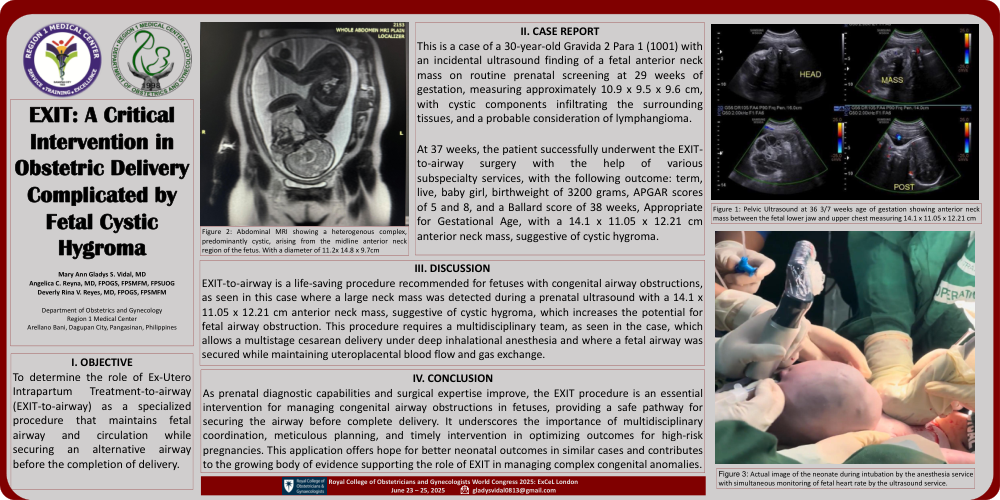
This is a case of a 30-year-old Gravida 2 Para 1 (1001) with an incidental ultrasound finding of a fetal anterior neck mass during routine prenatal screening at 29 weeks of gestation, measuring approximately 10.9 x 9.5 x 9.6 cm, with cystic components infiltrating the surrounding tissues, and a probable consideration of lymphangioma. She was advised to consult an apex hospital for further intervention; however, the patient was noncompliant.
At 36 weeks and 5 days of gestation, the patient consulted a provincial hospital, where a repeat ultrasound was performed with the same findings. She was then referred to our institution and admitted for further evaluation and preparation for a possible EXIT-to-airway.
Upon admission, baseline diagnostics revealed unremarkable results. Therefore, the team decided to proceed with the EXIT-to-airway procedure.
The patient successfully underwent the EXIT-to-airway procedure and was intubated by an anesthesiologist. The total blood loss was 500 cc, with the following outcome: a term live baby girl weighing 3200 grams, APGAR scores of 5 and 8, and a Ballard score of 38 weeks, appropriate for gestational age, with a 14.1 x 11.05 x 12.21 cm anterior neck mass, suggestive of cystic hygroma.
DISCUSSION
EXIT-to-airway is a life-saving procedure recommended for fetuses with congenital airway obstructions, as seen in this case where a large neck mass was detected during a prenatal ultrasound with a 14.1 x 11.05 x 12.21 cm anterior neck mass, suggestive of cystic hygroma, which increases the potential for fetal airway obstruction. This procedure requires a multidisciplinary team, as seen in the case, which allows a multistage cesarean delivery under deep inhalational anesthesia and where a fetal airway was secured while maintaining uteroplacental blood flow and gas exchange.
CONCLUSION
As prenatal diagnostic capabilities and surgical expertise improve, the EXIT procedure is an essential intervention for managing congenital airway obstructions in fetuses, providing a safe pathway for securing the airway before complete delivery. It underscores the importance of multidisciplinary coordination, meticulous planning, and timely intervention in optimizing outcomes for high-risk pregnancies. This application offers hope for better neonatal outcomes in similar cases and contributes to the growing body of evidence supporting the role of EXIT in managing complex congenital anomalies.
X