2,281 posters, 63 videos, 56 audios, 43 topics, 18 sessions, 6,174 authors, 2,323 institutions
ePostersLive by SciGen Technologies S.A. All rights reserved.
RCOG World Congress 2025
June 23 - 25, 2025 | ExCeL London, UK
EP.0470
Prenatal diagnosis of double discordance : a case report
Poster Presenter
Authors
Imene Labidi, Sana Menjli, khaoula Magdoud, Hassine Saber Abouda
Affiliations
Part of Topic
Fetal medicine
Introduction :
Double discordance (DD), also known as congenitally corrected transposition of the great arteries (ccTGA), is a rare congenital heart disease.
It accounts for approximately 0.5% to 1% of all congenital heart defects.
Prenatal diagnosis is exceptionally rare, with most cases being identified in adulthood following the onset of cardiac complications.We present a rare case of prenatal diagnosis of DD, highlighting the prenatal findings, management strategies, and implications for postnatal care and prognosis.
Case Report :
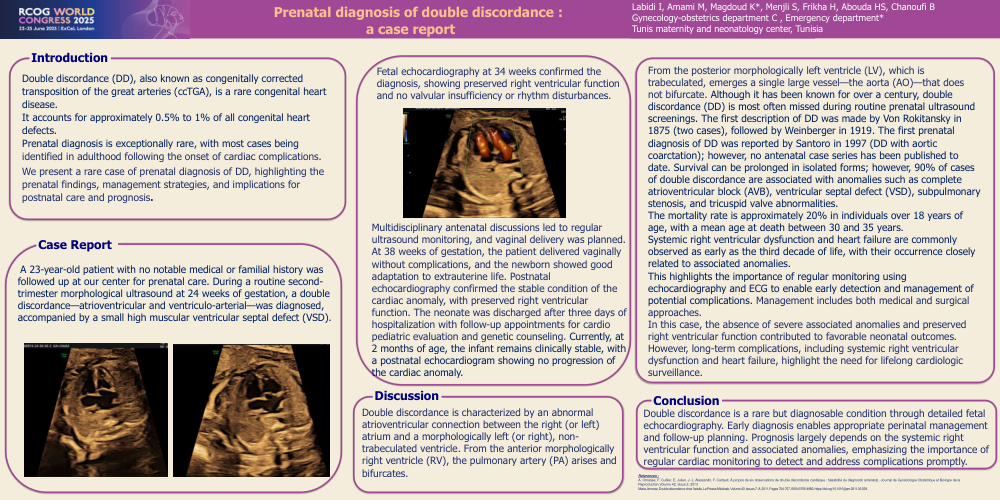
A 23-year-old patient with no notable medical or familial history was followed up at our center for prenatal care. During a routine second-trimester morphological ultrasound at 24 weeks of gestation, a double discordance—atrioventricular and ventriculo-arterial—was diagnosed, accompanied by a small high muscular ventricular septal defect (VSD). Fetal echocardiography at 34 weeks confirmed the diagnosis, showing preserved right ventricular function and no valvular insufficiency or rhythm disturbances.
Multidisciplinary antenatal discussions led to regular ultrasound monitoring, and vaginal delivery was planned. At 38 weeks of gestation, the patient delivered vaginally without complications, and the newborn showed good adaptation to extrauterine life. Postnatal echocardiography confirmed the stable condition of the cardiac anomaly, with preserved right ventricular function. The neonate was discharged after three days of hospitalization with follow-up appointments for cardio pediatric evaluation and genetic counseling. Currently, at 2 months of age, the infant remains clinically stable, with a postnatal echocardiogram showing no progression of the cardiac anomaly.
Discussion:
Double discordance is characterized by an abnormal atrioventricular connection between the right (or left) atrium and a morphologically left (or right), non-trabeculated ventricle. From the anterior morphologically right ventricle (RV), the pulmonary artery (PA) arises and bifurcates.
From the posterior morphologically left ventricle (LV), which is trabeculated, emerges a single large vessel—the aorta (AO)—that does not bifurcate. Although it has been known for over a century, double discordance (DD) is most often missed during routine prenatal ultrasound screenings. The first description of DD was made by Von Rokitansky in 1875 (two cases), followed by Weinberger in 1919. The first prenatal diagnosis of DD was reported by Santoro in 1997 (DD with aortic coarctation); however, no antenatal case series has been published to date. Survival can be prolonged in isolated forms; however, 90% of cases of double discordance are associated with anomalies such as complete atrioventricular block (AVB), ventricular septal defect (VSD), subpulmonary stenosis, and tricuspid valve abnormalities.
The mortality rate is approximately 20% in individuals over 18 years of age, with a mean age at death between 30 and 35 years.
Systemic right ventricular dysfunction and heart failure are commonly observed as early as the third decade of life, with their occurrence closely related to associated anomalies.
This highlights the importance of regular monitoring using echocardiography and ECG to enable early detection and management of potential complications. Management includes both medical and surgical approaches.
In this case, the absence of severe associated anomalies and preserved right ventricular function contributed to favorable neonatal outcomes. However, long-term complications, including systemic right ventricular dysfunction and heart failure, highlight the need for lifelong cardiologic surveillance.
Conclusion :
Double discordance is a rare but diagnosable condition through detailed fetal echocardiography. Early diagnosis enables appropriate perinatal management and follow-up planning. Prognosis largely depends on the systemic right ventricular function and associated anomalies, emphasizing the importance of regular cardiac monitoring to detect and address complications promptly.