2,281 posters, 63 videos, 56 audios, 43 topics, 18 sessions, 6,174 authors, 2,323 institutions
ePostersLive by SciGen Technologies S.A. All rights reserved.
RCOG World Congress 2025
June 23 - 25, 2025 | ExCeL London, UK
EP.0467
Idiopathic fetal stroke diagnosed antenatally and the need for uniform diagnostic definitions.
Poster Presenter
Authors
Affiliations
Part of Topic
Fetal medicine
Idiopathic fetal stroke diagnosed antenatally and the need for uniform diagnostic definitions.
Introduction
- Fetal stroke often presents as fetal intracranial haemorrhage(ICH).
- Idiopathic fetal ICH is a rare but well reported phenomenon with the true in incidence of ICH in utero remaining undetermined.
- Various predisposing risk factors for fetal ICH are recognised:
- Maternal risk factors:
- Genetic and autoimmune causes
- Coagulopathies
- Severe maternal trauma recreational drug use.
- Fetal risk factors:
- Congenital coagulopathy
- Monochorionic twin pregnancies
- Feto-maternal haemorrhages.
- Maternal risk factors:
- In the majority of cases the cause of fetal ICH remains unknown.
- Fetuses diagnosed prenatally with ICH are exposed to higher risks of adverse neurodevelopmental outcomes, perinatal mortality, neonatal death and long-term neurological deficit
- Antenatally, such events are diagnosed sonographically.
- Here we present a case of an idiopathic fetal stroke diagnosed antenatally.
Case Report
- A 35 year old woman, gravida 1 para 0 was referred for serial growth scans at 31 and 36 weeks of gestation as per hospital policy due to low BMI (17.5 g/m2).
- Her medical history was unremarkable. Her antenatal fetal ultrasound scans at 20 and 31 weeks both showed normal appearances of the brain.
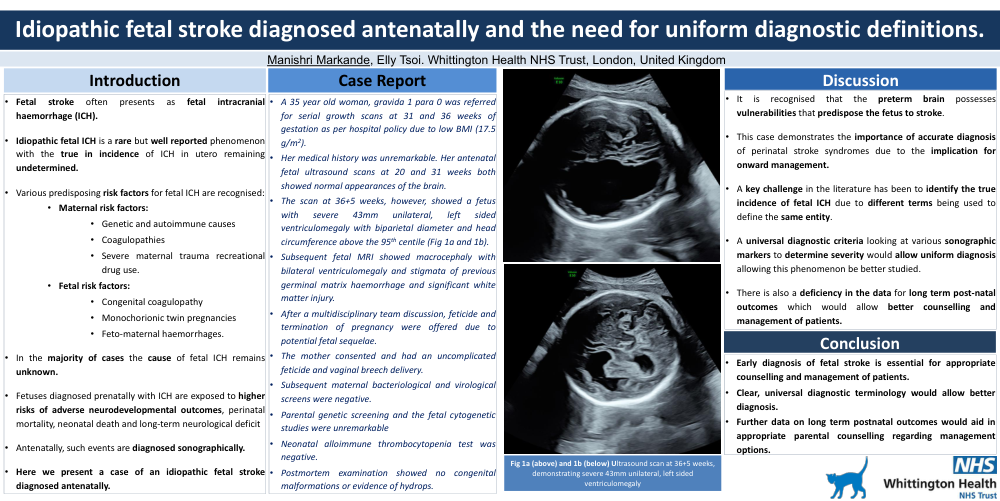
- The scan at 36+5 weeks, however, showed a fetus with severe 43mm unilateral, left sided ventriculomegaly with biparietal diameter and head circumference above the 95th centile (Fig 1a and 1b).
- Subsequent fetal MRI showed macrocephaly with bilateral ventriculomegaly and stigmata of previous germinal matrix haemorrhage and significant white matter injury.
- After a multidisciplinary team discussion, feticide and termination of pregnancy were offered due to potential fetal sequelae.
- The mother consented and had an uncomplicated feticide and vaginal breech delivery.
- Subsequent maternal bacteriological and virological screens were negative.
- Parental genetic screening and the fetal cytogenetic studies were unremarkable
- Neonatal alloimmune thrombocytopenia test was negative.
- Postmortem examination showed no congenital malformations or evidence of hydrops.
Discussion
- It is recognised that the preterm brain possesses vulnerabilities that predispose the fetus to stroke.
- This case demonstrates the importance of accurate diagnosis of perinatal stroke syndromes due to the implication for onward management.
- A key challenge in the literature has been to identify the true incidence of fetal ICH due to different terms being used to define the same entity.
- A universal diagnostic criteria looking at various sonographic markers to determine severity would allow uniform diagnosis allowing this phenomenon be better studied.
- There is also a deficiency in the data for long term post-natal outcomes which would allow better counselling and management of patients.
Conclusion
- Early diagnosis of fetal stroke is essential for appropriate counselling and management of patients.
- Clear, universal diagnostic terminology would allow better diagnosis.
- Further data on long term postnatal outcomes would aid in appropriate parental counselling regarding management options.