2,281 posters, 63 videos, 56 audios, 43 topics, 18 sessions, 6,174 authors, 2,323 institutions
ePostersLive by SciGen Technologies S.A. All rights reserved.
RCOG World Congress 2025
June 23 - 25, 2025 | ExCeL London, UK
EP.0458
Late pregnancy termination and selective feticide: The Indian journey and current scenario
Poster Presenter
Authors
Affiliations
Part of Topic
Fetal medicine
Audio
Late pregnancy termination and selective feticide: The Indian journey and current scenario
Purnima Satoskar 1,2 Siddhesh Rajiwade3 Jassawalla M J4, Minnie Bodhanwala5
1.Professor, Obstetrics and Gynaecology ,Seth G. S. Medical College & Nowrosjee Wadia Maternity Hospital 2. Consultant, Jaslok Hospital, Mumbai 3. Assistant Professor, 4. Director 5. CEO, Nowrosjee Wadia Maternity Hospital
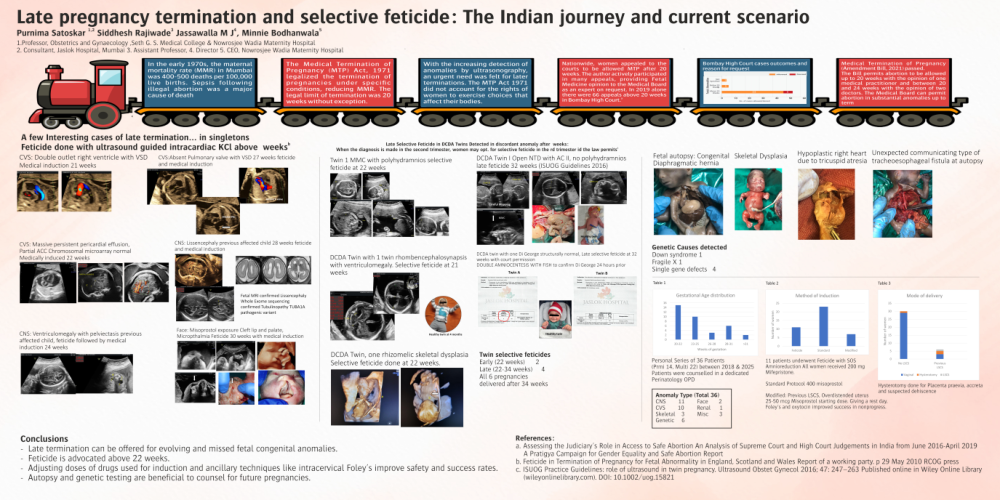
1 : In the early 1970s, the maternal mortality rate (MMR) in Mumbai was 400-500 deaths per 100,000 live births. Sepsis following illegal abortion was a major cause of death
2: The Medical Termination of Pregnancy (MTP) Act, 1971 legalized the termination of pregnancies under specific conditions, reducing MMR. The legal limit of termination was 20 weeks without exception.
3: With the increasing detection of anomalies by ultrasonography, an urgent need was felt for later terminations. The MTP Act 1971 did not account for the rights of women to exercise choices that affect their bodies.
4: Nationwide, women appealed to the courts to be allowed MTP after 20 weeks. The author actively participated in many appeals, providing Fetal Medicine opinion to the Medical Board as an expert on request. In 2019 alone there were 66 appeals above 20 weeks in Bombay High Court.
Medical Termination of Pregnancy (Amendment Bill, 2021) passed.
The Bill permits abortion to be allowed up to 20 weeks with the opinion of one medical practitioner and between 20 and 24 weeks with the opinion of two doctors. The Medical Board can permit abortion in substantial anomalies up to term
This eposter analyzes a personal series of 36 patients (Primi 14 Multi 22) of MTP from 20-34 weeks between 2018-2025. Patients were counselled in a dedicated Perinatology OPD.
11 patients underwent Feticide with SOS Amnioreduction
All women received 200 mg Mifepristone.
Standard Protocol started with 400mcg misoprostol
Modified Protocol: Previous LSCS, Overdistended uterus 25-50 mcg Misoprostol starting dose. Giving a rest day, Foley’s and oxytocin improved success in nonprogress. 32 out of 36 patients had a vaginal bith. Hysterotomy was needed for placenta praevoa, accreta and suspected dehiscence.
Twin selective feticides
Early (22 weeks) 2
Late (22-34 weeks) 4 (as per ISUOG guidelines)
All 6 pregnancies delivered after 34 weeks
Genetic Causes detected
Down syndrome 1
Fragile X 1
Single gene defects 4
Conclusions
Late termination can be offered for evolving and missed fetal congenital anomalies.
Feticide is advocated above 22 weeks.
Adjusting doses of drugs used for induction and ancillary techniques like intracervical Foley's improve safety and success rates.
Autopsy and genetic testing are beneficial to counsel for future pregnancies.
References:
a. Assessing the Judiciary’s Role in Access to Safe Abortion An Analysis of Supreme Court
and High Court Judgements in India from June 2016-April 2019 A Pratigya Campaign for
Gender Equality and Safe Abortion Report
b. Feticide in Termination of Pregnancy for Fetal Abnormality in England, Scotland and
Wales Report of a working party. p 29 May 2010 RCOG press
c. ISUOG Practice Guidelines: role of ultrasound in twin pregnancy. Ultrasound Obstet
Gynecol 2016; 47: 247–263 Published online in Wiley Online Library
(wileyonlinelibrary.com). DOI: 10.1002/uog.15821