2,281 posters, 63 videos, 56 audios, 43 topics, 18 sessions, 6,174 authors, 2,323 institutions
ePostersLive by SciGen Technologies S.A. All rights reserved.
RCOG World Congress 2025
June 23 - 25, 2025 | ExCeL London, UK
EP.0450
Detection of female genital tract abnormalities in antenatally detected Unilateral Renal Agenesis
Poster Presenter
Authors
Christina Resta, Konstantinos Malligiannis Ntalianis, Brianna Cloke, Lisa Story, Spyridon Bakalis, Pankaj Mishra, Massimo Garriboli, Srividhya Sankaran
Affiliations
Guy's and St Thomas' Hospital NHS Foundation Trust, Department of Obstetrics, Maternal and Fetal Medicine, Evelina Women’s and Children’s clinical Group, Guy’s and St Thomas' Hospital, Department of Paediatric and Adolescent Gynaecology, Evelina Women’s and Children’s clinical Group, Guy’s and St Thomas' Hospital, Department of Paediatric urology, Evelina Women’s and Children’s clinical Group, Guy’s and St Thomas' Hospital
Part of Topic
Fetal medicine
Detection of female genital tractabnormalities in
antenatally detected FetalUnilateral Renal Agenesis
Christina Resta 1, Konstantinos Malligiannis Ntalianis,1, Brianna Cloke,2, Lisa Story 1, Spyridon Bakalis1, Pankaj Mishra3, Massimo Garriboli3, Srividhya Sankaran1
Affiliations
1 Department of Obstetrics, Maternal and Fetal Medicine, Evelina Women’s and Children’s clinical Group, Guy’s and St Thomas' Hospital, London, UK
2 Department of Paediatric and Adolescent Gynaecology, EvelinaWomen’s and Children’s
clinical Group, Guy’s and St Thomas' Hospital, London, UK
3 Department of Paediatric urology, Evelina Women’s and Children’s clinical Group, Guy’s and St Thomas' Hospital, London, UK
Introduction
Renal agenesis refers to the complete absence of kidney tissue on one or both sides. Unilateral renal agenesis is found in approximately 1 in 2,000 births, while bilateral renal agenesis, which is lethal, occurs in about 1 in 5,000 newborns. In female population, unilateral renal agenesis is associated withgenital tract abnormalities, which may cause problem in childhood and adolescence.
Aim
To determine the prevalence and characteristics of antenatally identified fetal unilateral renal agenesis and associated female genital abnormalities in a large cohort.
Materials and Methods
Ultrasound database astraia was searched to identify cases of unilateral renal agenesis from 2005 to 2024 detected antenatally before birth. All casesunderwent systematic assessment through prenatal screening and postnatal confirmation via ultrasound at 6
weeks of life. Data including antenatal features such as associated fetalabnormalities and postnatal data, including the gender, postnatal ultrasound findings and detection of associated congenital abnormalities, including female genital tract abnormalities.
Results
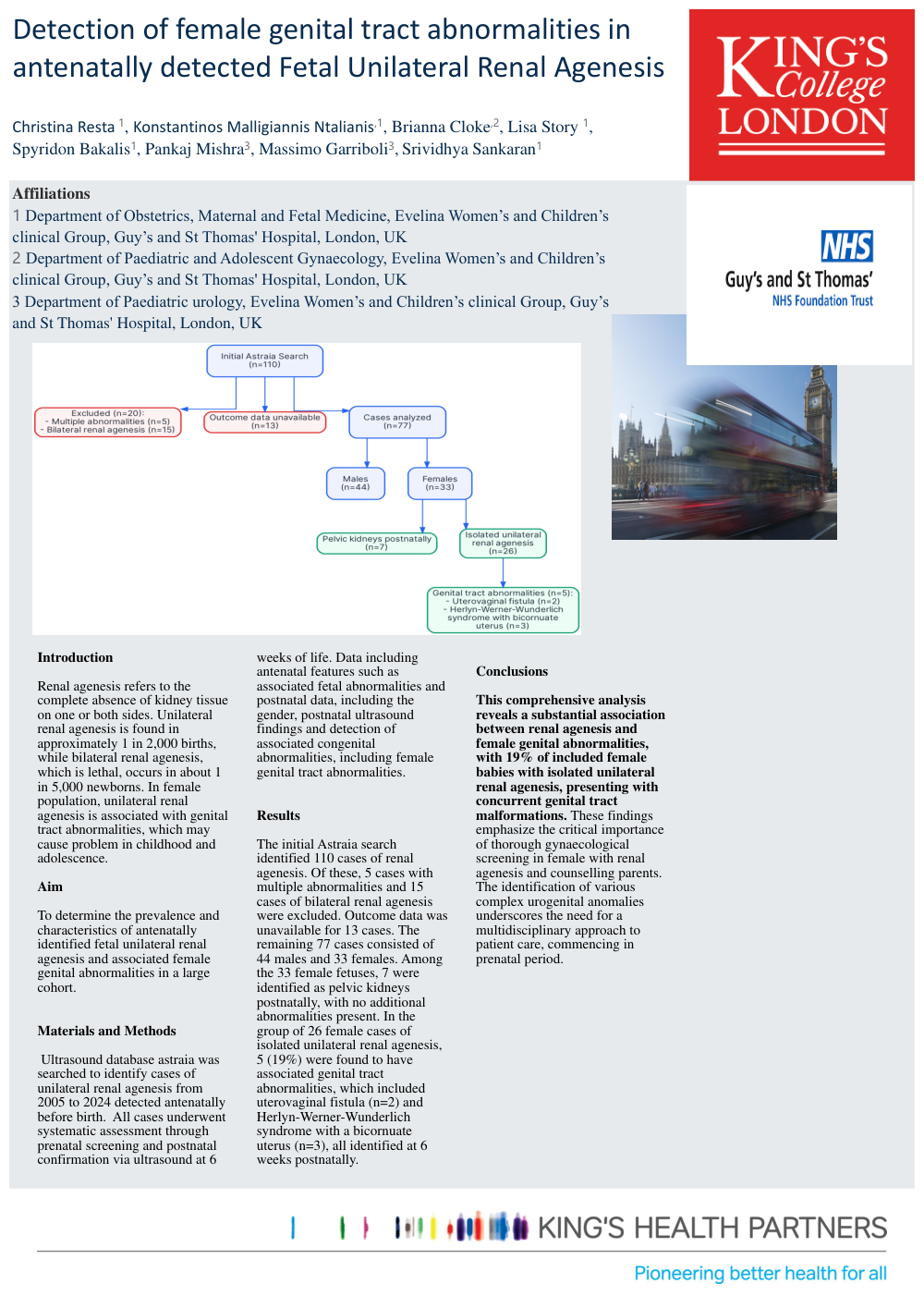
The initial Astraia search identified 110 cases of renal agenesis. Of these, 5 cases with multiple abnormalities and 15 cases of bilateral renal agenesis wereexcluded. Outcome data was unavailable for 13 cases. The remaining 77 cases consisted of 44 males and 33 females. Among
the 33 female fetuses, 7 were identified as pelvic kidneys postnatally, with no additional abnormalities present. In the group of 26 female cases of isolatedunilateral renal agenesis, 5 (19%) were found to have associated genital tract abnormalities, which included uterovaginal fistula (n=2) and Herlyn-Werner-Wunderlich syndrome with a bicornuate uterus (n=3), all identified at 6 weeks postnatally.
Conclusions
This comprehensive analysis reveals asubstantial association between renal agenesis and female genital abnormalities, with 19% of included female babies with isolated unilateral renal agenesis, presenting with concurrent genital tract malformations. These findings emphasize the criticalimportance of thorough gynaecological screening in female with renal agenesis and counselling parents. The identification of various complex urogenital anomalies underscores the need for a multidisciplinary approach to patient care, commencing in prenatal period.