2,281 posters, 63 videos, 56 audios, 43 topics, 18 sessions, 6,174 authors, 2,323 institutions
ePostersLive by SciGen Technologies S.A. All rights reserved.
RCOG World Congress 2025
June 23 - 25, 2025 | ExCeL London, UK
PP.0014
Antepartum Fetal Heart Rate Patterns in Small for Gestational Age Fetuses
Poster Presenter
Part of Topic
Fetal medicine
OBJECTIVE
Small for gestational age (SGA) fetuses are routinely born with normal pregnancy outcomes (NPO). Antepartum fetal heart rate (FHR) monitoring (cardiotocography; CTG) is a common test of fetal wellbeing. However, it doesn’t account for physiological variations attributable to fetal size. Establishing a reference point for CTG features in SGA fetuses could help prevent unnecessary pregnancy interventions or adverse outcomes.
DESIGN
This is a retrospective case-control study comparing term FHR traces from NPO fetuses classified as SGA/IUGR during pregnancy or at birth to NPO fetuses with a birthweight above the 10th or below the 90th centile (appropriate gestational age; AGA). All fetuses included were delivered vaginally with NPO to ensure differences in FHR patterns weren’t attributable to other pathologies.
METHODS
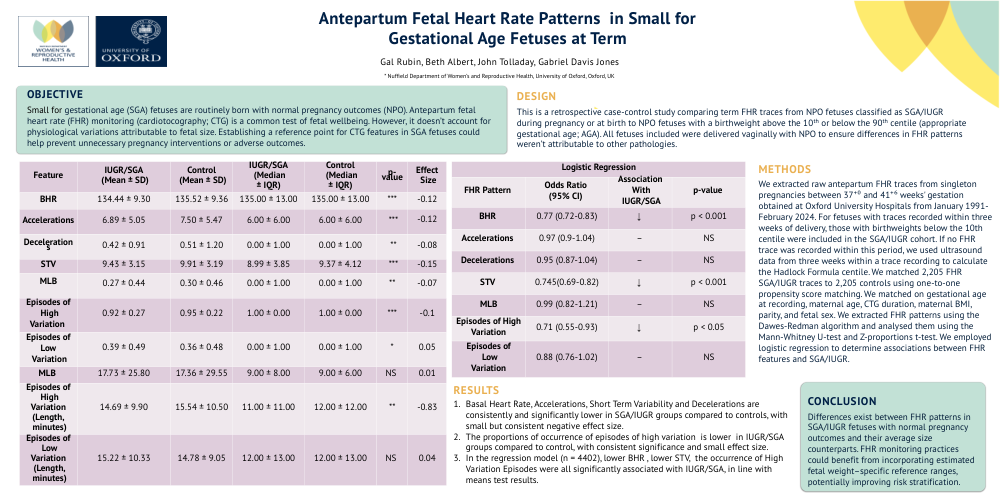
pregnancies between 37+0 and 41+6 weeks' gestation obtained at Oxford University Hospitals from January 1991- February 2024. For fetuses with traces recorded within three weeks of delivery, those with birthweights below the 10th centile were included in the SGA/IUGR cohort. If no FHR trace was recorded within this period, we used ultrasound data from three weeks within a trace recording to calculate the Hadlock Formula centile. We matched 2,205 FHR SGA/IUGR traces to 2,205 controls using one-to-one propensity score matching. We matched on gestational age at recording, maternal age, CTG duration, maternal BMI, parity, and fetal sex. We extracted FHR patterns using the Dawes-Redman algorithm and analysed them using the Mann-Whitney U-test and Z-proportions t-test. We employed logistic regression to determine associations between FHR features and SGA/IUGR.
RESULTS
1. Basal HeartRate,Accelerations,ShortTermVariabilityandDecelerationsare consistently and significantly lower in SGA/IUGR groups compared to controls, with small but consistent negative effect size.
2. The proportions of occurrence of episodes of high variation is lower in IUGR/SGA groups compared to control, with consistent significance and small effect size.
3. In the regression model (n = 4402), lower BHR , lower STV, the occurrence of High Variation Episodes were all significantly associated with IUGR/SGA, in line with means test results.
CONCLUSION
Differences exist between FHR patterns in SGA/IUGR fetuses with normal pregnancy outcomes and their average size counterparts. FHR monitoring practices could benefit from incorporating estimated fetal weight–specific reference ranges, potentially improving risk stratification.