2,281 posters, 63 videos, 56 audios, 43 topics, 18 sessions, 6,174 authors, 2,323 institutions
ePostersLive by SciGen Technologies S.A. All rights reserved.
RCOG World Congress 2025
June 23 - 25, 2025 | ExCeL London, UK
EP.0441
Reproductive Tract Infections before Conception and the Risk of Neonatal Death
Poster Presenter
Part of Topic
Fetal medicine
Reproductive Tract Infections before Conception Increase Neonatal Mortality: A Neglected Prevention Window
Wu Yuyan1; Yang Ying2; Wu Qianru1; Wang Long1; Ma Xu2
1. Institute for Epidemiology and Health Statistics, School of Public Health, Lanzhou University, Lanzhou, China.
2. National Institute for Family Planning, Beijing, China.
Background
Although the global active response to the call for reducing neonatal mortality as set forth in the Sustainable Development Goals, as of 2023, the global neonatal mortality rate has only dropped to 17 deaths per 1,000 live births. And the burden of neonatal deaths in low- and middle-income countries still looms large, with a significant gap remaining to meet the 2030 target of fewer than 12 deaths per 1,000 live births. Notably, some neonatal deaths are still attributed to pre-existing, but unidentified, maternal risk factors, such as reproductive tract infections (RTIs), which often become a blind spot for prevention and control due to delayed screening windows. While the impact of RTIs during pregnancy on adverse outcomes has been extensively studied, research directly linking pre-pregnancy or early-pregnancy RTIs to neonatal mortality is limited.
Method
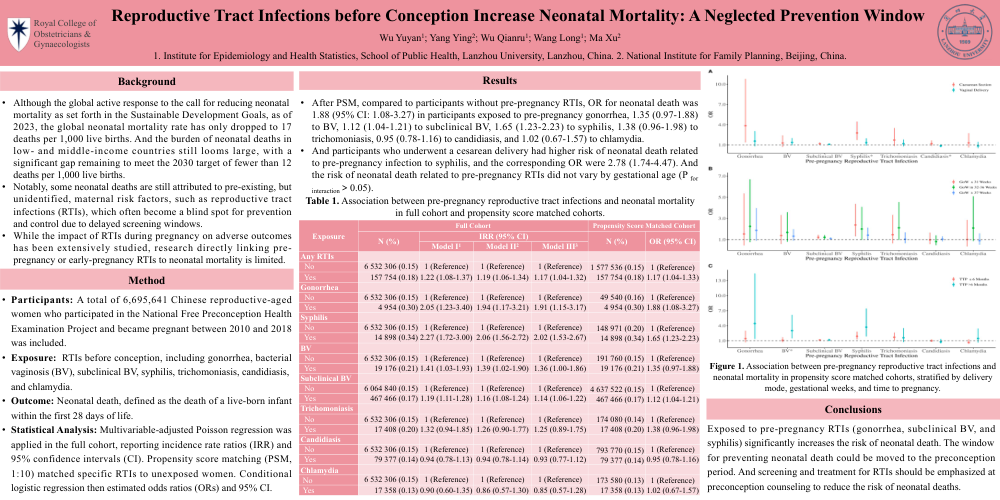
Participants: A total of 6,695,641 Chinese reproductive-aged women who participated in the National Free Preconception Health Examination Project and became pregnant between 2010 and 2018 was included. Exposure: RTIs before conception, including gonorrhea, bacterial vaginosis (BV), subclinical BV, syphilis, trichomoniasis, candidiasis, and chlamydia. Outcome: Neonatal death, defined as the death of a live-born infant within the first 28 days of life. Statistical Analysis: Multivariable-adjusted Poisson regression was applied in the full cohort, reporting incidence rate ratios (IRR) and 95% confidence intervals (CI). Propensity score matching (PSM, 1:10) matched specific RTIs to unexposed women. Conditional logistic regression then estimated odds ratios (ORs) and 95% CI.
Results
After PSM, compared to participants without pre-pregnancy RTIs, OR for neonatal death was 1.88 (95% CI: 1.08-3.27) in participants exposed to pre-pregnancy gonorrhea, 1.35 (0.97-1.88) to BV, 1.12 (1.04-1.21) to subclinical BV, 1.65 (1.23-2.23) to syphilis, 1.38 (0.96-1.98) to trichomoniasis, 0.95 (0.78-1.16) to candidiasis, and 1.02 (0.67-1.57) to chlamydia. And participants who underwent a cesarean delivery had higher risk of neonatal death related to pre-pregnancy infection to syphilis, and the corresponding OR were 2.78 (1.74-4.47). And the risk of neonatal death related to pre-pregnancy RTIs did not vary by gestational age (P for interaction>0.05).
Conclusions
Exposed to pre-pregnancy RTIs (gonorrhea, subclinical BV, and syphilis) significantly increases the risk of neonatal death. The window for preventing neonatal death could be moved to the preconception period. And screening and treatment for RTIs should be emphasized at preconception counseling to reduce the risk of neonatal deaths.