2,281 posters, 63 videos, 56 audios, 43 topics, 18 sessions, 6,174 authors, 2,323 institutions
ePostersLive by SciGen Technologies S.A. All rights reserved.
RCOG World Congress 2025
June 23 - 25, 2025 | ExCeL London, UK
PP.0022
Prediction of neonatal RDS by fetal pulmonary artery Doppler in term ELCS
Poster Presenter
Part of Topic
Fetal medicine
Introduction:
Despite advances in perinatal care, some neonates born by elective caesarean section at term still develop unexpected respiratory distress, often requiring oxygen therapy or SCBU admission. As current protocols rely heavily on gestational age alone, there is a clinical need for a non-invasive, objective method to assess fetal lung maturity and optimize delivery timing. Fetal pulmonary artery Doppler, particularly the acceleration time to ejection time ratio (AT/ET), offers a promising approach by reflecting pulmonary vascular resistance and functional lung readiness and maturity.
Study Objective:
To assess the utility of fetal pulmonary artery Doppler indices, particularly AT/ET ratio, as predictors of neonatal respiratory distress syndrome (RDS) in low-risk term pregnancies undergoing elective caesarean section from 37 weeks gestation onward.
Design:
Prospective observational study
Methods:
A total of 957 singleton low risk pregnancies scheduled for elective caesarean section at ≥37 weeks were enrolled. Within 24 hours prior to delivery, fetal pulmonary artery Doppler ultrasonography was performed to measure (AT), (ET), Peak Systolic Velocity (PSV), and calculate AT/ET ratio. Neonates were evaluated postnatally for RDS based on clinical signs, need for oxygen or CPAP support, and SCBU admission. Antenatal corticosteroids were selectively administered to women delivering before 39 weeks fulfilling the inclusion criteria. Statistical analysis included Mann-Whitney U test, Spearman correlation, logistic regression, and ROC curve analysis.
Conclusion:
The AT/ET ratio derived from fetal pulmonary artery Doppler is a reliable non-invasive predictor of neonatal RDS in term elective caesarean deliveries. Its strong association with neonatal respiratory outcomes and high diagnostic accuracy support its integration into routine antenatal assessment protocols, particularly when considering early-term delivery or selective steroid administration.
Results:
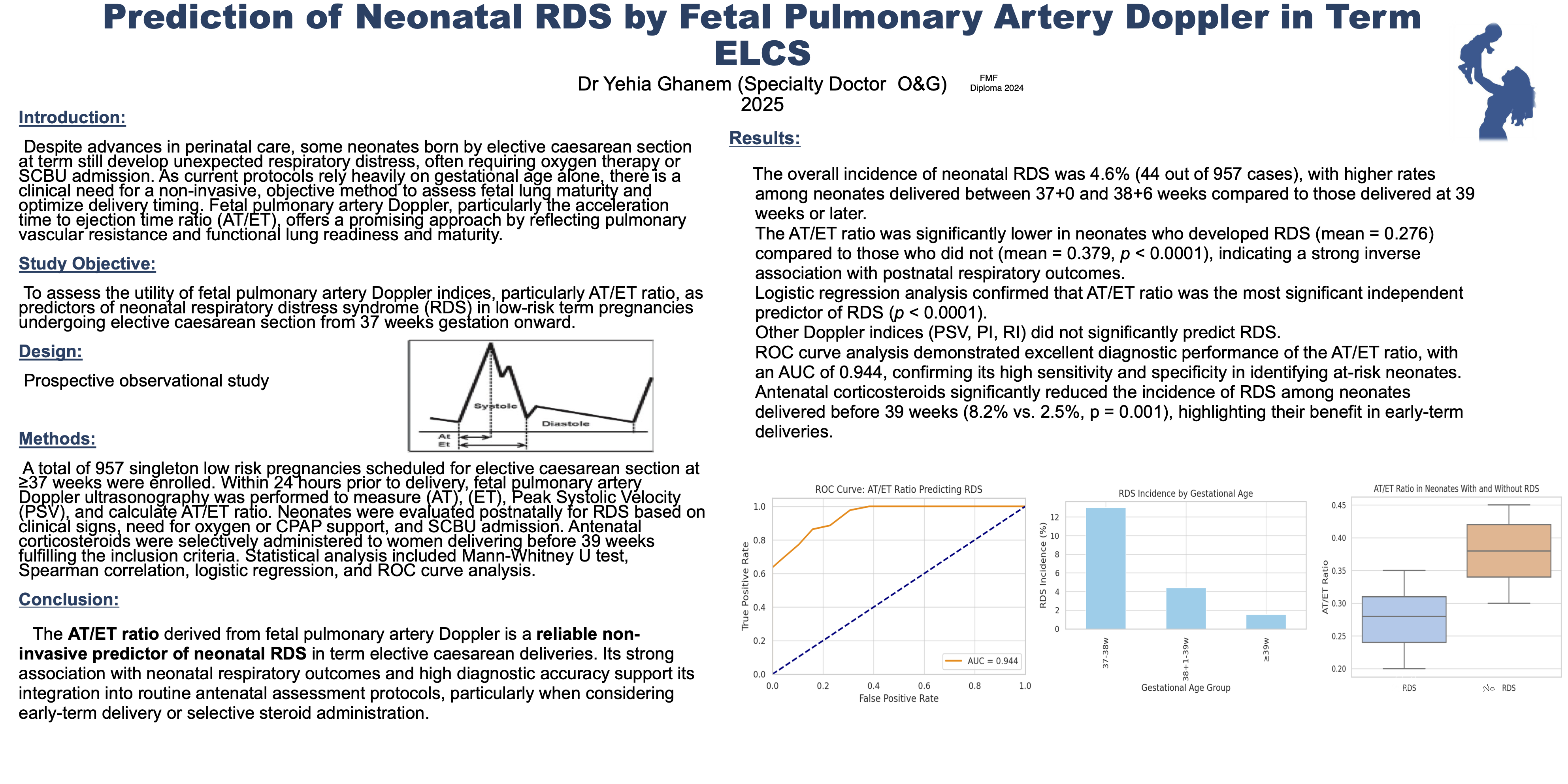
The overall incidence of neonatal RDS was 4.6% (44 out of 957 cases), with higher rates among neonates delivered between 37+0 and 38+6 weeks compared to those delivered at 39 weeks or later.
The AT/ET ratio was significantly lower in neonates who developed RDS (mean = 0.276) compared to those who did not (mean = 0.379, p < 0.0001), indicating a strong inverse association with postnatal respiratory outcomes.
Logistic regression analysis confirmed that AT/ET ratio was the most significant independent predictor of RDS (p < 0.0001).
Other Doppler indices (PSV, PI, RI) did not significantly predict RDS.
ROC curve analysis demonstrated excellent diagnostic performance of the AT/ET ratio, with an AUC of 0.944, confirming its high sensitivity and specificity in identifying at-risk neonates.
Antenatal corticosteroids significantly reduced the incidence of RDS among neonates delivered before 39 weeks (8.2% vs. 2.5%, p = 0.001), highlighting their benefit in early-term deliveries.