2,281 posters, 63 videos, 56 audios, 43 topics, 18 sessions, 6,174 authors, 2,323 institutions
ePostersLive by SciGen Technologies S.A. All rights reserved.
RCOG World Congress 2025
June 23 - 25, 2025 | ExCeL London, UK
EP.0434
The Effect of Doxorubicin and Cisplatin on the Developing Foetal Gonads in-vivo
Poster Presenter
Authors
Affiliations
Part of Topic
Fetal medicine
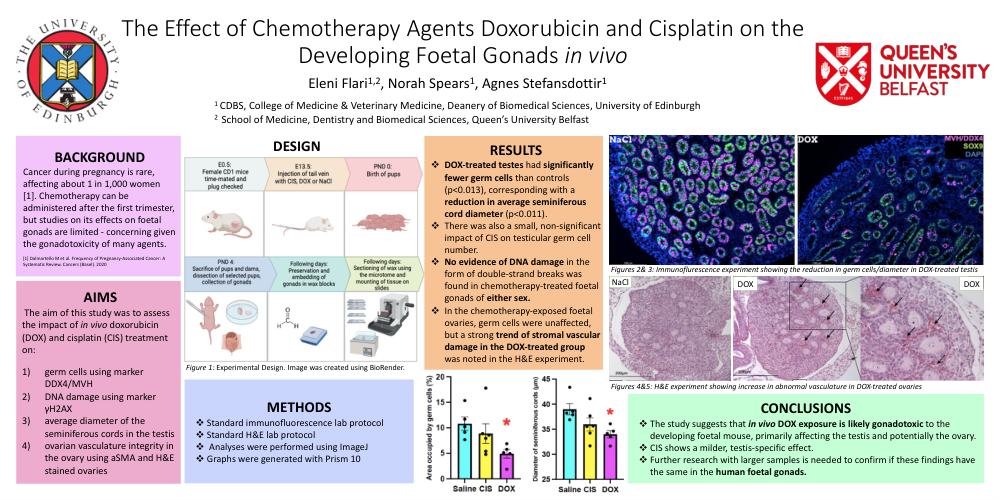
The Effect of Chemotherapy Agents Doxorubicin and Cisplatin on the Developing Foetal Gonads in vivo
BACKGROUND
Cancer during pregnancy is rare, affecting about 1 in 1,000 women. Chemotherapy can be administered after the first trimester, but studies on its effects on foetal gonads are limited - concerning given the gonadotoxicity of many agents.
AIMS
The aim of this study was to assess the impact of in vivo doxorubicin (DOX) and cisplatin (CIS) treatment on:
1) germ cells using marker DDX4/MVH
2) DNA damage using marker γH2AX
3) average diameter of the seminiferous cords in the testis
4) ovarian vasculature integrity in the ovary using aSMA and H&E stained ovaries
METHODS
Standard immunofluorescence lab protocol
Standard H&E lab protocol
Analyses were performed using ImageJ
Graphs were generated with Prism 10
RESULTS
DOX-treated testes had significantly fewer germ cells than controls (p<0.013), corresponding with a reduction in average seminiferous cord diameter (p<0.011).
There was also a small, non-significant impact of CIS on testicular germ cell number.
No evidence of DNA damage in the form of double-strand breaks was found in chemotherapy-treated foetal gonads of either sex. In the chemotherapy-exposed foetal ovaries, germ cells were unaffected, but a strong trend of stromal vascular damage in the DOX-treated group was noted in the H&E experiment.
CONCLUSIONS
The study suggests that in vivo DOX exposure is likely gonadotoxic to the developing foetal mouse, primarily affecting the testis and potentially the ovary.
CIS shows a milder, testis-specific effect. Further research with larger samples is needed to confirm if these findings have the same in the human foetal gonads.