2,281 posters, 63 videos, 56 audios, 43 topics, 18 sessions, 6,174 authors, 2,323 institutions
ePostersLive by SciGen Technologies S.A. All rights reserved.
RCOG World Congress 2025
June 23 - 25, 2025 | ExCeL London, UK
EP.0423
Antenatal Corticosteroid Use in Early-Onset Fetal Growth Restriction
Poster Presenter
Part of Topic
Fetal medicine
Antenatal Corticosteroid Use in Early-Onset Fetal Growth Restriction
Objective:
Early-onset fetal growth restriction (EOFGR) carries significant perinatal risks and there are considerable management challenges regarding delivery timing, balancing the risk of intrauterine demise versus prematurity. Antenatal corticosteroids (ACS) 24 hours to 7 days prior to delivery improves neonatal respiratory outcomes, and Irish and British national guidance recommend administration to women at risk of delivery prior to 35 weeks’ gestation.Our aim was to evaluate ACS use in severe EOFGR pregnancies of uteroplacental cause under 28 weeks’ gestation, to evaluate timing of administration and concordance with recently updated national guidance.
Methods:
A retrospective cohort study was carried out from July 2016 to June 2022 of cases diagnosed with EOFGR between 18-28 weeks’ gestation in a single Irish tertiary maternity hospital, as defined by Delphi consensus (i.e. estimated fetal weight or abdominal circumference <3rd centile, or estimated fetal weight or abdominal circumference <10th centile with abnormal umbilical artery doppler). Genetic, structural or infectious causes of FGR, multiple pregnancies and preterm prelabour rupture of membranes at time of diagnosis of FGR were excluded from analysis.
Results:
A total of 398 women with EOFGR were delivered during the study period, of which 202 (50.8%) were of uteroplacental aetiology. The mean gestational age at diagnosis was 24+3 weeks’ gestation (range 18+3 to 27+6 weeks’ gestation). 14.6% (29/202) of women had a history of FGR. Pre-eclampsia was present in 17.3% (35/202) and 37 women were cigarette smokers (18.3%).
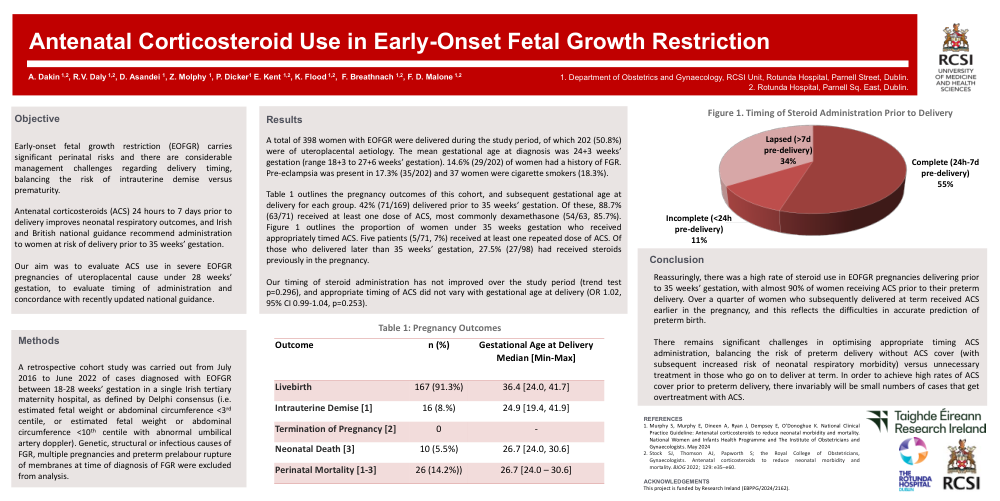
Table 1 outlines the pregnancy outcomes of this cohort, and subsequent gestational age at delivery for each group. 42% (71/169) delivered prior to 35 weeks’ gestation. Of these, 88.7% (63/71) received at least one dose of ACS, most commonly dexamethasone (54/63, 85.7%). Figure 1 outlines the proportion of women under 35 weeks gestation who received appropriately timed ACS. Five patients (5/71, 7%) received at least one repeated dose of ACS. Of those who delivered later than 35 weeks’ gestation, 27.5% (27/98) had received steroids previously in the pregnancy.
Our timing of steroid administration has not improved over the study period (trend test p=0.296), and appropriate timing of ACS did not vary with gestational age at delivery (OR 1.02, 95% CI 0.99-1.04, p=0.253).
Conclusion:
Reassuringly, there was a high rate of steroid use in EOFGR pregnancies delivering prior to 35 weeks’ gestation, with almost 90% of women receiving ACS prior to their preterm delivery. Over a quarter of women who subsequently delivered at term received ACS earlier in the pregnancy, and this reflects the difficulties in accurate prediction of preterm birth.
There remains significant challenges in optimising appropriate timing ACS administration, balancing the risk of preterm delivery without ACS cover (with subsequent increased risk of neonatal respiratory morbidity) versus unnecessary treatment in those who go on to deliver at term. In order to achieve high rates of ACS cover prior to preterm delivery, there invariably will be small numbers of cases that get overtreatment with ACS.