2,281 posters, 63 videos, 56 audios, 43 topics, 18 sessions, 6,174 authors, 2,323 institutions
ePostersLive by SciGen Technologies S.A. All rights reserved.
RCOG World Congress 2025
June 23 - 25, 2025 | ExCeL London, UK
EP.0418
Amniocentesis: Current Trends and Outcomes in a Middle-Income Setting
Part of Topic
Fetal medicine
Amniocentesis: Current Trends and Outcomes in a Middle-Income Setting
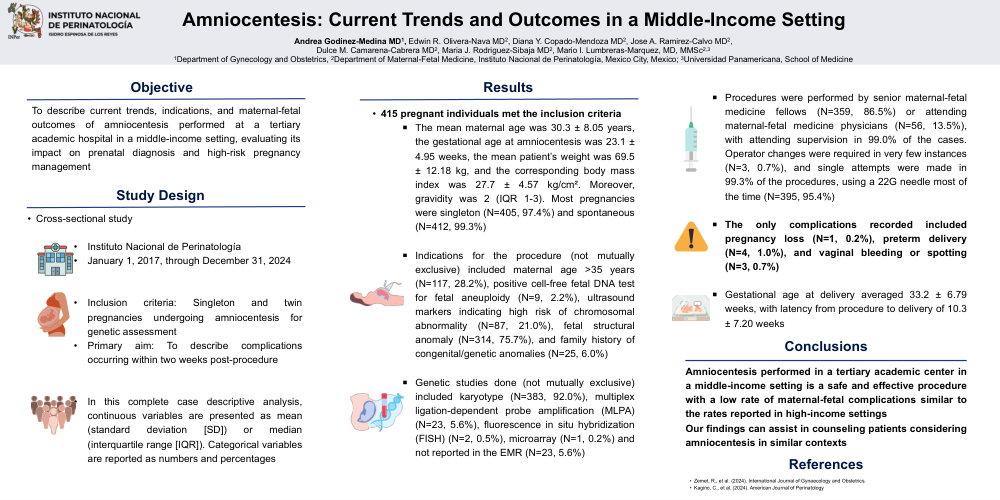
Objectives. To describe current trends, indications, and maternal-fetal outcomes of amniocentesis performed at a tertiary hospital in a middle-income setting, evaluating its impact on prenatal diagnosis and high-risk pregnancy management.
Study Design. Cross-sectional study conducted at the Instituto Nacional de Perinatologia in Mexico City.
Methods. Data from January 1, 2017, through December 31, 2024, were collected from the electronic medical record (EMR) and stored in REDCap. Singleton and twin pregnancies undergoing amniocentesis for genetic assessment were included for analysis. Complications occurring within two weeks post-procedure were documented. In this complete case descriptive analysis, continuous variables are presented as mean (standard deviation [SD]) or median (interquartile range [IQR]). Categorical variables are reported as numbers and percentages.
Results. 415 pregnant individuals met the inclusion criteria. The mean maternal age was 30.3 ± 8.05 years, the gestational age at amniocentesis was 23.1 ± 4.95 weeks, the mean patients’ weight was 69.5 ± 12.18 kg, and the corresponding body mass index was 27.7 ± 4.57 kg/cm². Moreover, gravidity was 2 (IQR 1-3). Most pregnancies were singleton (N=405, 97.4%) and spontaneous (N=412, 99.3%). Indications for the procedure (not mutually exclusive) included maternal age >35 years (N=117, 28.2%), positive cell-free fetal DNA test for fetal aneuploidy (N=9, 2.2%), ultrasound markers indicating high risk of chromosomal abnormality (N=87, 21.0%), fetal structural anomaly (N=314, 75.7%), and family history of congenital/genetic anomalies (N=25, 6.0%). Genetic studies done (not mutually exclusive) included karyotype (N=383, 92.0%), multiplex ligation-dependent probe amplification (MLPA) (N=23, 5.6%), fluorescence in situ hybridization (FISH) (N=2, 0.5%), microarray (N=1, 0.2%), and not reported in the EMR (N=23, 5.6%). Procedures were performed by senior maternal-fetal medicine fellows (N=359, 86.5%) or attending maternal-fetal medicine physicians (N=56, 13.5%), with attending supervision in 99.0% of the cases. Operator changes were required in very few instances (N=3, 0.7%), and single attempts were made in 99.3% of the procedures, using a 22G needle most of the time (N=395, 95.4%). The only complications recorded included pregnancy loss (N=1, 0.2%), preterm delivery (N=4, 1.0%), and vaginal bleeding or spotting (N=3, 0.7%). Gestational age at delivery averaged 33.2 ± 6.79 weeks, with latency from procedure to delivery of 10.3 ± 7.20 weeks.
Conclusions. Amniocentesis performed in a tertiary academic center in a middle-income setting is a safe and effective procedure with a low rate of maternal-fetal complications similar to the rates reported in high-income countries. Our findings can assist in counseling patients considering amniocentesis in similar contexts.