2,281 posters, 63 videos, 56 audios, 43 topics, 18 sessions, 6,174 authors, 2,323 institutions
ePostersLive by SciGen Technologies S.A. All rights reserved.
RCOG World Congress 2025
June 23 - 25, 2025 | ExCeL London, UK
EP.0415
An illustrative analysis of BEGOTTEN Study: Fetal growth patterns and pregnancy outcomes
Poster Presenter
Authors
Nawami Jasm, Shalayna Sakaria, Emma Bateman, Katie Newman, Manlo Kwok
Affiliations
Part of Topic
Fetal medicine
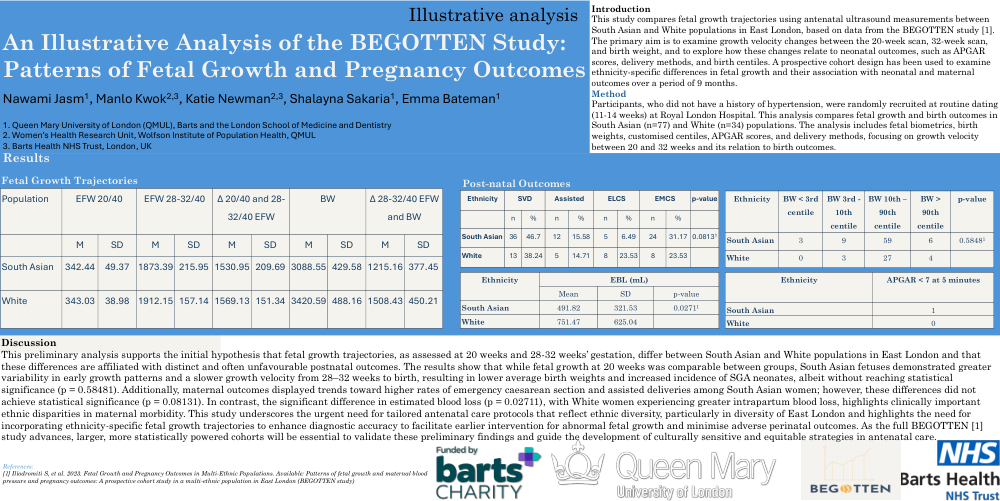
An Illustrative Analysis of the BEGOTTEN Study:
Patterns of Fetal Growth and Pregnancy Outcomes
Introduction
This study compares fetal growth trajectories using antenatal ultrasound measurements between
South Asian and White populations in East London, based on data from the BEGOTTEN study [1].
The primary aim is to examine growth velocity changes between the 20-week scan, 32-week scan,
and birth weight, and to explore how these changes relate to neonatal outcomes, such as APGAR
scores, delivery methods, and birth centiles. A prospective cohort design has been used to examine
ethnicity-specific differences in fetal growth and their association with neonatal and maternal
outcomes over a period of 9 months.
Method
Participants, who did not have a history of hypertension, were randomly recruited at routine dating
(11-14 weeks) at Royal London Hospital. This analysis compares fetal growth and birth outcomes in
South Asian (n=77) and White (n=34) populations. The analysis includes fetal biometrics, birth
weights, customised centiles, APGAR scores, and delivery methods, focusing on growth velocity
between 20 and 32 weeks and its relation to birth outcomes.
Discussion
This preliminary analysis supports the initial hypothesis that fetal growth trajectories, as assessed at 20 weeks and 28-32 weeks’ gestation, differ between South Asian and White populations in East London and that
these differences are affiliated with distinct and often unfavourable postnatal outcomes. The results show that while fetal growth at 20 weeks was comparable between groups, South Asian fetuses demonstrated greater
variability in early growth patterns and a slower growth velocity from 28–32 weeks to birth, resulting in lower average birth weights and increased incidence of SGA neonates, albeit without reaching statistical
significance (p = 0.58481). Additionally, maternal outcomes displayed trends toward higher rates of emergency caesarean section and assisted deliveries among South Asian women; however, these differences did not
achieve statistical significance (p = 0.08131). In contrast, the significant difference in estimated blood loss (p = 0.02711), with White women experiencing greater intrapartum blood loss, highlights clinically important
ethnic disparities in maternal morbidity. This study underscores the urgent need for tailored antenatal care protocols that reflect ethnic diversity, particularly in diversity of East London and highlights the need for
incorporating ethnicity-specific fetal growth trajectories to enhance diagnostic accuracy to facilitate earlier intervention for abnormal fetal growth and minimise adverse perinatal outcomes. As the full BEGOTTEN [1]
study advances, larger, more statistically powered cohorts will be essential to validate these preliminary findings and guide the development of culturally sensitive and equitable strategies in antenatal care.