2,281 posters, 63 videos, 56 audios, 43 topics, 18 sessions, 6,174 authors, 2,323 institutions
ePostersLive by SciGen Technologies S.A. All rights reserved.
RCOG World Congress 2025
June 23 - 25, 2025 | ExCeL London, UK
EP.0414
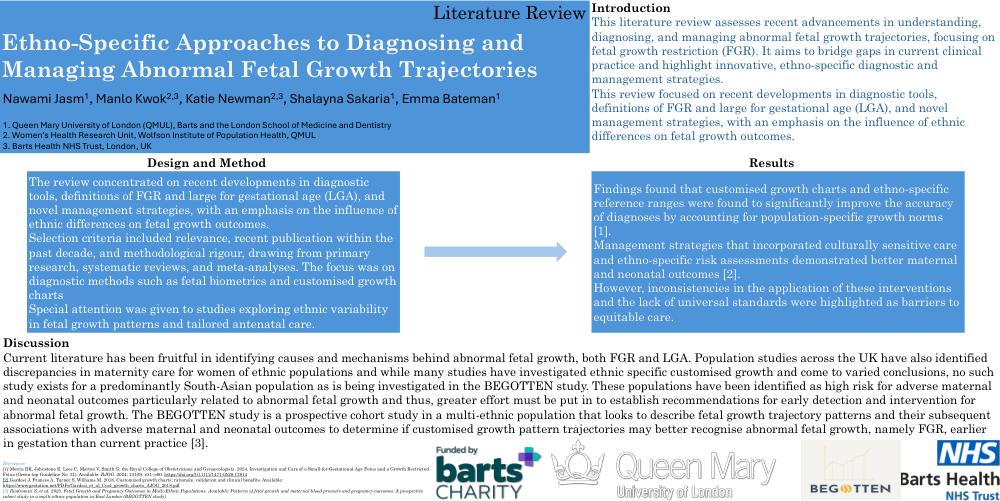
Literature review: Ethno-Specific Approaches to Diagnosing and Managing Abnormal Fetal Growth Trajectories
Poster Presenter
Authors
Nawami Jasm, Emma Bateman, Shalayna Sakaria, Manlo Kwok, Katie Newman
Affiliations
Part of Topic
Fetal medicine
Ethno-Specific Approaches to Diagnosing and Managing Abnormal Fetal Growth Trajectories
Introduction
This literature review assesses recent advancements in understanding, diagnosing, and managing abnormal fetal growth trajectories, focusing on fetal growth restriction (FGR). It aims to bridge gaps in current clinical practice and highlight innovative, ethno-specific diagnostic and management strategies.
This review focused on recent developments in diagnostic tools, definitions of FGR and large for gestational age (LGA), and novel management strategies, with an emphasis on the influence of ethnic differences on fetal growth outcomes.
Design and Method
The review concentrated on recent developments in diagnostic tools, definitions of FGR and large for gestational age (LGA), and novel management strategies, with an emphasis on the influence of ethnic differences on fetal growth outcomes.
Selection criteria included relevance, recent publication within the past decade, and methodological rigour, drawing from primary research, systematic reviews, and meta-analyses. The focus was on diagnostic methods such as fetal biometrics and customised growth charts
Special attention was given to studies exploring ethnic variability in fetal growth patterns and tailored antenatal care.
Results
Findings found that customised growth charts and ethno-specific reference ranges were found to significantly improve the accuracy of diagnoses by accounting for population-specific growth norms [1].
Management strategies that incorporated culturally sensitive care and ethno-specific risk assessments demonstrated better maternal and neonatal outcomes [2].
However, inconsistencies in the application of these interventions and the lack of universal standards were highlighted as barriers to equitable care.
Discussion
Current literature has been fruitful in identifying causes and mechanisms behind abnormal fetal growth, both FGR and LGA. Population studies across the UK have also identified discrepancies in maternity care for women of ethnic populations and while many studies have investigated ethnic specific customised growth and come to varied conclusions, no such study exists for a predominantly South-Asian population as is being investigated in the BEGOTTEN study. These populations have been identified as high risk for adverse maternal and neonatal outcomes particularly related to abnormal fetal growth and thus, greater effort must be put in to establish recommendations for early detection and intervention for abnormal fetal growth. The BEGOTTEN study is a prospective cohort study in a multi-ethnic population that looks to describe fetal growth trajectory patterns and their subsequent associations with adverse maternal and neonatal outcomes to determine if customised growth pattern trajectories may better recognise abnormal fetal growth, namely FGR, earlier in gestation than current practice [3].