2,281 posters, 63 videos, 56 audios, 43 topics, 18 sessions, 6,174 authors, 2,323 institutions
ePostersLive by SciGen Technologies S.A. All rights reserved.
RCOG World Congress 2025
June 23 - 25, 2025 | ExCeL London, UK
EP.0411
Trends in prevalence of Down’s syndrome in Scotland (2000-2021): a population-based study
Poster Presenter
Authors
Affiliations
Part of Topic
Fetal medicine
Trends in prevalence of Down’s syndrome in Scotland (2000-2021): a population-based study
Introduction
Down’s syndrome (DS) is the most common chromosomal condition diagnosed during pregnancy, with a total birth prevalence of 18·4 per 10,000 total births in Scotland.1
Screening for DS in pregnancy has been nationally coordinated in Scotland since 2001.2 There have been many changes to the screening pathway, most recently with the introduction of non-invasive prenatal testing (NIPT) as a secondary screening test in September 2020.3 NIPT is offered as an additional, and more accurate, screening test to women with a pregnancy identified as higher chance for DS by first line screening. To assess the impact of implementing NIPT on screening decisions and pregnancy outcomes, it is important to first understand the baseline trends in total birth and live birth prevalence of DS.
To date, comprehensive and comparable analysis of trends in prevalence of DS and associations with specific socio-demographic factors are unavailable in Scotland.
We aimed to understand the long-term trends in total and live birth prevalence of DS in Scotland (2000-2021) and explore associations between DS prevalence and socio-demographic factors.
Methods
A retrospective observational population-based study of total and live birth prevalence of Down’s syndrome in Scotland.
Prevalence rate ratios (PRR), 95% confidence intervals (CI) and p-values reported. All analyses conducted in R (v4.2.1).
Results
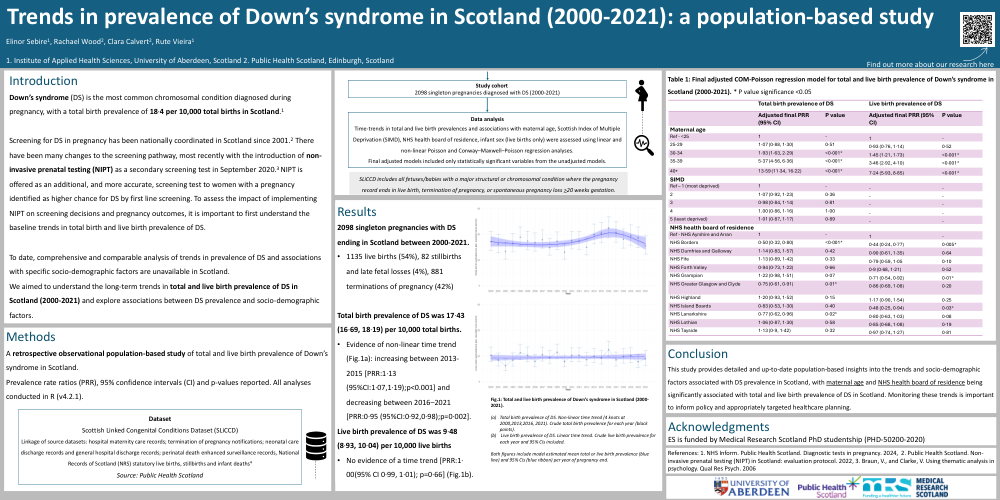
2098 singleton pregnancies with DS ending in Scotland between 2000-2021.
Total birth prevalence of DS was 17·43 (16·69, 18·19) per 10,000 total births. Evidence of non-linear time trend (Fig.1a): increasing between 2013-2015 [PRR:1·13 (95%CI:1·07,1·19);p<0.001] and decreasing between 2016–2021 [PRR:0·95 (95%CI:0·92,0·98);p=0·002].
Live birth prevalence of DS was 9·48 (8·93, 10·04) per 10,000 live births. No evidence of a time trend [PRR:1· 00(95% CI 0·99, 1·01); p=0·66] (Fig.1b).