2,281 posters, 63 videos, 56 audios, 43 topics, 18 sessions, 6,174 authors, 2,323 institutions
ePostersLive by SciGen Technologies S.A. All rights reserved.
RCOG World Congress 2025
June 23 - 25, 2025 | ExCeL London, UK
PP.0021
Pregnancy outcome after severe early-onset fetal growth restriction: EVERREST cohort
Poster Presenter
Authors
Jenny Stokes, Katarzyna Maksym, Rebecca Spencer, Anke Diemert, Kurt Hecher, Jana Brodszki, Stefan R Hansson, Claudia Galan-Rullo, Fatima Crispi, Francesc Figueras, Anna L David
Affiliations
Women’s Health Division, University College London Hospital NHS Foundation Trust, University of Leeds, Department of Obstetrics and Fetal Medicine, University Medical Center Hamburg-Eppendorf, Department of Obstetrics and Gynaecology, Lund University, Barcelona Center for Maternal-Fetal and Neonatal Medicine (Hospital Clínic and Hospital Sant Joan de Deu), IDIBAPS, University of Barcelona
Part of Topic
Fetal medicine
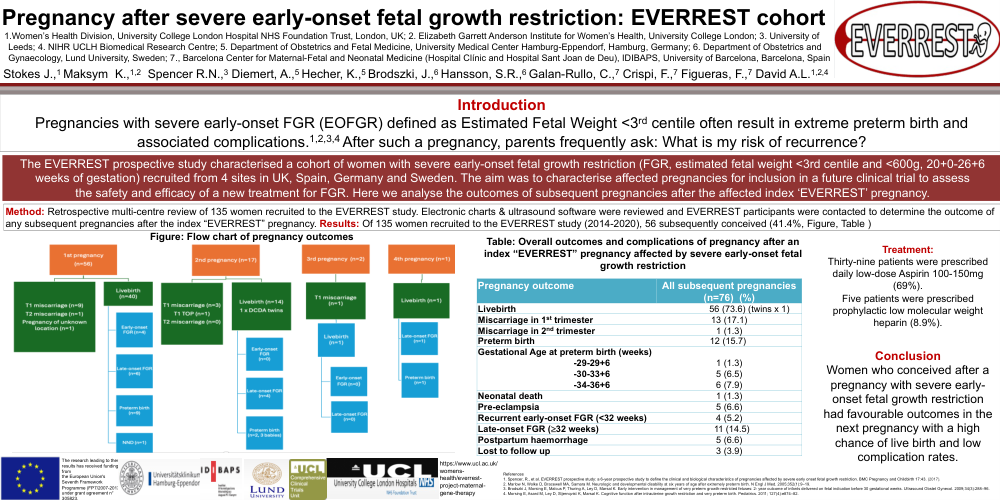
Pregnancy after severe early-onset fetal growth restriction: EVERREST cohort
Introduction
Pregnancies with severe early-onset FGR (EOFGR) defined as Estimated Fetal Weight <3rd centile often result in extreme preterm birth and associated complications.1,2,3,4 After such a pregnancy, parents frequently ask: What is my risk of recurrence?
The EVERREST prospective study characterised a cohort of women with severe early-onset fetal growth restriction (FGR, estimated fetal weight <3rd centile and <600g, 20+0-26+6 weeks of gestation) recruited from 4 sites in UK, Spain, Germany and Sweden. The aim was to characterise affected pregnancies for inclusion in a future clinical trial to assess
the safety and efficacy of a new treatment for FGR. Here we analyse the outcomes of subsequent pregnancies after the affected index ‘EVERREST’ pregnancy.
Method: Retrospective multi-centre review of 135 women recruited to the EVERREST study. Electronic charts & ultrasound software were reviewed and EVERREST participants were contacted to determine the outcome of any subsequent pregnancies after the index “EVERREST” pregnancy. Results: Of 135 women recruited to the EVERREST study (2014-2020), 56 subsequently conceived
Treatment:
Thirty-nine patients were prescribed daily low-dose Aspirin 100-150mg (69%).
Five patients were prescribed prophylactic low molecular weight heparin (8.9%).
Conclusion
Women who conceived after a pregnancy with severe early-onset fetal growth restriction had favourable outcomes in the next pregnancy with a high chance of live birth and low complication rates.