2,281 posters, 63 videos, 56 audios, 43 topics, 18 sessions, 6,174 authors, 2,323 institutions
ePostersLive by SciGen Technologies S.A. All rights reserved.
RCOG World Congress 2025
June 23 - 25, 2025 | ExCeL London, UK
PP.0112
Retroperitoneal Bleeding: a Rare Complication of Vaginal Hysterectomy
Poster Presenter
Authors
Affiliations
Part of Topic
Urogynaecology/pelvic floor
Retroperitoneal Bleeding: a Rare Complication of Vaginal Hysterectomy
K. Fairbrother, N. Chikhes
Objective
Vaginal hysterectomy is a commonly performed procedure for the management of uterovaginal prolapse. Haemorrhage occurs in 2% of women undergoing vaginal surgery for prolapse, but there are very few documented cases of retroperitoneal haematoma as a complication. Morbidity and mortality are high, and patients may not manifest clinically until significant blood loss has occurred. Early recognition and intervention are crucial to improving outcomes.
Case report
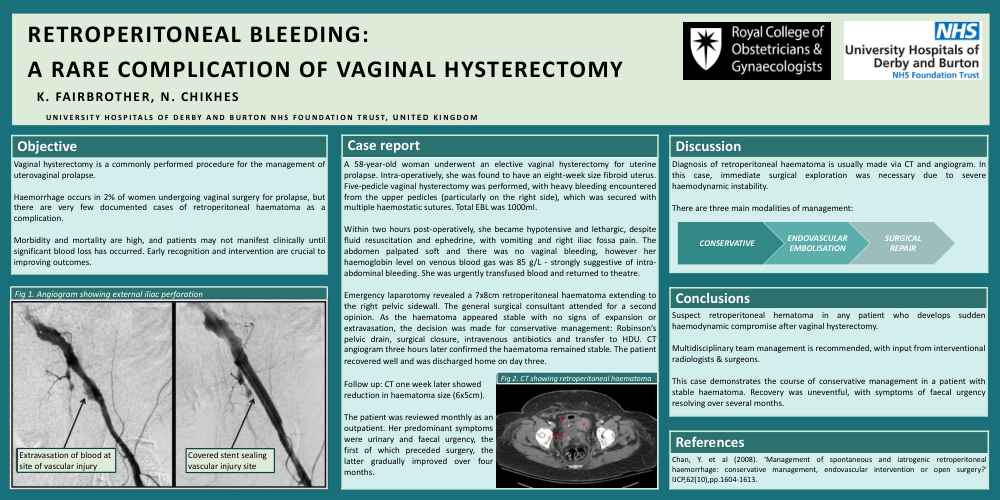
A 58-year-old woman underwent an elective vaginal hysterectomy for uterine prolapse. Intra-operatively, she was found to have an eight-week size fibroid uterus. Five-pedicle vaginal hysterectomy was performed, with heavy bleeding encountered from the upper pedicles (particularly on the right side), which was secured with multiple haemostatic sutures. Total EBL was 1000ml. Within two hours post-operatively, she became hypotensive and lethargic, despite fluid resuscitation and ephedrine, with vomiting and right iliac fossa pain. The abdomen palpated soft and there was no vaginal bleeding, however her haemoglobin level on venous blood gas was 85 g/L - strongly suggestive of intraabdominal bleeding. She was urgently transfused blood and returned to theatre. Emergency laparotomy revealed a 7x8cm retroperitoneal haematoma extending to the right pelvic sidewall. The general surgical consultant attended for a second opinion. As the haematoma appeared stable with no signs of expansion or extravasation, the decision was made for conservative management: Robinson’s pelvic drain, surgical closure, intravenous antibiotics and transfer to HDU. CT angiogram three hours later confirmed the haematoma remained stable. The patient recovered well and was discharged home on day three.
Follow up: CT one week later showed reduction in haematoma size (6x5cm). The patient was reviewed monthly as an outpatient. Her predominant symptoms were urinary and faecal urgency, the first of which preceded surgery, the latter gradually improved over four months.
Discussion
Diagnosis of retroperitoneal haematoma is usually made via CT and angiogram. In this case, immediate surgical exploration was necessary due to severe haemodynamic instability. There are three main modalities of management:
Conservative
Endovascular embolisation
Surgical repair
Conclusions
Suspect retroperitoneal hematoma in any patient who develops sudden haemodynamic compromise after vaginal hysterectomy. Multidisciplinary team management is recommended, with input from interventional radiologists & surgeons. This case demonstrates the course of conservative management in a patient with stable haematoma. Recovery was uneventful, with symptoms of faecal urgency resolving over several months.
References
Chan, Y. et al (2008). ‘Management of spontaneous and iatrogenic retroperitoneal haemorrhage: conservative management, endovascular intervention or open surgery?' IJCP,62(10),pp.1604-1613.