2,281 posters, 63 videos, 56 audios, 43 topics, 18 sessions, 6,174 authors, 2,323 institutions
ePostersLive by SciGen Technologies S.A. All rights reserved.
RCOG World Congress 2025
June 23 - 25, 2025 | ExCeL London, UK
EP.2156
Recurrence of Uterovaginal Prolapse After Pelvic Floor Surgery.
Poster Presenter
Part of Topic
Urogynaecology/pelvic floor
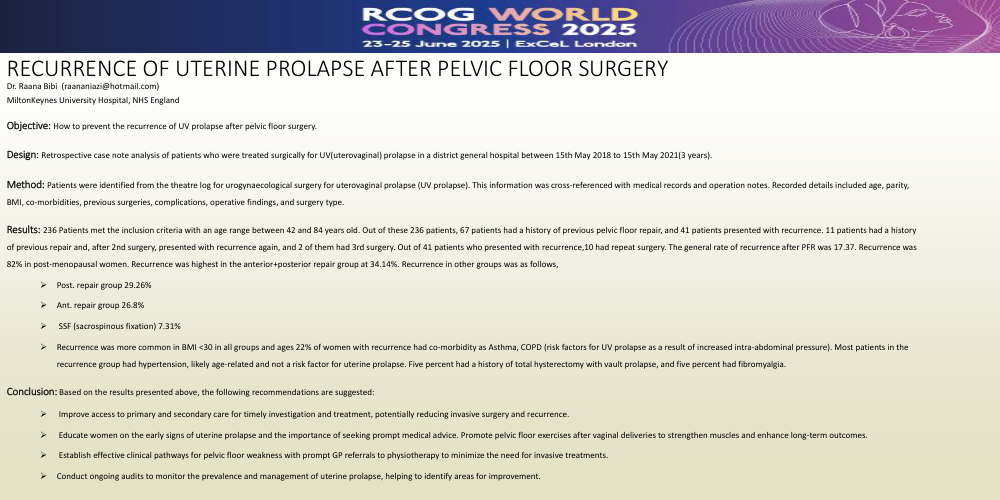
Objective: How to prevent the recurrence of UV prolapse after pelvic floor surgery.
Design: Retrospective case note analysis of patients who were treated surgically for UV(uterovaginal) prolapse in a district general hospital between 15th May 2018 to 15th May 2021(3 years).
Method: Patients were identified from the theatre log for urogynaecological surgery for uterovaginal prolapse (UV prolapse). This information was cross-referenced with medical records and operation notes. Recorded details included age, parity, BMI, co-morbidities, previous surgeries, complications, operative findings, and surgery type.
Results: 236 Patients met the inclusion criteria with an age range between 42 and 84 years old. Out of these 236 patients, 67 patients had a history of previous pelvic floor repair, and 41 patients presented with recurrence. 11 patients had a history of previous repair and, after 2nd surgery, presented with recurrence again, and 2 of them had 3rd surgery. Out of 41 patients who presented with recurrence,10 had repeat surgery. The general rate of recurrence after PFR was 17.37. Recurrence was 82% in post-menopausal women. Recurrence was highest in the anterior+posterior repair group at 34.14%. Recurrence in other groups was as follows,
Conclusion: Based on the results presented above, the following recommendations are suggested: