2,281 posters, 63 videos, 56 audios, 43 topics, 18 sessions, 6,174 authors, 2,323 institutions
ePostersLive by SciGen Technologies S.A. All rights reserved.
RCOG World Congress 2025
June 23 - 25, 2025 | ExCeL London, UK
EP.2159
Practice of Colpocliasis in Gondar University Hospital: Retrospective study, Gondar, Ethiopia
Poster Presenter
Authors
Affiliations
Part of Topic
Urogynaecology/pelvic floor
Practice of Colpocleisis in Gondar University Hospital: Retrospective study, Gondar, Ethiopia
Birhanu Abera Ayana
Affiliations
Department of Gynecology & Obstetrics, Clinical Division, University of Global Health Equity
Abstract
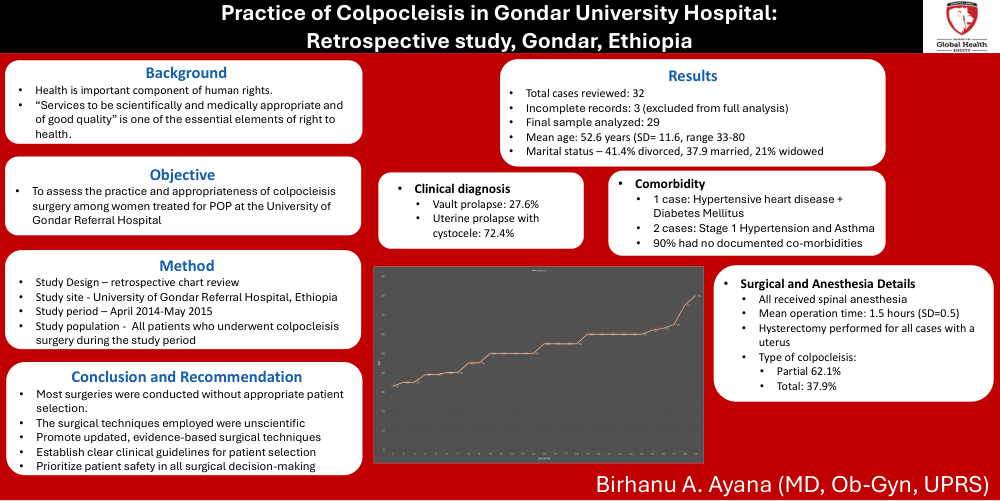
Background: Health is an important component of human rights. “Services to be scientifically and medically appropriate and of good quality” is one of the essential elements of the right to health. Pelvic organ prolapse is a health concern affecting millions of women worldwide. Prevalence of up to 55% has been reported in some countries. This study tries to review cases treated with the colpocliasis technique in one of the teaching referral hospitals in Ethiopia over 1 1-year period (April 2014-May 2015).
Methods: A retrospective chart review was conducted in the University of Gondar referral hospital on patients who had undergone colpocleisis surgery over a one-year period (April 2014-May 2015). Socio-demographic and clinical data were extracted from the patient card with a standard data extraction format. Descriptive statistics (mean and standard deviation, and frequency) were employed to summarize the patient characteristics and the practice of colpocleisis.
Results: Three out of the 32 cases managed with colpocliasis had incomplete records and were not analyzed for the whole variables. The mean age of cases was found to be 52.62 (SD= 11.6) (33-80). With regard to marital status, 41.4 % were divorced, 37.9% were married, and 21% were widowed. Of the 29 cases, one case was diagnosed with hypertensive heart disease and diabetes mellitus, and the other two with stage 1 hypertension and Asthma, respectively; the remaining 90% of cases have no documented co-morbidity. About a quarter of the cases (27.6%) were diagnosed with vault prolapse, while the remaining 72.4% were diagnosed with uterine prolapse and cystocele. All patients received spinal anesthesia, and the mean operation time was 1.50 hrs (SD 0.50 hr). Hysterectomy was done for all cases with uterus, and 62.1 % of the cases had partial colpocleisis, as 37.9% had a total colpocleisis. The mean total hospital stay was 18.5 days (SD 13.27). The mean hospital stay after operation was 5.6 days (SD 5.1). The mean HCT levels Pre-operation and post-operation were 42% (SD=4) and 32.9% (SD=6).
Conclusion: The surgeries were done without appropriate patient selection. Except for one case, which has hypertensive heart disease and DM, the others have none of the indications for colpocleisis. In addition to the inappropriate patient selection, the technique employed was also unscientific. The patients don’t get any of the benefits of colpocleisis.
Recommendation: It should be the responsibility of the ministry, the academic institutions, and individual obstetricians and gynecologists to expand new updated techniques and to ensure patients’ safety.
Keywords: Pelvic Organ Prolapse, colpocliasis, Ethiopia