2,281 posters, 63 videos, 56 audios, 43 topics, 18 sessions, 6,174 authors, 2,323 institutions
ePostersLive by SciGen Technologies S.A. All rights reserved.
RCOG World Congress 2025
June 23 - 25, 2025 | ExCeL London, UK
PP.0048
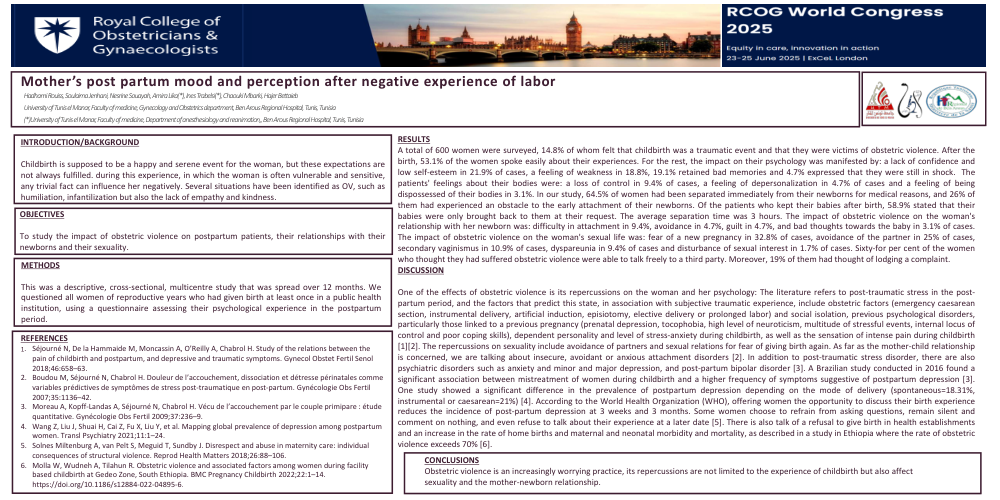
Mother’s post partum mood and perception after negative experience of labor
Poster Presenter
Part of Topic
Labour ward management
Mother’s post partum mood and perception after negative experience of labor
Hadhami Rouiss, Soulaima Jenhani, Nesrine Souayah, Amira Lika(*), Ines Trabelsi(*), Chaouki Mbarki, Hajer Bettaieb
University of Tunis el Manar, Faculty of medicine, Gynecology and Obstetrics department, Ben Arous Regional Hospital, Tunis, Tunisia
(*)University of Tunis el Manar, Faculty of medicine, Department of anesthesiology and reanimation,, Ben Arous Regional Hospital, Tunis, Tunisia
Introduction
Childbirth is supposed to be a happy and serene event for the woman, but these expectations are not always fulfilled. during this experience, in which the woman is often vulnerable and sensitive, any trivial fact can influence her negatively. Several situations have been identified as OV, such as humiliation, infantilization but also the lack of empathy and kindness.
Objective: To study the impact of obstetric violence on postpartum patients, their relationships with their newborns and their sexuality.
Design: This was a descriptive, cross-sectional, multicentre study.
Method: Our study was spread over 12 months. We questioned all women of reproductive years who had given birth at least once in a public health institution, using a questionnaire assessing their psychological experience in the postpartum period.
Results: A total of 600 women were surveyed, 14.8% of whom felt that childbirth was a traumatic event and that they were victims of obstetric violence. After the birth, 53.1% of the women spoke easily about their experiences. For the rest, the impact on their psychology was manifested by: a lack of confidence and low self-esteem in 21.9% of cases, a feeling of weakness in 18.8%, 19.1% retained bad memories and 4.7% expressed that they were still in shock. The patients' feelings about their bodies were: a loss of control in 9.4% of cases, a feeling of depersonalization in 4.7% of cases and a feeling of being dispossessed of their bodies in 3.1%. In our study, 64.5% of women had been separated immediately from their newborns for medical reasons, and 26% of them had experienced an obstacle to the early attachment of their newborns. Of the patients who kept their babies after birth, 58.9% stated that their babies were only brought back to them at their request. The average separation time was 3 hours. The impact of obstetric violence on the woman's relationship with her newborn was: difficulty in attachment in 9.4%, avoidance in 4.7%, guilt in 4.7%, and bad thoughts towards the baby in 3.1% of cases. The impact of obstetric violence on the woman's sexual life was: fear of a new pregnancy in 32.8% of cases, avoidance of the partner in 25% of cases, secondary vaginismus in 10.9% of cases, dyspareunia in 9.4% of cases and disturbance of sexual interest in 1.7% of cases. Sixty-for per cent of the women who thought they had suffered obstetric violence were able to talk freely to a third party. Moreover, 19% of them had thought of lodging a complaint.
Discussion :
One of the effects of obstetric violence is its repercussions on the woman and her psychology: The literature refers to post-traumatic stress in the post-partum period, and the factors that predict this state, in association with subjective traumatic experience, include obstetric factors (emergency caesarean section, instrumental delivery, artificial induction, episiotomy, elective delivery or prolonged labour) and social isolation, previous psychological disorders, particularly those linked to a previous pregnancy (prenatal depression, tocophobia, high level of neuroticism, multitude of stressful events, internal locus of control and poor coping skills), dependent personality and level of stress-anxiety during childbirth, as well as the sensation of intense pain during childbirth [1][2]. The repercussions on sexuality include avoidance of partners and sexual relations for fear of giving birth again. As far as the mother-child relationship is concerned, we are talking about insecure, avoidant or anxious attachment disorders [2]. In addition to post-traumatic stress disorder, there are also psychiatric disorders such as anxiety and minor and major depression, and post-partum bipolar disorder [3]. A Brazilian study conducted in 2016 found a significant association between mistreatment of women during childbirth and a higher frequency of symptoms suggestive of postpartum depression [3]. One study showed a significant difference in the prevalence of postpartum depression depending on the mode of delivery (spontaneous=18.31%, instrumental or caesarean=21%) [4]. According to the World Health Organisation (WHO), offering women the opportunity to discuss their birth experience reduces the incidence of post-partum depression at 3 weeks and 3 months. Some women choose to refrain from asking questions, remain silent and comment on nothing, and even refuse to talk about their experience at a later date [5]. There is also talk of a refusal to give birth in health establishments and an increase in the rate of home births and maternal and neonatal morbidity and mortality, as described in a study in Ethiopia where the rate of obstetric violence exceeds 70% [6].
Conclusion:
Obstetric violence is an increasingly worrying practice, its repercussions are not limited to the experience of childbirth but also affect sexuality and the mother-newborn relationship.
Références :
- Séjourné N, De la Hammaide M, Moncassin A, O’Reilly A, Chabrol H. Study of the relations between the pain of childbirth and postpartum, and depressive and traumatic symptoms. Gynecol Obstet Fertil Senol 2018;46:658–63.
- Boudou M, Séjourné N, Chabrol H. Douleur de l’accouchement, dissociation et détresse périnatales comme variables prédictives de symptômes de stress post-traumatique en post-partum. Gynécologie Obs Fertil 2007;35:1136–42.
- Moreau A, Kopff-Landas A, Séjourné N, Chabrol H. Vécu de l’accouchement par le couple primipare : étude quantitative. Gynécologie Obs Fertil 2009;37:236–9.
- Wang Z, Liu J, Shuai H, Cai Z, Fu X, Liu Y, et al. Mapping global prevalence of depression among postpartum women. Transl Psychiatry 2021;11:1–24.
- Solnes Miltenburg A, van Pelt S, Meguid T, Sundby J. Disrespect and abuse in maternity care: individual consequences of structural violence. Reprod Health Matters 2018;26:88–106.
- Molla W, Wudneh A, Tilahun R. Obstetric violence and associated factors among women during facility based childbirth at Gedeo Zone, South Ethiopia. BMC Pregnancy Childbirth 2022;22:1–14. https://doi.org/10.1186/s12884-022-04895-6.