2,281 posters, 63 videos, 56 audios, 43 topics, 18 sessions, 6,174 authors, 2,323 institutions
ePostersLive by SciGen Technologies S.A. All rights reserved.
RCOG World Congress 2025
June 23 - 25, 2025 | ExCeL London, UK
EP.1443
Furosemide for Postpartum Hypertension in Preeclamptic patients: A Systematic Review and Meta-Analysis
Poster Presenter
Part of Topic
Labour ward management
Efficacy Of Furosemide In Accelerated Recovery From Postpartum Hypertension In Patients With Preeclampsia: A Systematic Review And Meta-Analysis
Authors: Yassin M. El-Shnawy&, Nader Y. Khalafallah&, Merna A. Arid&, Maryam A. Farid&, Mariam S. Danial&, Marina S. Danial&, Amro A. Abdelbaky&, Youssef H. Gerges&, Youssef A. Khaled
Abstract
Background:
Preeclampsia is a disease characterized by hypertension and proteinuria during pregnancy. Following delivery, severe hypertension and the risk of eclampsia remain for at least 48 hours. Furosemide is a loop diuretic that can be used in the postpartum period to accelerate blood pressure recovery.
Objective:
To investigate the efficacy of furosemide in accelerating the recovery of postpartum hypertension in patients with preeclampsia.
Methodology:
We conducted this systematic review and meta-analysis according to PRISMA guidelines. PubMed, Scopus, Cochrane Library, Google Scholar, and ClinicalTrials.gov were searched for clinical trials evaluating the efficacy of Furosemide in the postpartum period in patients with preeclampsia. Need for antihypertensive medication at postpartum period, at discharge and post discharge were the only outcomes used in meta-analysis and represented by forest plots. This study is registered on PROSPERO, CRD42024520598.
Results:
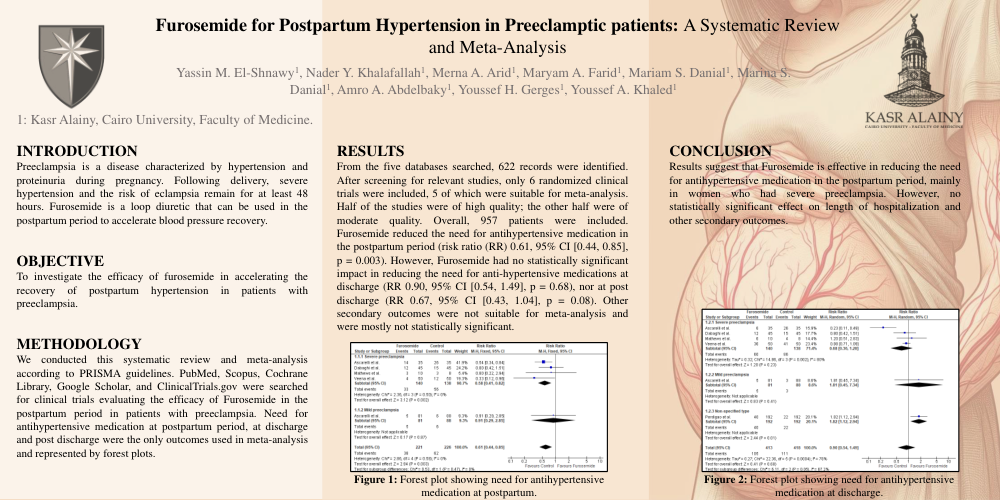
From the five databases searched, 622 records were identified. After screening for relevant studies, only 6 randomized clinical trials were included, 5 of which were suitable for meta-analysis. Half of the studies were of high quality; the other half were of moderate quality. Overall, 957 patients were included. Furosemide reduced the need for antihypertensive medication in the postpartum period (risk ratio (RR) 0.61, 95% CI [0.44, 0.85], p = 0.003). However, Furosemide had no statistically significant impact in reducing the need for anti-hypertensive medications at discharge (RR 0.90, 95% CI [0.54, 1.49], p = 0.68), nor at post discharge (RR 0.67, 95% CI [0.43, 1.04], p = 0.08). Other secondary outcomes were not suitable for meta-analysis and were mostly not statistically significant.
Conclusion:
Results suggest that Furosemide is effective in reducing the need for antihypertensive medication in the postpartum period, mainly in women who had severe preeclampsia. However, no statistically significant effect on length of hospitalization and other secondary outcomes.