2,281 posters, 63 videos, 56 audios, 43 topics, 18 sessions, 6,174 authors, 2,323 institutions
ePostersLive by SciGen Technologies S.A. All rights reserved.
RCOG World Congress 2025
June 23 - 25, 2025 | ExCeL London, UK
EP.1442
AN AUDIT OF LABOUR INDUCTION USINGPROSTAGLANDINS:INDICATIONS AND OUTCOMES
Poster Presenter
Authors
Affiliations
Part of Topic
Labour ward management
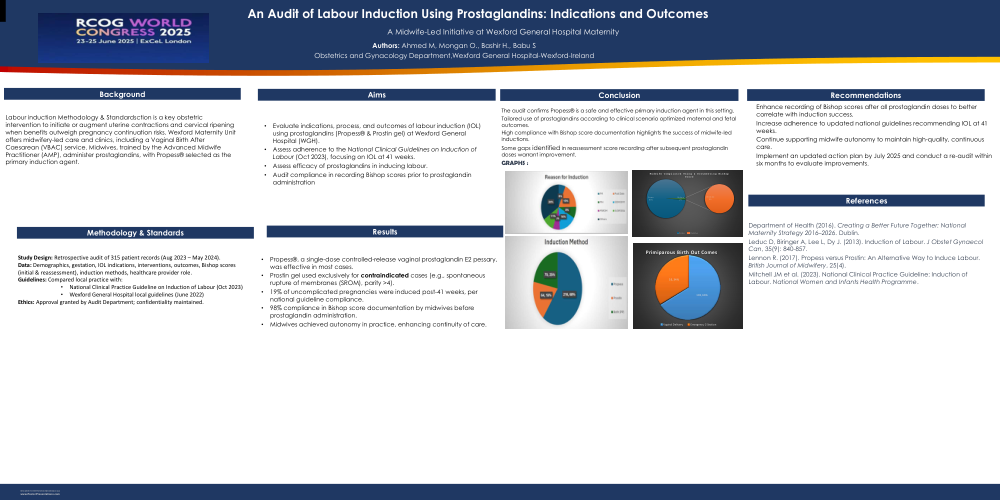
An Audit of Labour Induction Using Prostaglandins: Indications and Outcomes A Midwife-Led Initiative at Wexford General Hospital Maternity Authors: Ahmed M, Mongan O., Bashir H., Babu S Obstetrics and Gynacology Department,Wexford General Hospital-Wexford-Ireland Background Labour induction Methodology & Standardsction is a key obstetric intervention to initiate or augment uterine contractions and cervical ripening when benefits outweigh pregnancy continuation risks. Wexford Maternity Unit offers midwifery-led care and clinics, including a Vaginal Birth After Caesarean (VBAC) service. Midwives, trained by the Advanced Midwife Practitioner (AMP), administer prostaglandins, with Propess® selected as the primary induction agent. Methodology & Standards Study Design: Retrospective audit of 315 patient records (Aug 2023 – May 2024). Data: Demographics, gestation, IOL indications, interventions, outcomes, Bishop scores (initial & reassessment), induction methods, healthcare provider role. Guidelines: Compared local practice with: Aims • Evaluate indications, process, and outcomes of labour induction (IOL) using prostaglandins (Propess® & Prostin gel) at Wexford General Hospital (WGH). • Assess adherence to the National Clinical Guidelines on Induction of Labour (Oct 2023), focusing on IOL at 41 weeks. • Assess efficacy of prostaglandins in inducing labour. • Audit compliance in recording Bishop scores prior to prostaglandin administration Conclusion The audit confirms Propess® is a safe and effective primary induction agent in this setting. Tailored use of prostaglandins according to clinical scenario optimized maternal and fetal outcomes. High compliance with Bishop score documentation highlights the success of midwife-led inductions. Some gaps identified in reassessment score recording after subsequent prostaglandin doses warrant improvement. GRAPHS : Results • Propess®, a single-dose controlled-release vaginal prostaglandin E2 pessary, was effective in most cases. • Prostin gel used exclusively for contraindicated cases (e.g., spontaneous rupture of membranes (SROM), parity >4). Midwife Compliance Using & Documenting Bishop Score Done 98% Other 2% Done Undone Undone 2% Primiparous Birth Out Comes 53, 34% • National Clinical Practice Guideline on Induction of Labour (Oct 2023) • Wexford General Hospital local guidelines (June 2022) Ethics: Approval granted by Audit Department; confidentiality maintained. RESEARCH POSTER PRESENTATION DESIGN © 2022 • 19% of uncomplicated pregnancies were induced post-41 weeks, per national guideline compliance. • 98% compliance in Bishop score documentation by midwives before prostaglandin administration. • Midwives achieved autonomy in practice, enhancing continuity of care. 103, 66% Vaginal Delivery Emergency C-Section Recommendations Enhance recording of Bishop scores after all prostaglandin doses to better correlate with induction success. Increase adherence to updated national guidelines recommending IOL at 41 weeks. Continue supporting midwife autonomy to maintain high-quality, continuous care. Implement an updated action plan by July 2025 and conduct a re-audit within six months to evaluate improvements. References Department of Health (2016). Creating a Better Future Together: National Maternity Strategy 2016–2026. Dublin. Leduc D, Biringer A, Lee L, Dy J. (2013). Induction of Labour. J Obstet Gynaecol Can, 35(9): 840-857. Lennon R. (2017). Propess versus Prostin: An Alternative Way to Induce Labour. British Journal of Midwifery, 25(4). Mitchell JM et al. (2023). National Clinical Practice Guideline: Induction of Labour. National Women and Infants Health Programme.