2,281 posters, 63 videos, 56 audios, 43 topics, 18 sessions, 6,174 authors, 2,323 institutions
ePostersLive by SciGen Technologies S.A. All rights reserved.
RCOG World Congress 2025
June 23 - 25, 2025 | ExCeL London, UK
PP.0047
Development and delivery of a multi-professional Women’s Health Hub.
Poster Presenter
Authors
Hlupekile Chipeta, Kathryn Hage, Sian Taylor, Eloise Pearson, Liz Ward
Affiliations
Leeds Teaching Hospitals NHS Trust, Bellbrooke Surgery, East Park Medical Centre, Leeds Health and Care Partnership, West Yorkshire Integrated Care Board, Burmantoffs, Harehills and Richmond Hill Primary Care Network
Part of Topic
Quality improvement
Development and Delivery of a Multi-professional Women’s Health Hub in a Primary Care Practice in the United Kingdom
Introduction
The Women’s Health Strategy for England encouraged the improved accessibility to women’s services through the expansion of women’s health hubs (WHH). While Leeds benefits from a robust community gynaecology service, funding for development of a WHH provided an opportunity to introduce a service targeting women in one of the most deprived areas of the city.
Objective
To design and implement a multi-professional women’s health hub in Leeds and address long waiting list times.
Design
Patients are seen in a weekly clinic delivered in a GP practice. Staffing includes a consultant gynaecologist, two GPs undergoing postgraduate training with a view to running the hub long term, and specialty and CSRH resident doctors.
Eligible women are referred to women’s health events and condition specific support groups.
An alternate monthly virtual Hub MDT is open to Leeds primary care workers for discussion of gynaecology cases and education on common conditions.
Methods
Three primary care networks (PCNs) with the highest deprivation indices and gynaecology referral rates were identified. A practice was selected from one of these PCNs able to accommodate a gynaecology clinic within its existing infrastructure. Focus groups were held with women and clinical staff to inform the hub’s design.
Patients are pulled from a secondary care gynaecology waiting list. Thirty-minute first appointment times allow for holistic patient care and clinician education. The IT infrastructure is a hybrid of hospital and primary care systems with clinical paperwork from the hospital.
PCN patient ambassadors upskill, design, and facilitate support groups in menopause, menstrual dysfunction, PCOS and PMS/PMDD aimed to improve understanding and empower women to better manage their own health. Women’s health events provide well-women checks and prompt women’s health screening including cervix and breast.
Results
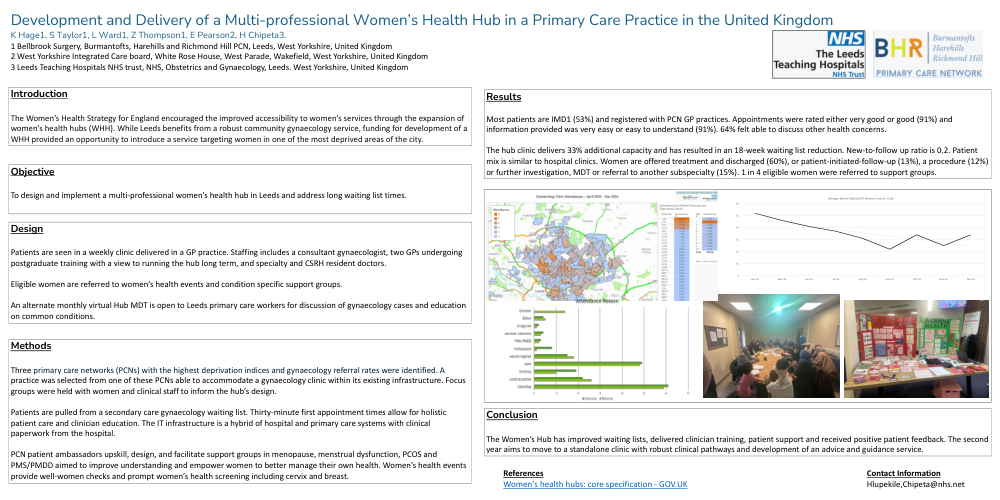
Most patients are IMD1 (53%) and registered with PCN GP practices. Appointments were rated either very good or good (91%) and information provided was very easy or easy to understand (91%). 64% felt able to discuss other health concerns.
The hub clinic delivers 33% additional capacity and has resulted in an 18-week waiting list reduction. New-to-follow up ratio is 0.2. Patient mix is similar to hospital clinics. Women are offered treatment and discharged (60%), or patient-initiated-follow-up (13%), a procedure (12%) or further investigation, MDT or referral to another subspecialty (15%). 1 in 4 eligible women were referred to support groups.
Conclusion
The Women’s Hub has improved waiting lists, delivered clinician training, patient support and received positive patient feedback. The second year aims to move to a standalone clinic with robust clinical pathways and development of an advice and guidance service.