2,281 posters, 63 videos, 56 audios, 43 topics, 18 sessions, 6,174 authors, 2,323 institutions
ePostersLive by SciGen Technologies S.A. All rights reserved.
RCOG World Congress 2025
June 23 - 25, 2025 | ExCeL London, UK
EP.1809
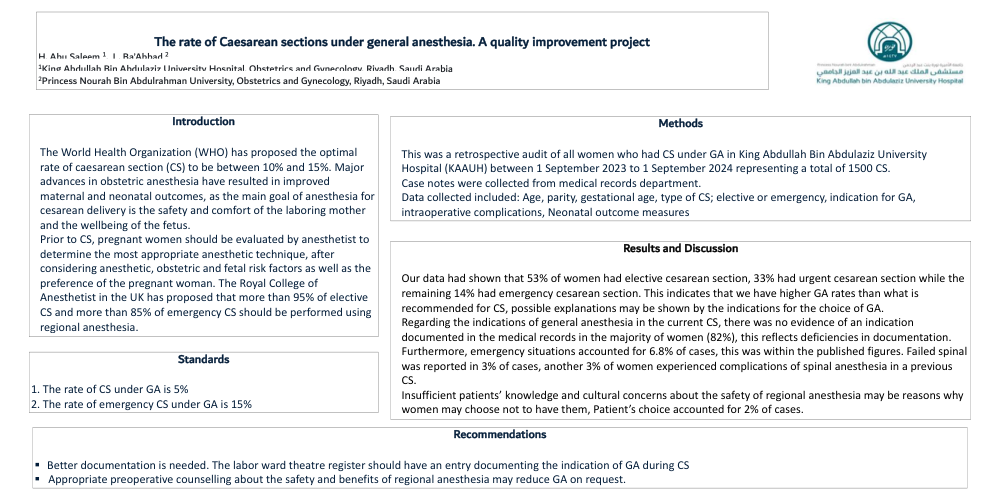
The rate of Caesarean sections under general anesthesia. A quality improvement project.
Poster Presenter
Authors
Affiliations
Part of Topic
Quality improvement
Introduction
The World Health Organization (WHO) has proposed the optimal rate of caesarean section (CS) to be between 10% and 15%. Major advances in obstetric anesthesia have resulted in improved maternal and neonatal outcomes, as the main goal of anesthesia for cesarean delivery is the safety and comfort of the laboring mother and the wellbeing of the fetus.
Prior to CS, pregnant women should be evaluated by anesthetist to determine the most appropriate anesthetic technique, after considering anesthetic, obstetric and fetal risk factors as well as the preference of the pregnant woman. The Royal College of Anesthetist in the UK has proposed that more than 95% of elective CS and more than 85% of emergency CS should be performed using regional anesthesia.
Standards:
1. The rate of CS under GA is 5%
2. The rate of emergency CS under GA is 15%
Methods
This was a retrospective audit of all women who had CS under GA in King Abdullah Bin Abdulaziz University Hospital (KAAUH) between 1 September 2023 to 1 September 2024 representing a total of 1500 CS.
Case notes were collected from medical records department.
Data collected included:
Age, parity, gestational age, type of CS; elective or emergency, indication for GA, intraoperative complications, Neonatal outcome measures
Results and Discussion
Our data had shown that 53% of women had elective cesarean section, 33% had urgent cesarean section while the remaining 14% had emergency cesarean section. This indicates that we have higher GA rates than what is recommended for CS, possible explanations may be shown by the indications for the choice of GA.
Regarding the indications of general anesthesia in the current CS, there was no evidence of an indication documented in the medical records in the majority of women (82%), this reflects deficiencies in documentation. Furthermore, emergency situations accounted for 6.8% of cases, this was within the published figures. Failed spinal was reported in 3% of cases, another 3% of women experienced complications of spinal anesthesia in a previous CS.
Insufficient patients’ knowledge and cultural concerns about the safety of regional anesthesia may be reasons why women may choose not to have them, Patient’s choice accounted for 2% of cases.
Recommendations
-Better documentation is needed. The labor ward theatre register should have an entry documenting the indication of GA during CS
-Appropriate preoperative counselling about the safety and benefits of regional anesthesia may reduce GA on request.