Loading...

2,281 posters, 63 videos, 56 audios, 43 topics, 18 sessions, 6,174 authors, 2,323 institutions

ePostersLive by SciGen Technologies S.A. All rights reserved.

RCOG World Congress 2025

June 23 - 25, 2025 | ExCeL London, UK

EP.1813

Clinical Audit: Is treatment for Hyperemesis Gravidarum patients as per standard guidelines?
Part of Topic

Quality improvement

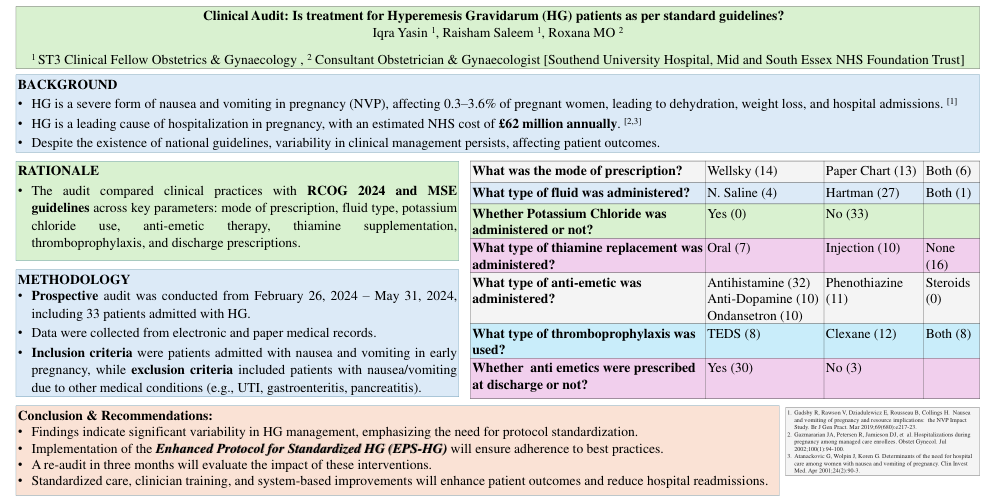
Clinical Audit: Is treatment for Hyperemesis Gravidarum (HG) patients as per standard guidelines? 

Iqra Yasin 1, Raisham Saleem 1, Roxana MO 2


1 ST3 Clinical Fellow Obstetrics & Gynaecology , 2 Consultant Obstetrician & Gynaecologist [Southend University Hospital, Mid and South Essex NHS Foundation Trust]


BACKGROUND

•HG is a severe form of nausea and vomiting in pregnancy (NVP), affecting 0.3–3.6% of pregnant women, leading to dehydration, weight loss, and hospital admissions. [1]
•HG is a leading cause of hospitalization in pregnancy, with an estimated NHS cost of £62 million annually. [2,3]
•Despite the existence of national guidelines, variability in clinical management persists, affecting patient outcomes.
 

RATIONALE

•The audit compared clinical practices with RCOG 2024 and MSE guidelines across key parameters: mode of prescription, fluid type, potassium chloride use, anti-emetic therapy, thiamine supplementation, thromboprophylaxis, and discharge prescriptions.
 

METHODOLOGY

•Prospective audit was conducted from February 26, 2024 – May 31, 2024, including 33 patients admitted with HG.
•Data were collected from electronic and paper medical records.
•Inclusion criteria were patients admitted with nausea and vomiting in early pregnancy, while exclusion criteria included patients with nausea/vomiting due to other medical conditions (e.g., UTI, gastroenteritis, pancreatitis).
 

Conclusion & Recommendations:

•Findings indicate significant variability in HG management, emphasizing the need for protocol standardization.
•Implementation of the Enhanced Protocol for Standardized HG (EPS-HG) will ensure adherence to best practices.
•A re-audit in three months will evaluate the impact of these interventions.
•Standardized care, clinician training, and system-based improvements will enhance patient outcomes and reduce hospital readmissions.
 
References

1. Gadsby R, Rawson V, Dziadulewicz E, Rousseau B, Collings H. Nausea and vomiting of pregnancy and resource implications: the NVP Impact Study. Br J Gen Pract . Mar 2019;69(680):e217 23.
2. Gazmararian JA, Petersen R, Jamieson DJ, et al. Hospitalizations during pregnancy among managed care enrollees . Obstet Gynecol. Jul 2002;100(1):94 100.
3. Atanackovic G, Wolpin J, Koren G. Determinants of the need for hospital care among women with nausea and vomiting of pregnancy. Clin Invest Med. Apr 2001;24(2):90 3.

Copyright © 2015-2026, ePostersLive® SciGen is a registered trademark of SciGen Technologies S.A. Patent pending.

This website and third-party tools we use rely on cookies for the best user experience. By selecting "I agree", you agree to cookie usage as described in our Privacy Policy.