2,281 posters, 63 videos, 56 audios, 43 topics, 18 sessions, 6,174 authors, 2,323 institutions
ePostersLive by SciGen Technologies S.A. All rights reserved.
RCOG World Congress 2025
June 23 - 25, 2025 | ExCeL London, UK
PP.0040
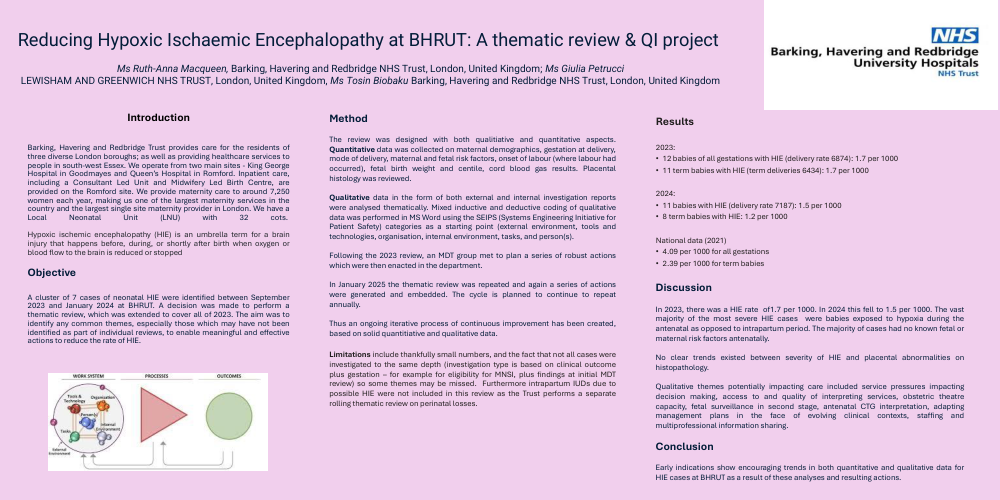
Reducing Hypoxic Ischaemic Encephalopathy at BHRUT: A thematic review & QI project
Poster Presenter
Part of Topic
Labour ward management
Introduction:
Barking, Havering and Redbridge Trust provides care for the residents of three diverse London boroughs; as well as providing healthcare services to people in south-west Essex. We operate from two main sites - King George Hospital in Goodmayes and Queen’s Hospital in Romford. We provide maternity care to around 7,250 women each year, making us one of the largest maternity services in the country. We have a Local Neonatal Unit (LNU) with 32 cots.
Objective:
A cluster of 7 cases of neonatal HIE were identified between September 2023 and January 2024 at BHRUT. A decision was made to perform a thematic review, which was extended to cover all of 2023. The aim was to identify any common themes, especially those which may have not been identified as part of individual reviews, to enable meaningful and effective actions to reduce the rate of HIE.
Method:
The review was designed with both qualitiative and quantitative aspects. Quantitative data was collected on maternal demographics, gestation at delivery, mode of delivery, maternal and fetal risk factors, onset of labour (where labour had occurred), fetal birth weight and centile, cord blood gas results. Placental histology was reviewed.
Qualitative data in the form of both external and internal investigation reports were analysed thematically. Mixed inductive and deductive coding of qualitative data was performed in MS Word using the SEIPS (Systems Engineering Initiative for Patient Safety) categories as a starting point (external environment, tools and technologies, organisation, internal environment, tasks, and person(s).
Following the 2023 review, an MDT group met to plan a series of actions which were undertaken in the department. In January 2025 the thematic review was repeated.
Results:
In 2023, there was a HIE rate 1.7 per 1000. In 2024 this fell to 1.5 per 1000. The vast majority of the most severe HIE cases were babies exposed to hypoxia during the antenatal as opposed to intrapartum period. No clear trends existed between severity of HIE and placental abnormalities on histopathology.
Qualitative themes included service pressures impacting decision making, access to and quality of interpreting services, obstetric theatre capacity, fetal surveillance in second stage, antenatal CTG interpretation, adapting management plans in the face of evolving clinical contexts, staffing and multiprofessional information sharing.
Conclusions
Early indications show encouraging trends in both quantitative and qualitative data for HIE cases at BHRUT as a result of these analyses and resulting actions.