2,281 posters, 63 videos, 56 audios, 43 topics, 18 sessions, 6,174 authors, 2,323 institutions
ePostersLive by SciGen Technologies S.A. All rights reserved.
RCOG World Congress 2025
June 23 - 25, 2025 | ExCeL London, UK
PP.0039
Optimizing Birth Initiative; Birth Outcomes Audit in Hutt Valley Hospital, New Zealand
Poster Presenter
Authors
Isobel Pugh, Alison Grant, Wendy Castle, Nicole Anderson, Christina Walton, Carolyn Coles, Gemma Nightingale
Affiliations
Part of Topic
Labour ward management
Optimising Birth Initiative; Birth Outcomes Audit in Hutt Valley Hospital, New Zealand
Isobel Pugh, Alison Grant, Wendy Castle, Nicole Anderson, Christina Walton, Carolyn Coles, Gemma Nightingale
Te Whatu Ora, Capital, Coast and Hutt Valley DHB, New Zealand
BACKGROUND
New Zealand is a high-income country with a population of 5.2 million people. The World Health Organisation (WHO) reports a global caesarean section rate of 21%, although this ranges from 5% - 43% depending on country, with lower rates in low-income countries (1).
Lower segment caesarean section (LSCS) rates in New Zealand have increased to 32% of all births in 2022 (2).
Hutt Valley District Health Board (DHB) is a secondary care level hospital with approximately 1,900 births per annum (2). It has an 8-bed birthing suite and 17-bed maternity ward. LSCS rates in Hutt Valley DHB were particularly high compared to the rest of the country, especially for those undergoing induction of labour (IOL).
Hutt Valley DHB serves a high-risk population. Māori comprise the largest ethnic minority at 16% of the patient population, with 9% Pacific and 12% Asian (2). Health outcomes for these patients are worse than their New Zealand European counterparts, with a national maternal mortality rate of almost double for Māori patients (3).
OPTIMISING BIRTH INITIATIVE
Given the increased maternal and neonatal morbidity and mortality associated with LSCS, the Optimising Birth initiative was developed to improve the birthing process, with the aim of reducing the rate of LSCS via a series of changes. The Optimising Birth Initiative was launched in December 2024 and included the following:
- Education and discussion with the maternity team about the project
- Introduction of a ‘Physiological Birth’ guideline
- Introduction of TENS machines and peanut balls
- A change in IOL protocol to use oral misoprostol
- Stricter booking processes for IOL with an agreed list of indications
INDUCTION OF LABOUR POLICY
The method of induction was changed in an attempt to reduce LSCS for ‘failed IOL’ or prolonged use of oxytocin. It also aligned Hutt Valley DHB with other units in New Zealand. A Cochrane review demonstrated that oral Misoprostol has comparable efficacy to vaginal Misoprostol or Prostin for IOL and results in fewer LSCS than Prostin (4). The IOL protocol utilises 8 doses of oral Misoprostol (tablet crushed and dissolved in water) per day for the first two days, administered every 2 hours or until the patient has established in labour. A Foley balloon catheter is inserted on the night of Day 2 and removed by 24 hours. Management for patients not in labour by Day 3 is individualised based on the clinical situation.
DESIGN AND METHODS
A retrospective audit was conducted over two six-month time periods.
Pre-initiative data included 796 patients between July-December 2023. There were 812 patients in the post-initiative period January-July 2024.
Patients were categorised according to the Robson 10 group classification (5). The key groups of focus were those undergoing IOL or presenting in spontaneous labour.
Badgernet, a digital maternity platform, was used from 2024 for data collection. Prior to this, paper notes were utilised. The data was compiled in Excel.
RESULTS
- There were 796 births in the pre-initiative group. Of these, 293 were LSCS deliveries, with an overall LSCS rate of 36.81%.
- The post-initiative group comprised 812 births and included 297 LSCS deliveries, with an overall LSCS rate of 36.58%. This demonstrates a modest overall reduction in LSCS rate.
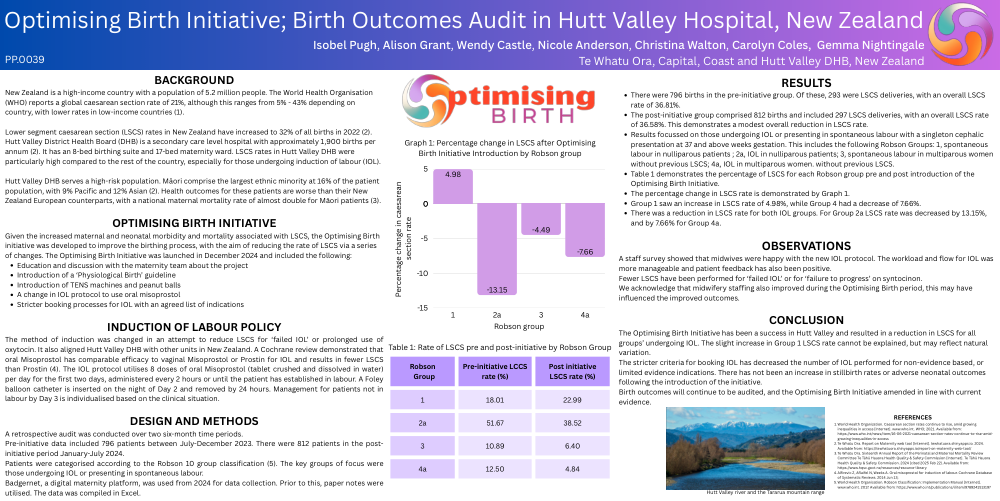
- Results focussed on those undergoing IOL or presenting in spontaneous labour with a singleton cephalic presentation at 37 and above weeks gestation. This includes the following Robson Groups: 1, spontaneous labour in nulliparous patients ; 2a, IOL in nulliparous patients; 3, spontaneous labour in multiparous women without previous LSCS; 4a, IOL in multiparous women. without previous LSCS.
- Table 1 demonstrates the percentage of LSCS for each Robson group pre and post introduction of the Optimising Birth Initiative.
- The percentage change in LSCS rate is demonstrated by Graph 1.
- Group 1 saw an increase in LSCS rate of 4.98%, while Group 4 had a decrease of 7.66%.
- There was a reduction in LSCS rate for both IOL groups. For Group 2a LSCS rate was decreased by 13.15%, and by 7.66% for Group 4a.
OBSERVATIONS
A staff survey showed that midwives were happy with the new IOL protocol. The workload and flow for IOL was more manageable and patient feedback has also been positive.
Fewer LSCS have been performed for ‘failed IOL’ or for ‘failure to progress’ on syntocinon.
We acknowledge that midwifery staffing also improved during the Optimising Birth period, this may have influenced the improved outcomes.
CONCLUSION
The Optimising Birth Initiative has been a success in Hutt Valley and resulted in a reduction in LSCS for all groups’ undergoing IOL. The slight increase in Group 1 LSCS rate cannot be explained, but may reflect natural variation.
The stricter criteria for booking IOL has decreased the number of IOL performed for non-evidence based, or limited evidence indications. There has not been an increase in stillbirth rates or adverse neonatal outcomes following the introduction of the initiative.
Birth outcomes will continue to be audited, and the Optimising Birth Initiative amended in line with current evidence.