2,281 posters, 63 videos, 56 audios, 43 topics, 18 sessions, 6,174 authors, 2,323 institutions
ePostersLive by SciGen Technologies S.A. All rights reserved.
RCOG World Congress 2025
June 23 - 25, 2025 | ExCeL London, UK
PP.0035
Nurturing New Beginnings - Challenges & Outcomes of setting a Preterm Birth Prevention Clinic
Poster Presenter
Authors
Humaeel Jafferji, Sayantana Patra Das, Orly Huff, Zubaida Abubakar-Aliyu, Priya Chowdhury, Husna Marjan, Eziaha Ogbuagu
Affiliations
Barking, Havering and Redbridge University Hospitals NHS Trust, Barnet hospital, Homerton University Hospital, East Suffolk and North Essex NHS Foundation Trust, DARTFORD AND GRAVESHAM NHS TRUST
Part of Topic
Quality improvement
Video
Nurturing New Beginnings – Challenges & Outcomes of Setting Up a Preterm Birth Prevention Clinic
Introduction -
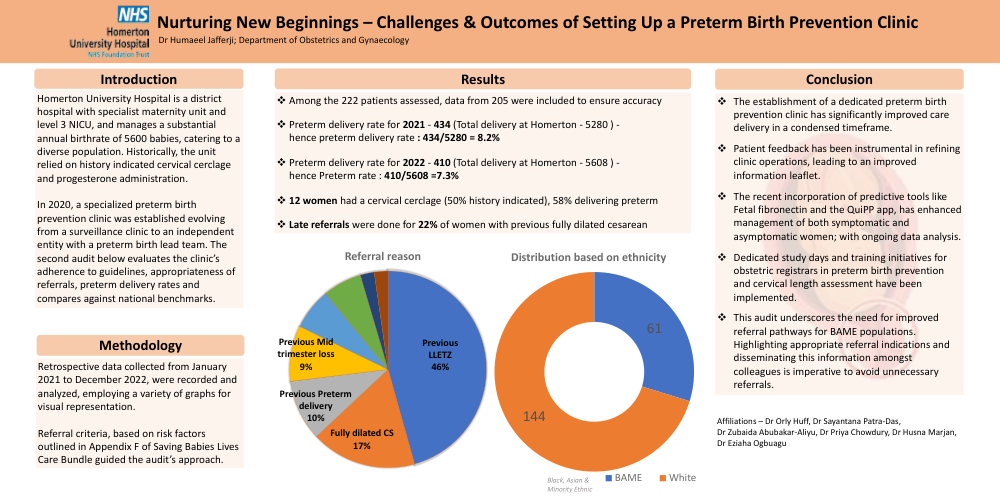
Homerton University Hospital is a district hospital with specialist maternity unit and level 3 NICU, and manages a substantial annual birthrate of 5600 babies, catering to a diverse population. Historically, the unit relied on history indicated cervical cerclage and progesterone administration. In 2020, a specialized preterm birth prevention clinic was established evolving from a surveillance clinic to an independent entity with a preterm birth lead team. The second audit below evaluates the clinic’s adherence to guidelines, appropriateness of referrals, preterm delivery rates and compares against national benchmarks.
Methodology -
Retrospective data collected from January 2021 to December 2022, were recorded and analyzed, employing a variety of graphs for visual representation. Referral criteria, based on risk factors outlined in Appendix F of Saving Babies Lives Care Bundle guided the audit’s approach.
Results -
Conclusion -