2,281 posters, 63 videos, 56 audios, 43 topics, 18 sessions, 6,174 authors, 2,323 institutions
ePostersLive by SciGen Technologies S.A. All rights reserved.
RCOG World Congress 2025
June 23 - 25, 2025 | ExCeL London, UK
PP.0033
Implementing A Comprehensive Cervical Screening in Antenatal Care Quality Improvement Programme
Poster Presenter
Part of Topic
Quality improvement
Introduction:
Only half of Western Sydney Primary Health Network women eligible for cervical screening are up-to-date, one of the lowest rates in Australia.
Pregnancy is a convenient opportunity to provide screening. Despite its national screening program, Australia has no formal programme for cervical screening within public hospital antenatal care and impediments exist at patient, clinician, and system levels.
Patient vaginal swab self-collection for human papilloma virus (HPV) testing is safe in pregnancy. Its availability removes some screening barriers including patient discomfort and staff time and skill required for speculum examination.
Aims:
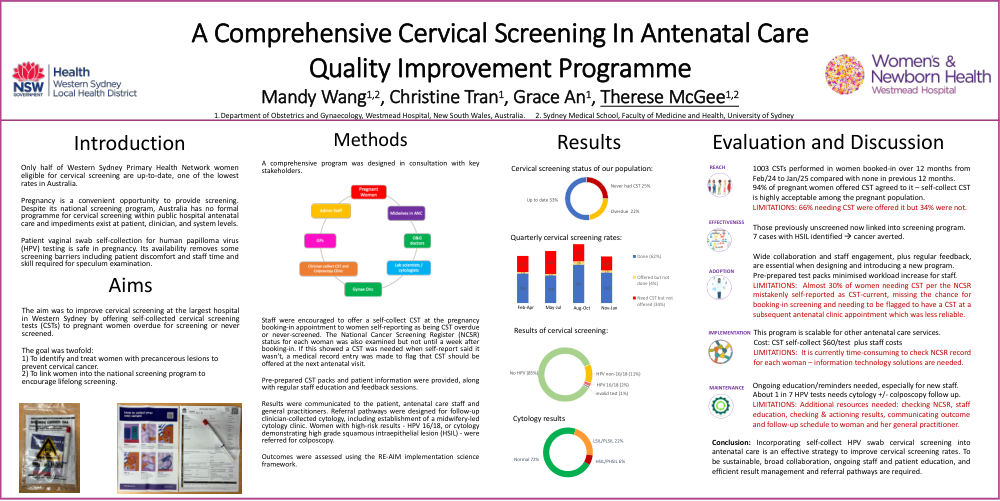
The aim was to improve cervical screening at the largest hospital in Western Sydney by offering self-collected cervical screening tests (CSTs) to pregnant women overdue for screening or never screened.
The goal was twofold:
1) To identify and treat women with precancerous lesions to prevent cervical cancer.
2) To link women into the national screening program to encourage lifelong screening.
1) To identify and treat women with precancerous lesions to prevent cervical cancer.
2) To link women into the national screening program to encourage lifelong screening.
Methods:
A comprehensive program was designed in consultation with key stakeholders.
Staff were encouraged to offer a self-collect CST at the pregnancy booking-in appointment to women self-reporting as being CST overdue or never-screened. The National Cancer Screening Register (NCSR) status for each woman was also examined but not until a week after booking-in. If this showed a CST was needed when self-report said it wasn't, a medical record entry was made to flag that CST should be offered at the next antenatal visit.
Pre-prepared CST packs and patient information were provided, along with regular staff education and feedback sessions.
Results were communicated to the patient, antenatal care staff and general practitioners. Referral pathways were designed for follow-up clinician-collected cytology, including establishment of a midwifery-led cytology clinic. Women with high-risk results - HPV 16/18, or cytology demonstrating high grade squamous intraepithelial lesion (HSIL) - were referred for colposcopy.
Outcomes were assessed using the RE-AIM implementation science framework.
Results:
Cervical screening status in our population (53% up to date, 22% overdue, 25% never screened).
Offered to those due: 66% (of whom 95% accepted), not offered 34%.
Results of screening: No HPV 85%, HPV non-16/18 11%, HPV 16/18 2%, invalid test 1%.
Cytology Results: Normal 72%, LSIL 22%, HSIL 6%.
Evaluation and Discussion:
REACH:
1003 CSTs performed in women booked-in over 12 months from Feb/24 to Jan/25 compared with none in previous 12 months.
94% of pregnant women offered CST agreed to it – self-collect CST is highly acceptable among the pregnant population.
Limitations: 66% needing CST were offered it but 34% were not.
EFFECTIVENESS:
Those previously unscreened now linked into screening program. 7 cases with HSIL identified cancer averted.
ADOPTION:
Wide collaboration and staff engagement, plus regular feedback, are essential when designing and introducing a new program.
Pre-prepared test packs minimised workload increase for staff.
Limitations: Almost 30% of women needing CST per the NCSR mistakenly self-reported as CST-current, missing the chance for booking-in screening and needing to be flagged to have a CST at a subsequent antenatal clinic appointment which was less reliable.
IMPLEMENTATION:
This program is scalable for other antenatal care services.
Cost: CST self-collect $60/test plus staff costs
Limitations: It is currently time-consuming to check NCSR record for each woman – information technology solutions are needed.
MAINTENANCE:
Ongoing education/reminders needed, especially for new staff.
About 1 in 7 HPV tests needs cytology +/- colposcopy follow up.
Limitations: Additional resources needed: checking NCSR, staff education, checking & actioning results, communicating outcome and follow-up schedule to woman and her general practitioner.
Conclusion:
Incorporating self-collect HPV swab cervical screening into antenatal care is an effective strategy to improve cervical screening rates. To be sustainable, broad collaboration, ongoing staff and patient education, and efficient result management and referral pathways are required.