2,281 posters, 63 videos, 56 audios, 43 topics, 18 sessions, 6,174 authors, 2,323 institutions
ePostersLive by SciGen Technologies S.A. All rights reserved.
RCOG World Congress 2025
June 23 - 25, 2025 | ExCeL London, UK
PP.0029
Impact of parvovirus B19 infections in pregnant women in 2024, Leicester, UK
Poster Presenter
Part of Topic
Fetal medicine
Impact of parvovirus B19 infections in pregnant women in 2024, Leicester, UK
Manjiri Khare,1,4 Farah Siddiqui,1,4 Ian Scudamore,1 Hatem A Mousa,1,4 Eamonn Breslin,1 Suzanna Dunkerton,1 Joshua Nazareth,2,4 Oliver TR Toovey,2 Dipak Patel,3 Julian W Tang2
1Maternal-Fetal Medicine, 2Clinical Microbiology, 3Pathology Data and Informatics Services, University Hospitals of Leicester (UHL) NHS Trust, 4University of Leicester, United Kingdom
Background: Parvovirus B19 (B19V) is a non-enveloped, single-stranded DNA virus within the Parvoviridae family, transmitted by short-range aerosols and contact with infected body fluids [1]. It can reach viral loads of greater than 100 billion copies/ml blood in the acute phase of the infection before the appearance of antibodies. Large community outbreaks of B19V infections usually occur on a 3-4 year cycle, but the frequency and size of such outbreaks may have been altered due to the social restrictions imposed during the COVID-19 pandemic. During 2024 there were widespread outbreaks of B19V across Europe [2]. In the UK, this led to increased numbers of acute infections in vulnerable individuals, including pregnant women [3]. Acute parvovirus B19 infection during pregnancy can lead to maternal and fetal anaemia, and in severe cases, nonimmunefetal hydrops and intra-uterine fetal death (IUFD). Currently, there are no licensed antiviral drugs or vaccines for parvovirus B19, though intravenous immunoglobulin can be used to reduce the viraemia in the immunosuppressed. Intrauterine transfusion (IUT) is offered if severe fetal anaemia or hydrops develops.
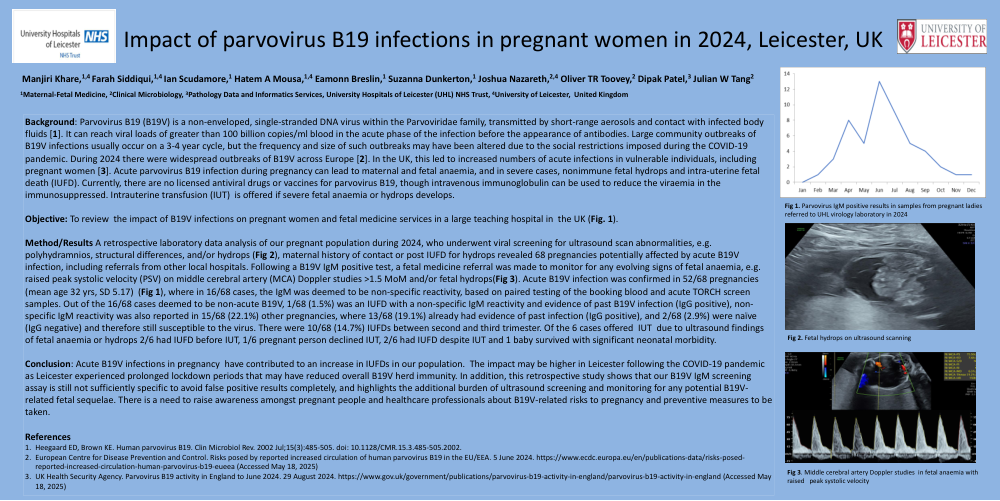
Objective: To review the impact of B19V infections on pregnant women and fetal medicine services in a large teaching hospital in the UK (Fig. 1).
Method/Results A retrospective laboratory data analysis of our pregnant population during 2024, who underwent viral screening for ultrasound scan abnormalities, e.g. polyhydramnios, structural differences, and/or hydrops (Fig 2), maternal history of contact or post IUFD for hydrops revealed 68 pregnancies potentially affected by acute B19V infection, including referrals from other local hospitals. Following a B19V IgM positive test, a fetal medicine referral was made to monitor for any evolving signs of fetal anaemia, e.g. raised peak systolic velocity (PSV) on middle cerebral artery (MCA) Doppler studies >1.5 MoMand/or fetal hydrops(Fig 3). Acute B19V infection was confirmed in 52/68 pregnancies (mean age 32 yrs, SD 5.17) (Fig 1), where in 16/68 cases, the IgM was deemed to be non-specific reactivity, based on paired testing of the booking blood and acute TORCH screen samples. Out of the 16/68 cases deemed to be non-acute B19V, 1/68 (1.5%) was an IUFD with a non-specific IgM reactivity and evidence of past B19V infection (IgG positive), non-specific IgM reactivity was also reported in 15/68 (22.1%) other pregnancies, where 13/68 (19.1%) already had evidence of past infection (IgG positive), and 2/68 (2.9%) were naïve (IgG negative) and therefore still susceptible to the virus. There were 10/68 (14.7%) IUFDs between second and third trimester. Of the 6 cases offered IUT due to ultrasound findings of fetal anaemiaor hydrops2/6 had IUFD before IUT, 1/6 pregnant person declined IUT, 2/6 had IUFD despite IUTand 1 baby survived with significant neonatal morbidity.
Conclusion: Acute B19V infections in pregnancy have contributed to an increase in IUFDs in our population. The impact may be higher in Leicester following the COVID-19 pandemic as Leicester experienced prolonged lockdown periods that may have reduced overall B19V herd immunity. In addition, this retrospective study shows that our B19V IgM screening assay is still not sufficiently specific to avoid false positive results completely, and highlights the additional burden of ultrasound screening and monitoring for any potential B19V-related fetal sequelae. There is a need to raise awareness amongst pregnant people and healthcare professionals about B19V-related risks to pregnancy and preventive measures to be taken.
References
UK Health Security Agency. Parvovirus B19 activity in England to June 2024. 29 August 2024. https://www.gov.uk/government/publications/parvovirus-b19-activity-in-england/parvovirus-b19-activity-in-england (Accessed May 18, 2025)