2,281 posters, 63 videos, 56 audios, 43 topics, 18 sessions, 6,174 authors, 2,323 institutions
ePostersLive by SciGen Technologies S.A. All rights reserved.
RCOG World Congress 2025
June 23 - 25, 2025 | ExCeL London, UK
PP.0024
Treatment options for heavy menstrual bleeding: Systematic review, pairwise and network meta-analyses.
Poster Presenter
Authors
Lily Nicholson, David Fisher, Ewelina Rogozinska, Jayne Tierney, Claire Vale, Ekaterina Bordea, Ngawai Moss, Niccola Hutchinson-Pascal, Rachael Hunter, Khalid Khan, Davor Jurkovic, Bassel Al Wattar
Affiliations
Medical Research Council Clinical Trials Unit, Institute for Clinical Trials and Methodology, University College London, Comprehensive Clinical Trials Unit, Institute for Clinical Trials and Methodology, University College London, Katie's Team, Queen Mary University of London, Co-Production Collective, University College London, Institute of Epidemiology & Health, Faculty of Pop Health Sciences, University College London, Department of Preventive Medicine and Public Health, University of Granada, Women's Health Department, University College London Hospitals
Part of Topic
General gynaecology
Video
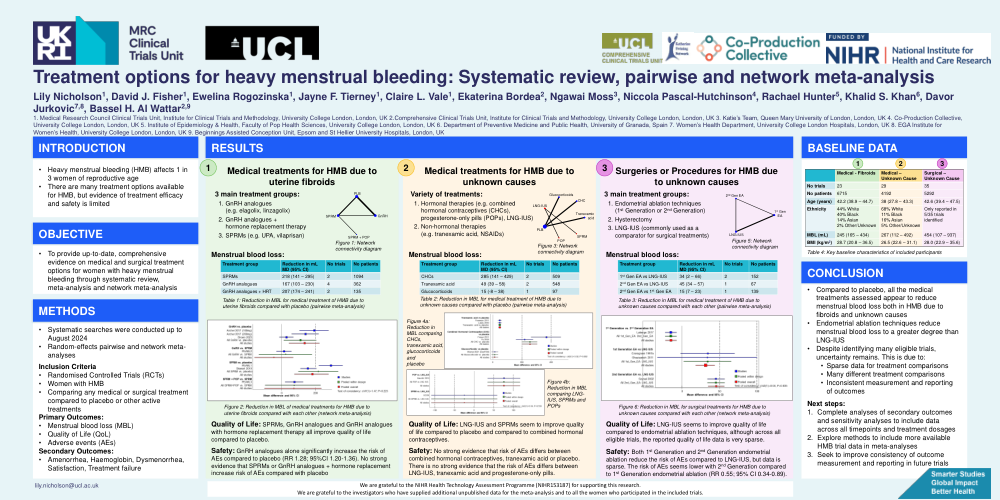
Treatment options for heavy menstrual bleeding: Systematic review, pairwise and network meta-analysis
Lily Nicholson, David J. Fisher, Ewelina Rogozinska, Jayne F. Tierney, Claire L. Vale, Ekaterina Bordea, Ngawai Moss, Niccola Pascal-Hutchinson, Rachael Hunter, Khalid S. Khan, Davor Jurkovic, Bassel H. Al Wattar
Introduction:
Heavy menstrual bleeding (HMB) affects 1 in 3 women of reproductive age. There are many treatment options available for HMB, but evidence of treatment efficacy and safety is limited.
Objectives:
To provide up-to-date, comprehensive evidence on medical and surgical treatment options for women with heavy menstrual bleeding through systematic review, meta-analysis and network meta-analysis.
Methods:
- Systematic searches were conducted up to August 2024.
- Random-effects pairwise and network meta-analyses
Inclusion Criteria
- Randomised Controlled Trials (RCTs)
- Women with HMB
- Comparing any medical or surgical treatment compared to placebo or other active treatments
Primary Outcomes:
- Menstrual blood loss (MBL)
- Quality of Life (QoL)
- Adverse events (AEs)
Secondary Outcomes:
- Amenorrhea, Haemoglobin, Dysmenorrhea, Satisfaction, Treatment failure
Baseline data (presented as a table only)
Results 1: Medical treatments for HMB due to uterine fibroids
3 main treatment groups:
- GnRH analogues (e.g. elagolix, linzagolix)
- GnRH analogues + hormone replacement therapy
- SPRMs (e.g. UPA, vilaprisan)
Menstrual Blood Loss: (results presented as figures and tables only)
Quality of Life: SPRMs, GnRH analogues and GnRH analogues with hormone replacement therapy all improve quality of life compared to placebo.
Safety: GnRH analogues alone significantly increase the risk of AEs compared to placebo (RR 1.28; 95%CI 1.20-1.36). No strong evidence that SPRMs or GnRH analogues + hormone replacement increase risk of AEs compared with placebo
Results 2: Medical treatments for HMB due to unknown causes
Variety of treatments:
- Hormonal therapies (e.g. combined hormonal contraceptives (CHCs), progesterone-only pills (POPs), LNG-IUS)
- Non-hormonal therapies (e.g. tranexamic acid, NSAIDs)
Menstrual blood loss: (results presented as figures and tables only)
Quality of Life: LNG-IUS and SPRMs seem to improve quality of life compared to placebo and compared to combined hormonal contraceptives.
Safety: No strong evidence that risk of AEs differs between combined hormonal contraceptives, tranexamic acid or placebo. There is no strong evidence that the risk of AEs differs between LNG-IUS, tranexamic acid and progesterone-only pills.
Results 3: Surgeries or procedures for HMB due to unknown causes
3 main treatment groups:
- Endometrial ablation techniques (1st Generation or 2nd Generation)
- Hysterectomy
- LNG-IUS (commonly used as a comparator for surgical treatments)
Menstrual blood loss: (results presented as figures and tables only)
Quality of Life: LNG-IUS seems to improve quality of life compared to endometrial ablation techniques, although across all eligible trials, the reported quality of life data is very sparse.
Safety: Both 1st Generation and 2nd Generation endometrial ablation reduce the risk of AEs compared to LNG-IUS, but data is sparse. The risk of AEs seems lower with 2nd Generation compared to 1st Generation endometrial ablation (RR 0.55; 95% CI 0.34-0.89).
Conclusion:
- Compared to placebo, all the medical treatments assessed appear to reduce menstrual blood loss both in HMB due to fibroids and unknown causes
- Endometrial ablation techniques reduce menstrual blood loss to a greater degree than LNG-IUS
- Despite identifying many eligible trials, uncertainty remains. This is due to:
- Sparse data for treatment comparisons
- Many different treatment comparisons
- Inconsistent measurement and reporting of outcomes
Next steps:
- Complete analyses of secondary outcomes and sensitivity analyses to include data across all timepoints and treatment dosages
- Explore methods to include more available HMB trial data in meta-analyses
- Seek to improve consistency of outcome measurement and reporting in future trials
Acknowledgements: We are grateful to the NIHR Health Technology Assessment Programme (NIHR153187) for supporting this research. We are grateful to the investigators who have supplied additional unpublished data for the meta-analysis and to all the women who participated in the included trials.