2,281 posters, 63 videos, 56 audios, 43 topics, 18 sessions, 6,174 authors, 2,323 institutions
ePostersLive by SciGen Technologies S.A. All rights reserved.
RCOG World Congress 2025
June 23 - 25, 2025 | ExCeL London, UK
EP.0022
Removal of retained products of conception via hysteroscopic shaving
Poster Presenter
Authors
Elias Tsakos, Emmanouil M. Xydias, Efthymios Didangelos, Stavroula Papadea, Vasileios Emmanouil, Apostolos Ziogas, Kanelina Bimpa
Affiliations
EmbryoClinic IVF, Democritus University of Thrace, School of Health Sciences, Faculty of Medicine, University of Thessaly, School of Health Sciences, Faculty of Medicine
Part of Topic
Abortion care
Removal of retained products of conception via hysteroscopic shaving
Dr. Elias Tsakos1, Dr. Emmanouil M. Xydias1, Dr. Efthymios Didangelos1, Dr. Stavroula Papadea1, Dr. Vasileios Emmanouil2, Dr. Apostolos Ziogas3, Dr. Kanelina Bimpa1
1EmbryoClinic IVF, Thessaloniki, Greece. 2Democritus University of Thrace, School of Health Sciences, Faculty of Medicine, Alexandroupoli, Greece. 3University of Thessaly, School of Health Sciences, Faculty of Medicine, Larissa, Greece
Introduction
Missed abortion is a commonly encountered condition, with multiple therapeutic options available for the treatment of most patients. However, decision-making is more complicated in patients with infertility; for whom optimizing the endometrial cavity for a subsequent attempt at conception within a limited time-frame, with minimal healthy tissue damage are of paramount importance. In the present case we demonstrate an option for removing retained products of conception via hysteroscopic shaving using the intrauterine BIGATTI Shaver®, a method with high promise in the field of Reproductive Medicine.
Case presentation
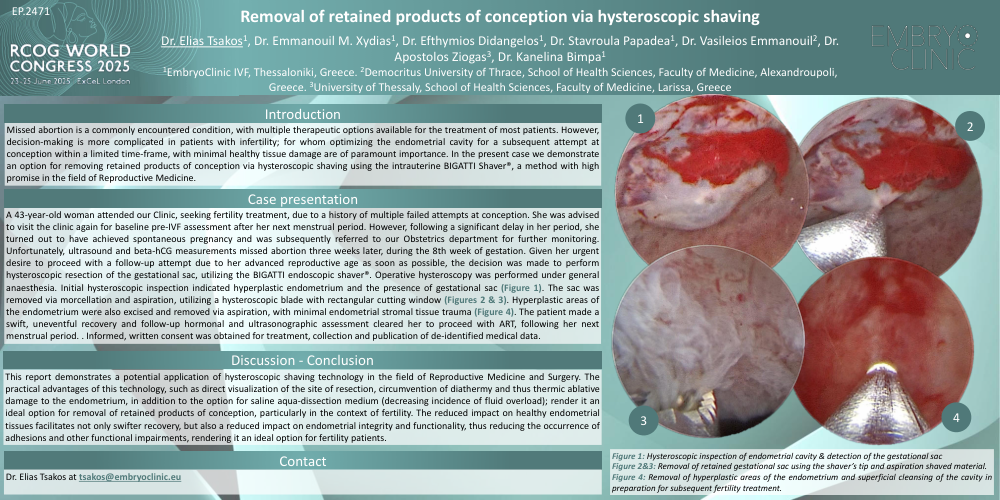
A 43-year-old woman attended our Clinic, seeking fertility treatment, due to a history of multiple failed attempts at conception. She was advised to visit the clinic again for baseline pre-IVF assessment after her next menstrual period. However, following a significant delay in her period, she turned out to have achieved spontaneous pregnancy and was subsequently referred to our Obstetrics department for further monitoring. Unfortunately, ultrasound and beta-hCG measurements missed abortion three weeks later, during the 8th week of gestation. Given her urgent desire to proceed with a follow-up attempt due to her advanced reproductive age as soon as possible, the decision was made to perform hysteroscopic resection of the gestational sac, utilizing the BIGATTI endoscopic shaver®. Operative hysteroscopy was performed under general anaesthesia. Initial hysteroscopic inspection indicated hyperplastic endometrium and the presence of gestational sac (Figure 1). The sac was removed via morcellation and aspiration, utilizing a hysteroscopic blade with rectangular cutting window (Figures 2 & 3). Hyperplastic areas of the endometrium were also excised and removed via aspiration, with minimal endometrial stromal tissue trauma (Figure 4). The patient made a swift, uneventful recovery and follow-up hormonal and ultrasonographic assessment cleared her to proceed with ART, following her next menstrual period. . Informed, written consent was obtained for treatment, collection and publication of de-identified medical data.
Discussion - Conclusion
This report demonstrates a potential application of hysteroscopic shaving technology in the field of Reproductive Medicine and Surgery. The practical advantages of this technology, such as direct visualization of the site of resection, circumvention of diathermy and thus thermic ablative damage to the endometrium, in addition to the option for saline aqua-dissection medium (decreasing incidence of fluid overload); render it an ideal option for removal of retained products of conception, particularly in the context of fertility. The reduced impact on healthy endometrial tissues facilitates not only swifter recovery, but also a reduced impact on endometrial integrity and functionality, thus reducing the occurrence of adhesions and other functional impairments, rendering it an ideal option for fertility patients.
Contact
Dr. Elias Tsakos at tsakos@embryoclinic.eu
Figure 1: Hysteroscopic inspection of endometrial cavity & detection of the gestational sac
Figure 2&3: Removal of retained gestational sac using the shaver’s tip and aspiration shaved material.
Figure 4: Removal of hyperplastic areas of the endometrium and superficial cleansing of the cavity in preparation for subsequent fertility treatment.