2,281 posters, 63 videos, 56 audios, 43 topics, 18 sessions, 6,174 authors, 2,323 institutions
ePostersLive by SciGen Technologies S.A. All rights reserved.
RCOG World Congress 2025
June 23 - 25, 2025 | ExCeL London, UK
EP.0002
Perceptions of Dilation and Evacuation Among Abortion Service Providers in Ethiopia
Poster Presenter
Part of Topic
Abortion care
Perception towards Dilatation and Evacuation and Associated Factors among Abortion Service Providers in Ethiopia: A Cross Sectional Study
Birhanu Abera1*, Abebawu Addis2, Abebawu Gebeyehu2, Yonas Getachew3, Mulat Adefris1, Melkau Abete4, Alula Teklu5
Affiliations
1Department of Gynecology & Obstetrics, University of Global Health Equity, Rwanda
2Department of Reproductive Health, University of Gondar, Ethiopia
3 CIRHT Ethiopia, Senior Clinical Advisor, Addis Ababa, Ethiopia
4Department of Gynecology & Obstetrics, Wollo University, Ethiopia
*corresponding author
Email address
Birhanu Abera–birhanua31@gmail.com
Abebawu Addis -abebaw.addis@gmail.com
Abebawu Gebeyehu-gabebaw2worku@gmail.com
Yonas Getachewu -gyonas06@yahoo.com
Mulat Adefris- mulatadefrisw@gmail.com
Melkamu Abetea - ateklu72@gmail.com
Alula Teklu - melkamuab@gmail.com
Abstract
Background:
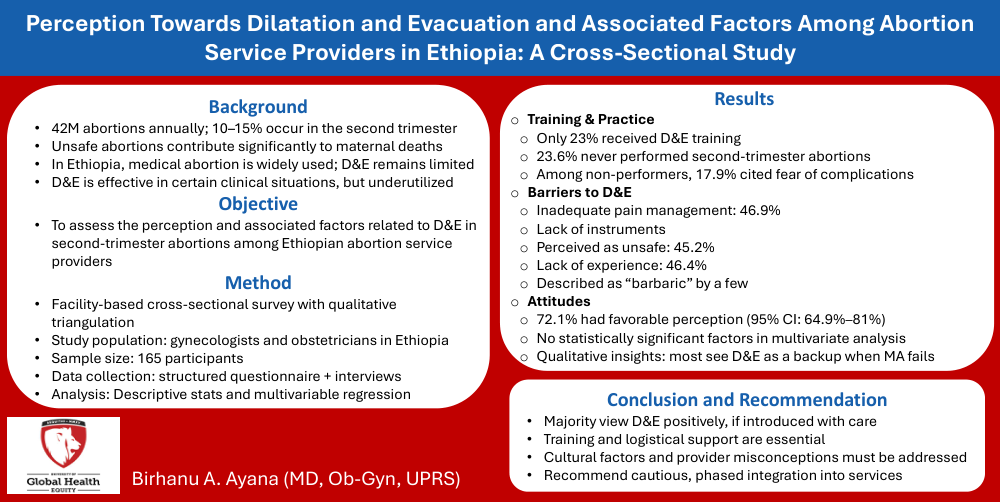
Globally, over 42 million abortions are performed annually, 10–15% of which occur in the second trimester. More than half of these are unsafe and disproportionately contribute to maternal mortality. In Ethiopia, medical abortion is the most commonly used method for second-trimester termination. However, dilatation and evacuation (D&E), which may be a better alternative in certain clinical scenarios, remains underutilized.
Objective:
To assess the perception of D&E in second-trimester abortion and identify associated factors among abortion service providers in Ethiopia
Methodology:
A facility-based cross-sectional study, complemented by a qualitative component, was conducted among gynecologists and obstetricians across Ethiopia
Result:
A total of 165 providers participated. Among them, 39 (23.6%) had never performed a safe second-trimester abortion. Of these, 7 (17.9%) cited fear of complications as the main reason. Only 38 (23%) had received specific training on D&E. Among those who had performed D&E, 38 (46.9%) reported challenges such as inadequate pain management and lack of appropriate materials. Barriers to providing D&E included lack of experience (39, 46.43%) and the perception that D&E is as unsafe as medical methods (38, 45.2%). A small number of participants considered D&E a "barbaric" procedure.
Overall, 111 participants (72.1%, 95% CI: 64.9%–81%) had a favorable attitude towards D&E for second-trimester abortion. However, multivariable analysis revealed no statistically significant factors associated with provider perception.
In the qualitative component, all respondents acknowledged a role for D&E in second-trimester abortion care, though opinions varied on its extent. Only one respondent advocated for D&E to have a role equal to medical abortion; the others supported its use as a backup method when medical abortion fails or is contraindicated.
Conclusion:
Most abortion service providers in Ethiopia hold a favorable view of D&E and acknowledge its potential positive contribution if carefully introduced. Further assessment of the socio-cultural context is essential, along with strategic interventions at all levels, to prevent unintended consequences and ensure integration without compromising existing services
Keywords:
Dilatation and Evacuation, Provider Perception, Second Trimester Abortion, Ethiopia