2,281 posters, 63 videos, 56 audios, 43 topics, 18 sessions, 6,174 authors, 2,323 institutions
ePostersLive by SciGen Technologies S.A. All rights reserved.
RCOG World Congress 2025
June 23 - 25, 2025 | ExCeL London, UK
PP.0020
Breath Carbon Monoxide Levels Versus Self-Reported Smoking in Predicting Adverse Pregnancy Outcomes
Poster Presenter
Part of Topic
Fetal medicine
Breath carbon monoxide levels, smoking and adverse pregnancy outcomes
BACKGROUND
- Leading modifiable risk factor for adverse pregnancy outcomes
- Associated with low birth weight and preterm birth
- Quitting significantly reduces risks
- Record-low smoking rates in England in 2023/24, but 7.4% of women were known to be smokers at the end of their pregnancy
- Important to identify pregnant smokers in order to provide appropriate cessation advice and increase fetal surveillance
- Not all women disclose smoking during antenatal visits (non-disclosure rates ranging from 3%–75%)
- To address this, biochemical markers have been recently used
- Breath carbon monoxide (CO) testing is a quick, cost-effective, and non-invasive way to assess smoking status
- In the UK, CO testing is recommended at booking and 36-weeksappointments for all women
METHODS AND COHORT CHARACTERISTICS
- Retrospective cohort study of one year of pregnancies (2023) in Oxford
- Statistical analysis in IBM SPSS Statistics version 29.0.2.0
- ANOVA with Games-Howell post-hoc tests, the Cochran-Armitage test for trend, binary logistic regression, and univariate linear regression
GAPS IN LITERATURE
- Previous studies examined best CO thresholds for identifying smokers, but not for predicting adverse pregnancy outcomes
- Unclear whether CO is a more reliable predictor of adverse outcomes than self-reported smoking status
AIMS
- To identify the CO threshold and relationship with adverse neonatal outcomes
- To compare the use of CO versus self-reported smoking as risk indicators
RESULTS
CO Threshold And Dose-Response Relationship
For each 1 ppm increase in CO:
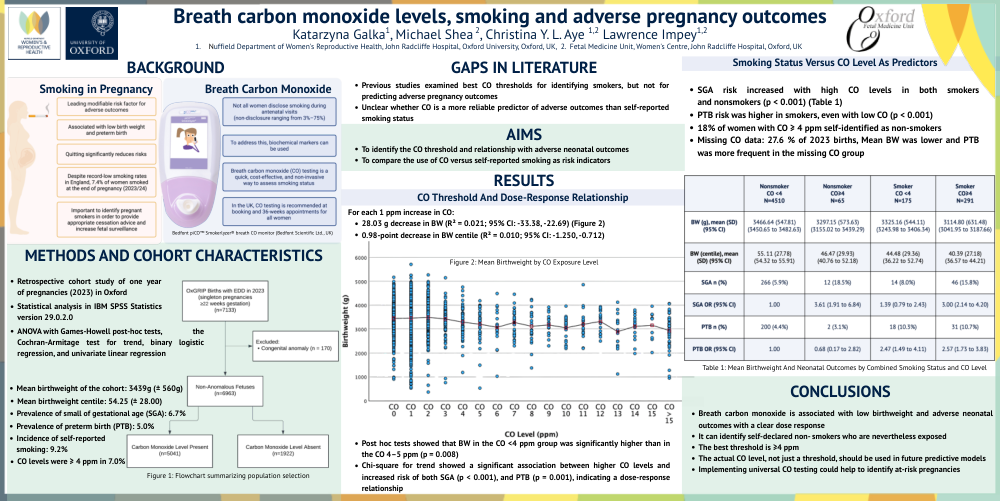
- 28.03 g decrease in BW (R² = 0.021; 95% CI: -33.38, -22.69) (Figure 2)
- 0.98-point decrease in BW centile (R² = 0.010; 95% CI: -1.250, -0.712)
- Post hoc tests showed that BW in the CO <4 ppm group was significantly higher than in the CO 4–5 ppm (p = 0.008)
- Chi-square for trend showed a significant association between higher CO levels and increased risk of both SGA (p < 0.001), and PTB (p = 0.001), indicating a dose-response relationship
Smoking Status Versus CO Level As Predictors
- SGA risk increased with high CO levels in both smokers and nonsmokers (p < 0.001) (Table 1)
- PTB risk was higher in smokers, even with low CO (p < 0.001)
- 18% of women with CO ≥ 4 ppm self-identified as non-smokers
- Missing CO data: 27.6 % of 2023 births Mean BW was lower and PTB was more frequent in the missing CO group
CONCLUSIONS
- Breath carbon monoxide is associated with low birthweight and adverse neonatal outcomes with a clear dose response
- It can identify self-declared non- smokers who are nevertheless exposed
- The best threshold is ≥4 ppm
- The actual CO level, not just a threshold, should be used in future predictive models
- Implementing universal CO testing could help to identify at-risk pregnancies