Loading...

2,281 posters, 63 videos, 56 audios, 43 topics, 18 sessions, 6,174 authors, 2,323 institutions

ePostersLive by SciGen Technologies S.A. All rights reserved.

RCOG World Congress 2025

June 23 - 25, 2025 | ExCeL London, UK

PP.0016

Normal fetal growth and birthweight in monochorionic vs dichorionic twin pregnancy
Poster Presenter

Oliver Hugh

Part of Topic

Fetal medicine

Normal fetal growth and birthweight in
monochorionic vs dichorionic twin pregnancy

Oliver Hugh, Jason Gardosi

Perinatal Institute, UK

Objectives

•There is ongoing debate as to whether monochorionic (MC) and dichorionic (DC) pregnancies require different growth charts1.
 
•We wanted to quantify fetal weight and birthweight in twins with different chorionicities when pathological factors are excluded.

Methods

Our cohort consisted of 2048 twins born in UK GAP units 2023 - 4.

We collected data on maternal characteristics, EFW measurements  and outcomes including gestational age and weight at birth

Fetal weight curves were modelled for each chorionicity using nested mixed-effects regression in pregnancies with 3 or more scans after excluding
 - preterm and post-term births  MC: <33+0 and >36+6  weeks

  DC:  <34+0 and >37+6  weeks

 - twin-twin discordance (>25%) 
 - maternal factors: BMI < 18.5 and >30,
 - age >40, smoking,  hypertension

 - previous SGA babies


Birthweights were compared using mixed-effects regression to quantify differences between MC and DC pregnancies after adjusting for confounders using a directed acyclic graph

Results

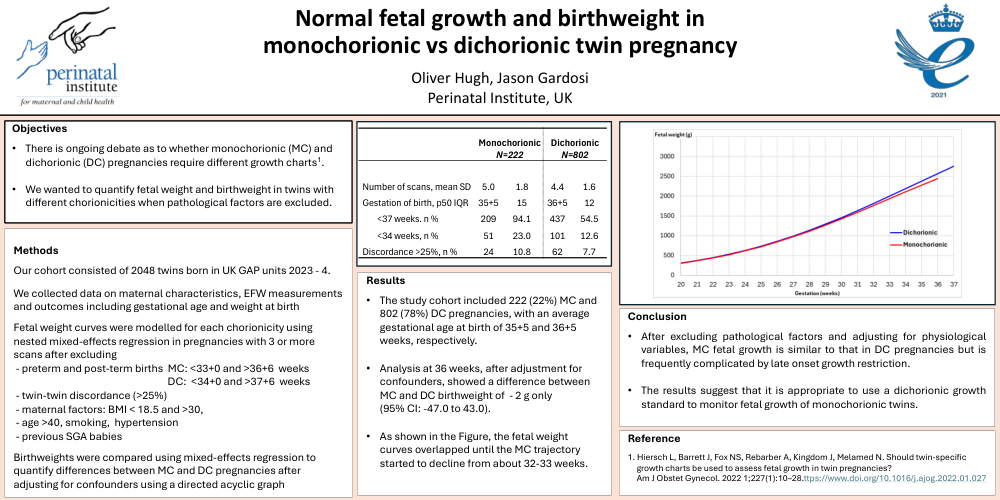
•The study cohort included 222 (22%) MC and 802 (78%) DC pregnancies, with an average gestational age at birth of 35+5 and 36+5 weeks, respectively.
 
•Analysis at 36 weeks, after adjustment for confounders, showed a difference between MC and DC birthweight of  - 2 g only
(95% CI: -47.0 to 43.0).
 
•As shown in the Figure, the fetal weight curves overlapped until the MC trajectory started to decline from about 32-33 weeks.
 

Conclusion

•After excluding pathological factors and adjusting for physiological variables, MC fetal growth is similar to that in DC pregnancies but is frequently complicated by late onset growth restriction.
 
•The results suggest that it is appropriate to use a dichorionic growth standard to monitor fetal growth of monochorionic twins.


Copyright © 2015-2026, ePostersLive® SciGen is a registered trademark of SciGen Technologies S.A. Patent pending.

This website and third-party tools we use rely on cookies for the best user experience. By selecting "I agree", you agree to cookie usage as described in our Privacy Policy.